GOP lawmakers override governor veto to pass voter suppression SAVE Kansas Act
 Prefer us on Google
to see more of our voting rights news coverage when you search.
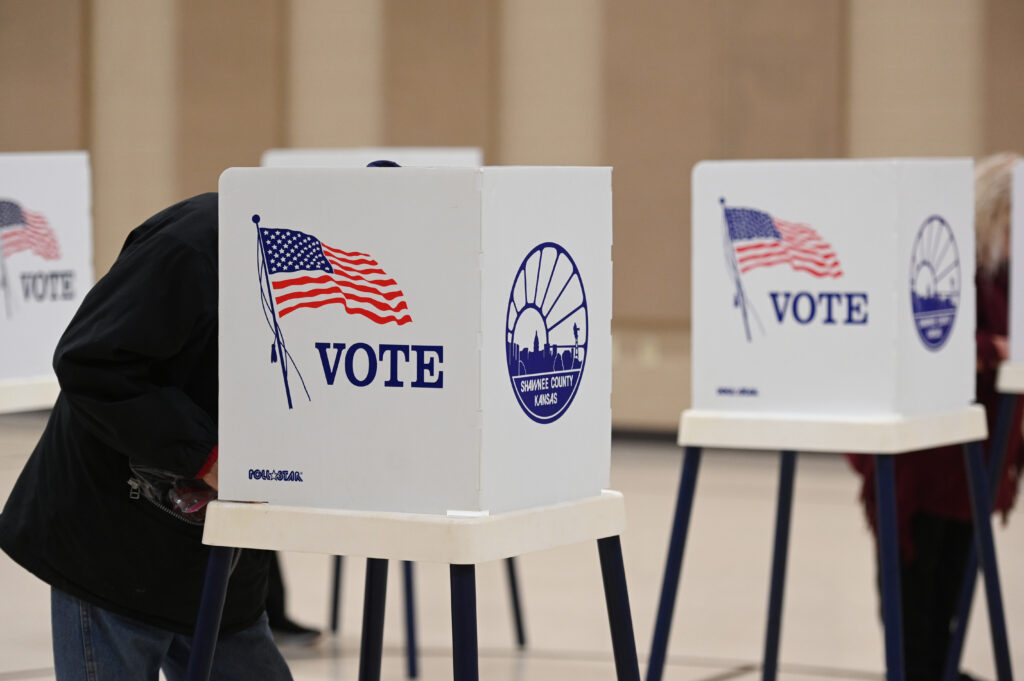
A Kansas law banning online voter registration through any non-government website and expanding voter purging practices was enacted last week after lawmakers overrode Gov. Laura Kelly’s (D) veto of the bill.
The SAVE Kansas Act mimics parts of the anti-voting SAVE America Act by burdening the voter registration process and easing voter purging procedures. Voters can no longer get registered online via community organizations, civic associations and other Get Out The Vote (GOTV) groups. Under the new law, only websites with a .gov domain can be used for online registration, unless the state secretary grants exceptions.
The law also allows the state secretary to cross check its voter rolls against the federal Systematic Alien Verification for Entitlements (SAVE) database, and to obtain personal information from other state agencies in efforts to broaden the net for purging voters.
The law’s enactment makes Kansas just the latest state to pass its own version of President Donald Trump’s agenda of restricting ballot access and suppressing voter turnout.
Get updates straight to your inbox — for free
Join 350,000 readers who rely on our daily and weekly newsletters for the latest in voting, elections and democracy.
“This legislation would impose restrictions on online voter registration that could suppress civic engagement and make it harder for Kansans to vote,” said Gov. Kelly when she vetoed the bill on April 8. “Furthermore, this legislation directs certain state agencies to provide the personal information—including name, date of birth, residential address, and the last four digits of the social security number—of public assistance benefit recipients to the Secretary of State’s Office, even though disclosure of this information may be prohibited under federal law.”
The state legislature overrode her veto the next day.
“This legislation reflects our commitment to maintaining accurate voter rolls while protecting the rights of every eligible Kansas voter for decades to come,” said Kansas Secretary of State Scott Schwab. “I appreciate the Kansas Legislature overriding Governor Kelly’s veto.”
Among the more troubling provisions of the law that expands the state’s voter purging powers is a provision that puts a voter on notice for removal if they’ve had “no election-related activity” over a four-year period.
This would entail not only people who haven’t voted during that time, but also those who haven’t “attempted to vote, requested or submitted an advance ballot application, filed an updated voter registration card, signed a petition … or responded to any official election mailing transmitted by the county election office,” as stated in the bill.
People placed in that category who fail to respond to a confirmation notice will now be removed from rolls, and will have to re-register to vote again.
The ACLU of Kansas testified in January that such methods could lead to the disenfranchisement of people who are otherwise eligible to vote.
In his testimony before the Kansas legislature, ACLU of Kansas director of policy and research Logan DeMond said that “voter inactivity must never be treated as evidence of ineligibility.”
He warned that people facing housing instability, who live in rural areas with limited mail access and those who simply choose not to vote could get “swept into purge processes, especially when combined with unreliable address or database matching.”
“These bills are part and parcel of the illegal and dangerous attempts nationally to subvert our democracy and to dismantle our fundamental constitutional protections against government overreach and state violence,” said ACLU of Kansas Executive Director Micah Kubic about the laws’s enactment.