Top election officials prepare to prevent and prosecute election interference
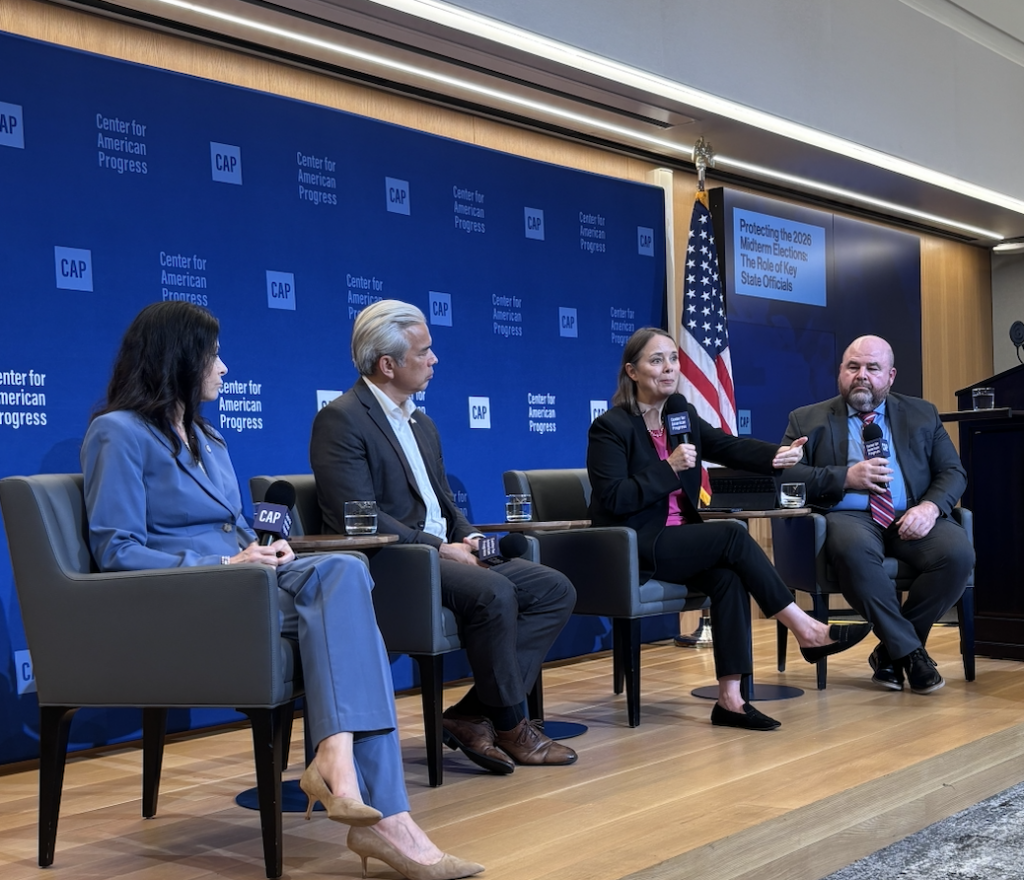
When the U.S. Supreme Court threw mail voting into a legal saga this summer, voters in Maine started canceling their absentee ballot requests, Secretary of State Shenna Bellows (D) said Wednesday during a discussion with top election officials.
Bellows said voters paid the price of Trump’s crusade on mail voting when they were confused about how to vote and if votes sent through the U.S. Postal Service would be counted at all. When the high Court stamped out efforts to revive mail ballot restrictions earlier this month, Bellows said Mainers took an immediate, collective sigh of relief.
While the ruling marked a big win for voters, top election officials say they remain concerned about Trump-mandated election interference. FBI, DOJ and Department of Homeland Security (DHS) chiefs have all floated plans to use their federal agents to seize control over election administration and intimidate voters.
Get updates straight to your inbox — for free
Join 350,000 readers who rely on our daily and weekly newsletters for the latest in voting, elections and democracy.
But the U.S. Constitution gives states, not the president and his cabinet, authority over elections. So it’s state leaders who are prepping for everything from U.S. military or Immigration and Customs Enforcement at the polls to ballot seizures and calls for recounts.
“If you can imagine it, we’re ready for it,” Attorney General Rob Bonta (D-Calif.) said.
Michigan’s Attorney General Dana Nessel (D) said she will have special agents from her office and the Michigan State Police on call for Election Day to be dispatched at any sign of trouble.
In Michigan and Maine, like in many states, elections are decentralized and run at the municipal level. Bellows said she’s been meeting with local election clerks biweekly to review election administration rules and make sure those on the front lines are ready for a smooth run of show. Right now, the clerks are in the middle of “logic and accuracy testing” for ballot tabulators.
“We’re training clerks, we’re training law enforcement, and we’re reassuring clerks that we will be — like in Michigan — we’ll be deployed all across the state on Election Day and we won’t have a clerk going into court alone or trying to throw their body in front of ICE,” Bellows said.
In addition to on-the-ground efforts, the state leaders said they already have briefs written to litigate against any possible circumstance of federal election interference, including from the DOJ.
It’s routine for federal monitors to show up to poll sites. Nessel said it’s happened for as long as she can remember. And while Michigan’s primary election went down without a hitch, Nessel said she’s worried that DOJ monitors could be sowing the seeds for future legal challenges to undermine elections.
Assistant Attorney General Harmeet Dhillon in August ordered a quota of 1,000 election monitors to be deployed nationwide, sounding alarms for voting rights experts and former DOJ officials.
“They didn’t do anything illegal, they didn’t do anything differently than what they usually do,” Nessel said of the DOJ monitors in her state. “But now my mind is like ‘Is this pre-litigation? Are they going to use that to manufacture something?”
Nessel added that while it can be difficult for states to prosecute federal agents due to federal immunity, state leaders won’t hold back in prosecuting armed troops at poll sites, voter intimidation or any other activity prohibited by law.