Democrats rally national firepower in final push for ‘yes’ vote on Virginia redistricting referendum
With just days until Virginians decide whether to approve a new redistricting plan, top Democratic leaders and influential voices gathered in a high-profile livestream to make their closing argument — framing next Tuesday’s vote as a decisive stand against Republican gerrymanders pushed by President Donald Trump.
The event underscored the immense stakes: control of the U.S. House, the ability to check Trump’s agenda and a broader fight over Democrats response to aggressive GOP map-drawing in states like Texas and Florida.
“Republicans were trying to gerrymander the national congressional map so they could rig the midterm elections and hold on to power,” House Minority Leader Hakeem Jeffries (D-N.Y.) said. “This is a critical step forward for the people of the Commonwealth of Virginia. But it has national and international implications. We can cut Donald Trump’s presidency in half, legislatively. But that’s going to require us to win back the House.”
Get updates straight to your inbox — for free
Join 350,000 readers who rely on our daily and weekly newsletters for the latest in voting, elections and democracy.
The urgency echoed across speakers, many of whom tied the referendum directly to Republican-led redistricting efforts in other states.
U.S. Sen. Mark Warner (D-Va.) pointed to earlier GOP map changes as the catalyst for the current push.
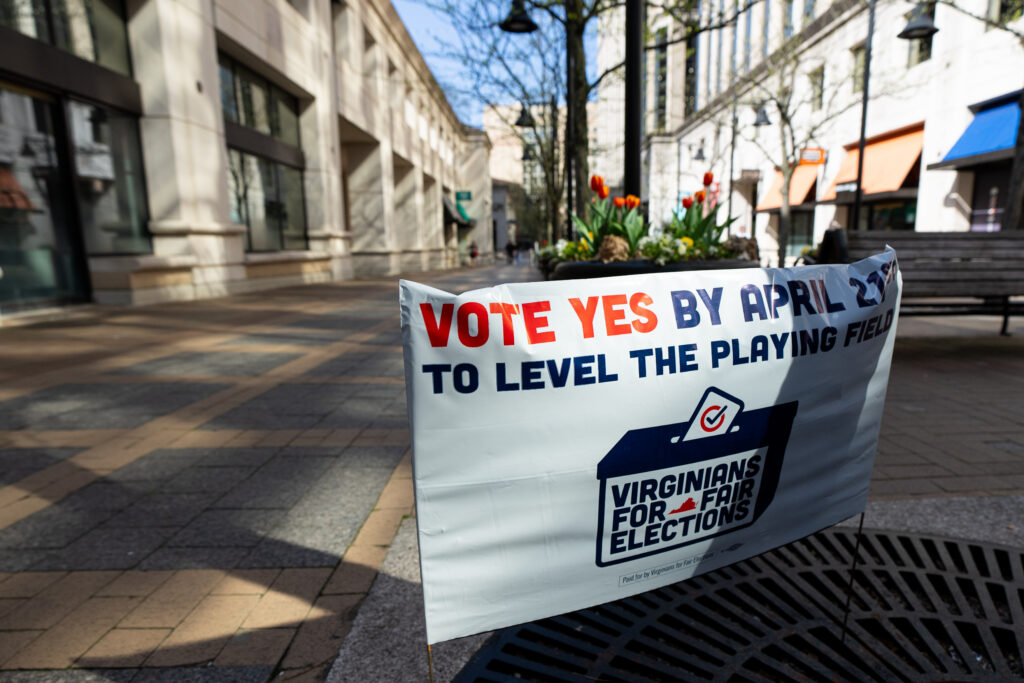
“We in Virginia have always supported bipartisan redistricting, but not when the other side pummels us with unfair practices,” Warner said. “So we in Virginia have the chance to level the playing field.”
That phrase — “level the playing field” — became the central message of the event, repeated by speakers as a rallying cry.
Virginia Gov. Abigail Spanberger also emphasized that the proposal is designed as a temporary countermeasure to actions taken by Republicans elsewhere.
“As we have seen states take action, Virginia has the ability to do something responsive. A ‘yes’ vote means that we are taking that responsive step to what we have seen other states do,” she said. “In a temporary manner, we have put forth new maps.”Virginia is taking the temporary, responsive and responsible step of pushing back against what other states have done in trying to stack the deck for Donald Trump in those congressional elections. And in a temporary manner, we have put forth new maps.”
Spanberger highlighted that the state’s independent redistricting system would return after the next census.
But the message from some speakers went further with the sentiment that Democrats must “fight fire with fire” — reflecting a broader strategic shift within the party, as leaders increasingly argue that unilateral adherence to redistricting norms is no longer viable.
“Well, this is simple,” Rep. Bobby Scott (D-Va.) said during the event. “We’re doing exactly what they’re doing.”
California Gov. Gavin Newsom, whose state recently passed its own redistricting response measure in a landslide, framed the moment in stark terms.
“We can’t be exhausted by these redistricting fights. They’re foundational,” Newsom said. “It’s the architecture. It’s the foundation on which everything else is built. We’ve got to save our republic so we can have the kitchen table, so that we can start debating those kitchen table issues once again.”
Newsom also pointed directly to Florida, where Republican Gov. Ron DeSantis is preparing a new round of redistricting, warning that Republicans are continuing to escalate.
“I should remind folks, Florida’s maps are already gerrymandered. Like, the maps in existence are a gerrymander that was too extreme for the legislature, but was shoehorned through by DeSantis,” he added. “This new map would be an extreme gerrymander on top of the existing extreme gerrymander.”
Back in Virginia, state leaders focused on mobilizing voters — particularly in the face of what they described as targeted misinformation.
State Sen. Louise Lucas (D) stressed that deceptive messaging campaigns by Republicans and allied groups are designed to confuse voters about what the referendum does.
“A lie that’s left standing becomes truth in the mind of some people,” Lucas said. “And so that’s precisely the reason why the Republicans continue to tell lies and spread propaganda.”
Virginia House Speaker Don Scott (D) echoed those concerns, saying misinformation efforts have specifically targeted Black voters.
“They are being deceitful,” Scott said. “They are lying straight up and straight down.”
Despite those challenges, speakers repeatedly pointed to growing momentum — including high early voting turnout and reports of bipartisan support — as signs the message is breaking through.
The broader pitch was clear: this is not a typical off-year vote, but a pivotal moment in a national struggle over democracy and fair representation.
For Democratic leaders, that response is urgent — especially as redistricting battles unfold in states like Florida, where new GOP maps could further tilt the balance of power.
With the House majority hanging on a handful of seats, even small shifts could have outsized consequences.
“This could be the difference of three seats,” Rep. Suhas Subramanyam (D-Va.) said. “This could be the election.”
For supporters of the referendum, Virginia voters now face a defining choice of whether to accept a political map shaped by one side — or to intervene to rebalance the system before it is locked in for the rest of the decade.