Voting rights groups ask federal judge to again block Trump’s mail voting restrictions
 Prefer us on Google
to see more of our voting rights news coverage when you search.
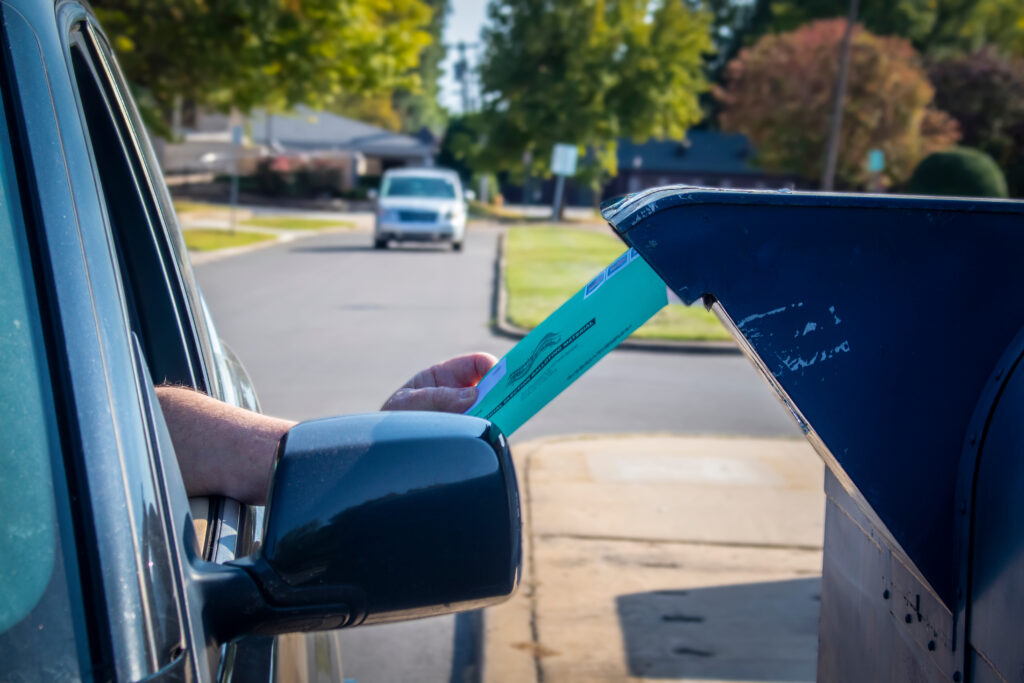
A coalition of voting rights groups asked a federal judge to — again — temporarily prevent the U.S. Postal Service (USPS) from implementing President Donald Trump’s March 2026 executive order on mail voting.
The group, led by the League of Women Voters of Massachusetts (LWV), filed a renewed motion for a preliminary injunction Monday. On Tuesday, U.S. District Court Judge Indira Talwani ordered the parties to brief the court ahead of an Aug. 7 hearing.
The request is the latest legal maneuver in a multi-front battle against the executive order, which would make it more difficult for Americans to vote. On Friday, a federal court in Washington, D.C., suspended a separate preliminary injunction that prevented USPS from working on the edict.
Trump’s order directs states to send USPS lists of voters who requested mail-in or absentee ballots, along with barcode information tied to those ballots. The Postal Service would then refuse to deliver ballots from voters not on the lists.
LWV previously asked Talwani to block the order’s implementation, but the judge decided that the D.C. court’s injunction eliminated the need to issue her own.
Get updates straight to your inbox — for free
Join 350,000 readers who rely on our daily and weekly newsletters for the latest in voting, elections and democracy.
The LWV case is one of four active lawsuits attacking the executive order. Talwani issued a temporary block in another, California v. Trump, but that injunction is limited to the 22 Democratic-led jurisdictions that sued the administration over Trump’s decree.
There are two other federal court cases being heard in Washington, D.C. In DSCC v. Trump, the district court judge shot down the Democratic party plaintiffs’ preliminary injunction request; they appealed, and a decision there is pending.*
But in the fourth lawsuit, NAACP v. U.S. Postal Service, after a federal judge granted a nationwide injunction preventing USPS from advancing the order, the D.C. Circuit Court of Appeals granted USPS’ request last week, pausing the lower court’s ruling while litigation continues.
So, now that the NAACP’s injunction has been stayed pending appeal, LWV wants to replace it.
Before the Circuit Court in D.C. paused the injunction, USPS confirmed it had stopped working on a rule proposal to implement the executive order in a letter to Democratic senators last week.
Talwani already called Trump’s executive order unconstitutional in the California lawsuit. The question here will be whether the LWV and other plaintiffs can show that they will suffer an “irreparable harm” if USPS is allowed to go ahead with the rulemaking.
In LWV’s filing, they argue that Trump’s order “has upended Plaintiff’s core organizational work of educating voters about and helping them participate in mail voting.” Experts have warned that the diktat, if left to stand, will confuse voters and lead to chaos on Election Day.
*Democratic plaintiffs in this case are represented by the Elias Law Group (ELG). ELG Chair Marc Elias is the founder of Democracy Docket.