Appeals court appears skeptical of DOJ’s emergency bid to block 20,000 ballots in California
 Prefer us on Google
to see more of our voting rights news coverage when you search.
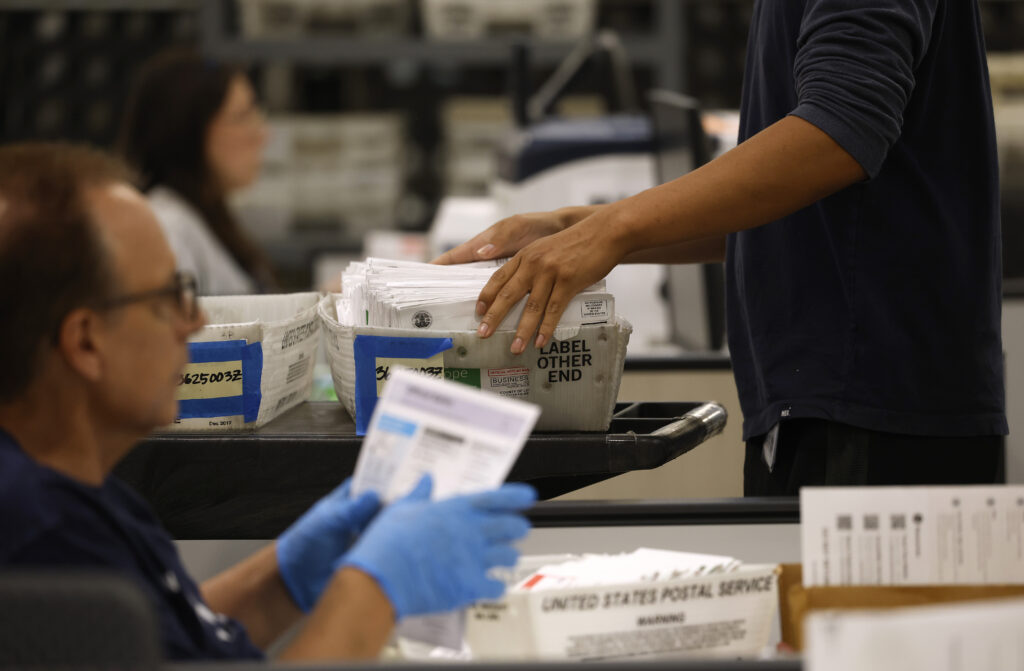
A federal appeals court appeared skeptical of the Trump administration’s bid to stop California from counting ballots from more than 20,000 people the federal government alleges are “likely” noncitizens.
A three-judge panel of the Ninth Circuit heard arguments for nearly two hours in a rare Sunday hearing on the Department of Justice’s emergency request for an injunction to block state election officials from tabulating those ballots until citizenship status is confirmed.
The Trump administration appealed to the Ninth Circuit despite the fact that a district court judge has yet to rule in the dispute. The outcome of the case will be critical as the DOJ threatens similar lawsuits to stop ballot counting or election certification in a number of states.
Two of the judges on the Ninth Circuit indicated they doubted they had jurisdiction over the case, and seriously questioned the merits of the administration’s argument that federal law barring noncitizens from voting preempts California’s right to run its elections.
Judge Mark Bennett, an appointee of President Donald Trump, quickly interrupted Matthew Donnelly, the attorney representing the DOJ, to question the timing of the administration’s lawsuit.
“How do we have jurisdiction when the district court has said it’s going to rule expeditiously?” Bennett asked, before adding more plainly: “I don’t see how we have jurisdiction.”
“You were the master of the filing of your complaint and you chose to file it two and a half weeks before the election, or maybe three weeks before the election, and you certainly knew that there was, in your mind, a problem well before that, right? So, you could have filed the complaint a month before you did, right?” Bennett grilled the government.
The DOJ sued California and Los Angeles County on Oct. 15, one week after mail ballots were sent to all registered voters. It then sought emergency relief from the appeals court after trying to give the district court judge its own deadline to rule. The district court judge declined to do so and has set a hearing for this coming Tuesday, Oct. 27.
“The emergency posture is here because the mail-in voting process is already occurring on a massive scale,” Donnelly said, claiming the DOJ was unaware of the “scope” of ballots already being processed.
Sam Siegel, an attorney representing California, shot back that this is “an emergency of their own making.”
“Its request would sow confusion and risk disenfranchising voters, and it has no basis in law or in fact,” Siegel said.
Get updates straight to your inbox — for free
Join 350,000 readers who rely on our daily and weekly newsletters for the latest in voting, elections and democracy.
Throughout the hearing, the DOJ’s attorney struggled to explain the administration’s methodology for flagging the 20,000 individuals as “likely” noncitizens, including what role an unidentified third-party played in analyzing the data and how the administration obtained California’s voter roll to start their investigation. The DOJ sued California for its unredacted voter roll earlier this year and lost.
“What gives the U.S. a high degree of confidence that the list that was acquired reflects the actual voter roll list that California employs for the 2026 elections?” Judge Gabriel Sanchez, an appointee of former President Joe Biden, pressed Donnelly.
Donnelly only pointed back to government filings that he said “indicates that there is a process where they can make a credibility determination as to whether or not the list is credible itself.”
On the merits more broadly, both Bennett and Sanchez took issue with the government’s sweeping assertion that a criminal statute that forbids noncitizens from voting gives it the power to demand California set aside ballots – suggesting it ran afoul of the Constitution.
“It seems to me you want us to issue an injunction that is entirely inconsistent with the law the California legislature has adopted pursuant to the Elections Clause. How can we do that?” Bennett said.
California law already requires a voter to attest under penalty of perjury that they are a citizen, they noted, and has in place a system for challenging ballots.
“You just don’t think it’s good enough?” Bennett asked the federal government. The DOJ’s attorney responded that they don’t believe that California is enforcing the federal criminal statute.
Seth Waxman, a former U.S. Solicitor General representing Los Angeles County, defended the state’s laws and said there is “nothing about this process that will prevent or impair in any way the government’s ability to prosecute people for this federal misdemeanor.”
So far, despite saying there may be more than 20,000 noncitizens illegally registered to vote, the administration has only charged 28 people in California with voting-related crimes.
Judge Patrick Bumatay, another Trump appointee, appeared the most sympathetic to the government’s arguments, telling Waxman, “I think the government is also concerned about not having the illegal vote count.”
The three-judge panel concluded the hearing after two hours and said it would try to move as fast as possible in issuing a decision.