Trump’s voter suppression crusade has failed. But his bid to subvert the midterms may just be getting started
 Prefer us on Google
to see more of our voting rights news coverage when you search.
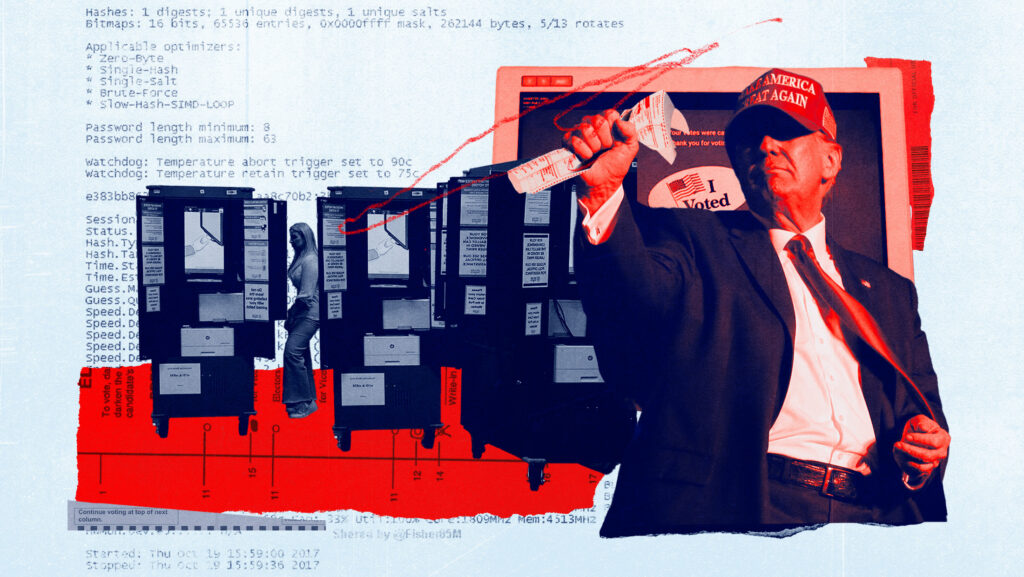
As voters head to the polls Tuesday, one thing has become clear: President Donald Trump’s dangerous effort to use the power of the federal government to subvert the midterms has failed — for now.
At almost every turn, the schemes of the administration and its allies to thwart a fair election have been stymied in the courts.
The nationwide campaign to gather sensitive voter data and use it to help states purge their rolls; the plot to use the U.S. Postal Service to upend mail voting; the longshot legal gambit to block certification of Alaska’s Senate race if the GOP candidate loses; the bid to force California to stop 20,000 people from voting; the threats to prosecute election officials if they don’t comply with the administration’s anti-voting demands; even Missouri Republicans’ Trump-backed plan to steal a congressional seat for their party by ripping up a majority Black district — all of these assaults have been struck down or blocked by federal judges.
Meanwhile, most indicators suggest we’re headed for a massive midterm turnout. Trump’s voter suppression strategy has been an unqualified flop.
But the fight is far from over. Election Day itself offers another chance for the administration to assert control — perhaps by sending law enforcement agents to the polls to intimidate voters.
The days and weeks after Tuesday will be fraught with even more danger. That’s when we can expect Trump and the GOP — having failed to stop voters from casting ballots — to unveil a fresh round of tactics designed to block those ballots from being counted or to prevent the results of key elections from taking effect.
Pro-democracy advocates are bracing for everything from lawsuits aiming to stop the counting of large batches of votes, to efforts to delay or challenge certification, to attempts to physically seize ballots or voting machines. Many of those tactics will likely draw on the same legal claims that failed in court, aiming to use them nonetheless to provide ammunition for post-election subversion.
Most of these schemes, too, are likely to fail once challenged in court. Even so, they could still succeed in creating enough confusion, anger and chaos to further weaken confidence in our elections.
“The Trump administration’s continued promotion of false narratives about election integrity coupled with the Department of Justice’s willingness to file baseless litigation aimed at undermining confidence in the results are a real danger to our democracy,” said Ben Hovland, a senior fellow at the Center for American Progress Action Fund and former chair of the U.S. Election Assistance Commission.
They are suing because “they can’t change the fact that states run elections, not the White House” and that “the American people choose our leaders and are turning out to vote in record numbers,” he added.
Get updates straight to your inbox — for free
Join 350,000 readers who rely on our daily and weekly newsletters for the latest in voting, elections and democracy.
The scattershot litigation strategy’s real aim is to allow Trump and his allies to claim fraud and undermine confidence in the election — despite Republicans controlling all three branches of the federal government and a majority of the state houses.
It’s pure power politics: a bet that the administration can flood the zone with enough nonsense that their opponents and the civil servants just trying to administer this election fairly will eventually give up.
And the risk is that the administration may succeed in delaying — but not denying — the electorate’s will this year, by taking extraordinary steps to obstruct certification and slow the seating of newly elected officials.
To understand the goals, consider some of the administration’s actions.
The DOJ’s subpoenas against election officials in California seek testimony on Nov. 4 – the day after Election Day, when those officials will be busy finalizing counts and preparing results for certification.
“The November 4 date is particularly telling,” said David Becker, executive director of the Center for Election Innovation & Research (CEIR) and a former DOJ voting rights lawyer. “The President of the United States is going to be complaining… and alleging that there’s some fraud, falsely.
His DOJ will never be able to prove that fraud in court. But it will be “actively trying to distract California election officials and pull them away from the work, leading to what might appear to be slow counts,” Becker added. “This is outrageous, and we should be outraged about this. And not just Democrats. Republicans should be outraged about this.”
Other administration schemes aim not to truly succeed, but rather to muddy the waters.
Consider the DOJ’s claims against California and Washington.
Even if it somehow prevailed in these cases — if you ignored the complete lack of procedural grounds to bring the lawsuits or their utter lack of merit — the victories probably wouldn’t change any electoral outcomes.
In California, the DOJ wants to set aside 20,000 votes. In Washington, it wants to set aside 400. Neither effort is likely to affect any electoral outcome.
There’s a slight chance that Rep. Marie Gluesenkamp Perez’s (D-Wash.) reelection in the 3rd Congressional District might be that close, but it’s not likely. And the idea of 20,000 votes out of the 22 million that Californians are expected to cast will make much of a difference across a handful of tight congressional races is similarly far-fetched.
In Alaska the stakes are higher — the administration wants the results to be set aside — but the legal arguments there are that much more suspect, relying on the vague preamble of a federal voter registration law in an attempt to conjure up a basis to sue.
The DOJ sued the Alaska Division of Elections barely a week before Election Day, saying that the appearance of one Daniel J. Sullivan on the ballot risked confusing voters who wanted to support incumbent Republican Sen. Dan Sullivan, even though the latter will appear with his title, party affiliation and incumbent status on the ballot.
That challenge has been quickly dismissed and the DOJ’s appeals appear doomed to similar fates. The lawsuit is obviously political, not legal, in nature — its primary purpose is to highlight the allegedly underhanded campaign tactics of Sen. Sullivan’s opponent, Democrat Mary Peltola. Secondarily, it’s given Republicans cover to make noise about refusing to seat Peltola if she should win.
But those are mostly empty threats.
Alaska Gov. Mike Dunleavy (R) has said the state might not certify the results, if his investigators find out that some law has been broken. But, so far, no one has been able to claim that there has been. More importantly, Dunleavy’s role in certification is ministerial — he doesn’t have a legal choice but to certify a result except in very specific situations that do not apply here.
“If any state authority, whether it’s a canvassing board or a secretary of state or governor,
wants to interfere with the rights of the voters by delaying or denying certification, the same thing will happen that has happened in the past,” said Becker, “which is: Parties with standing — whether it’s the winning candidate or whether its election officials — [they] are going to go to the courts, [and] they’re going to get immediate relief.”
Even if Dunleavy managed to stave off such a lawsuit, his own term ends next month, and a new governor will be sworn in Dec. 7. Odds are, Democratic candidate Jonathan Kreiss-Tomkins — who has dominated the polls and enjoyed bipartisan endorsements, including sitting Republican Sen. Lisa Murkowski — will take office then and will be able to quickly certify the election, well ahead of the U.S. Congress’s swearing-in date of Jan. 3.
Similar delays that might be caused by seized ballots or delayed county certifications will face similar lawsuits with similar results, Hovland said.
“Given all of the circumstances, I would not be surprised if people try to interfere with that [certification],” he said. “But ultimately, I would be completely confident that the court would direct that certification if it comes to it.”
What these challenges could succeed at? Spreading doubt and undermining faith in elections among Trump’s base.