Tennessee Judge Blocks Trump-Requested Military Deployment in Memphis
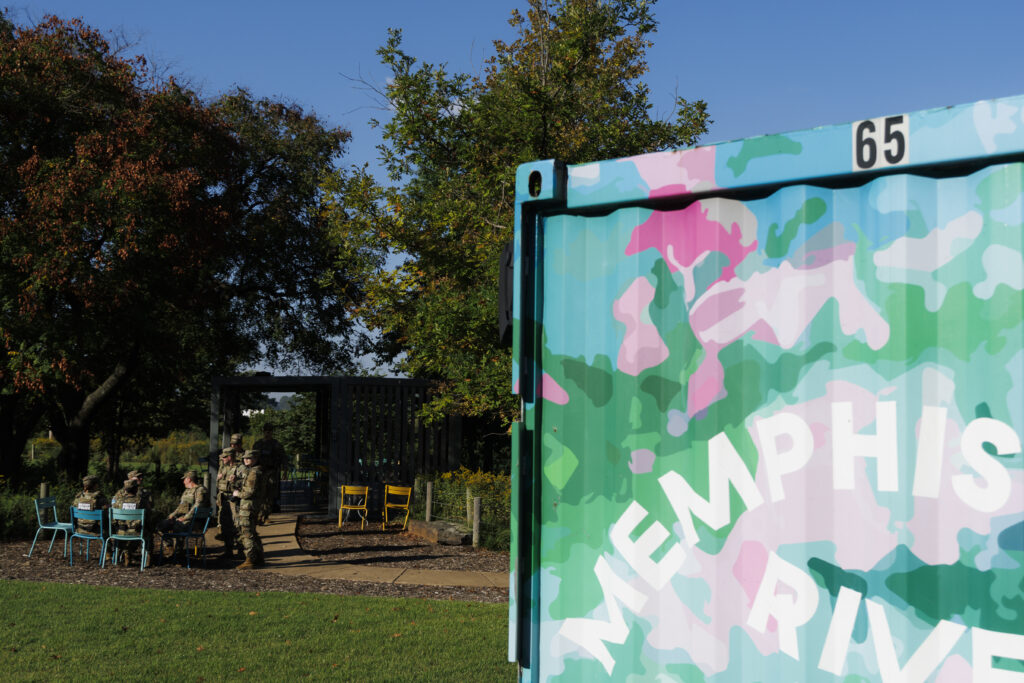
A Tennessee state judge dealt a blow to President Donald Trump’s effort to use soldiers in policing by temporarily halting Gov. Bill Lee’s (R) deployment of Tennessee National Guard troops to Memphis to assist with the Trump administration’s law enforcement surge in the city.
Davidson County Chancellor Patricia Head Moskal Monday found that a group of local officials who challenged Lee’s deployment will likely succeed in arguing that his use of state troops violated Tennessee law.
In September, over the objections of local and state officials, Lee announced that he would send hundreds of Tennessee Guard troops to Memphis at Trump’s request. Seven elected officials represented by Democracy Forward* went to state court and challenged Lee’s deployment, arguing that it violated Tennessee’s Constitution and state law.
Shelby County Mayor Lee Harris, a plaintiff in the case, wrote Monday on social media that the court’s decision was “a positive step toward ensuring the rule of law applies to everyone, including everyday Tennesseans and even the Governor.”
Get updates straight to your inbox — for free
Join 350,000 readers who rely on our daily and weekly newsletters for the latest in voting, elections and democracy.
Trump requested the deployment to have soldiers assist thousands of federal law enforcement officers who descended upon Memphis as part of his order claiming to authorize “hypervigilant policing” to curb violent crime in the city.
While local leaders welcomed the additional federal assistance to curb crime, they said they opposed troops in Memphis, which is one of the largest predominantly Black cities in the country.
Since his reelection, Trump has tried to wield the military as a police force, which threatens the country’s longstanding practice of constraining the use of soldiers in law enforcement.
However, Tennessee’s Constitution places strict limits on the governor’s use of the Guard, stating that troops can only be called into service “in case of rebellion or invasion, and then only when the General Assembly shall declare, by law, that the public safety requires it.”
As of early November, the Tennessee legislature had not declared that the public safety situation in Memphis warranted such a deployment, nor had Lee declared a state of emergency on crime in the city.
While she did not initially comment on the plaintiffs’ constitutional claims, in her ruling Monday Moskal found that they were likely to succeed in arguing that the deployment was unlawful under Tennessee’s military code. That law also constrains the governor’s use of the military for civilian law enforcement, barring him from doing so without a request for assistance from a city or county.
Moskal, who was appointed by former Tennessee Gov. Bill Haslam (R), said that crime in Memphis was not a “grave emergency” or “disaster” that would authorize Lee under the military code to deploy Guard troops. Such troops, she noted, “are not trained law enforcement personnel.” The judge added that there were no indications that Memphis or Shelby County leaders asked Lee for assistance.
Moskal’s order blocked Lee from “continuing the activation and deployment of Tennessee National Guard personnel.” The ruling did not take effect immediately, as the judge paused it to give the state the chance to file an appeal.
Trump has sent over 1,700 federal agents from several different agencies to carry out his surge in Memphis. As part of an agreement Lee and the president, Tennessee troops were also deployed to assist agents under Title 32, a group of federal laws that governs the structure of the National Guard.
Normally, Guard troops are under the command of state governors. But soldiers activated under Title 32 statutes are in a “hybrid” status because they are neither under full state or federal control. Instead, they are under the command and control of their state governor, but their duty is federally funded and regulated. But because soldiers remain under state control, they are not subject to federal laws that generally bar soldiers from carrying out law enforcement activities.
The U.S. Marshals Service “specially deputized” the Tennessee soldiers deployed to Memphis, allowing them to conduct patrols in the city and indirectly support federal agents, but preventing them from conducting arrests, searches, seizures or other direct law enforcement actions
Several Memphis residents have reported harassment by federal agents throughout Trump’s surge, according to ProPublica.
Trump’s effort to integrate the military into routine law enforcement has so far resulted in five domestic military interventions in major cities led by Democrats, who have responded with a flurry of lawsuits.
The Supreme Court is currently considering a question about the language of a statute Trump has used to federalize state Guard troops. The court’s answer to that question could undermine almost all of Trump’s deployments, though it likely will not affect the Tennessee Guard’s presence in Memphis.
*Marc Elias, the founder of Democracy Docket, serves as board chair of Democracy Forward.