Texas Asks SCOTUS to Reimpose Anti-Minority Gerrymander
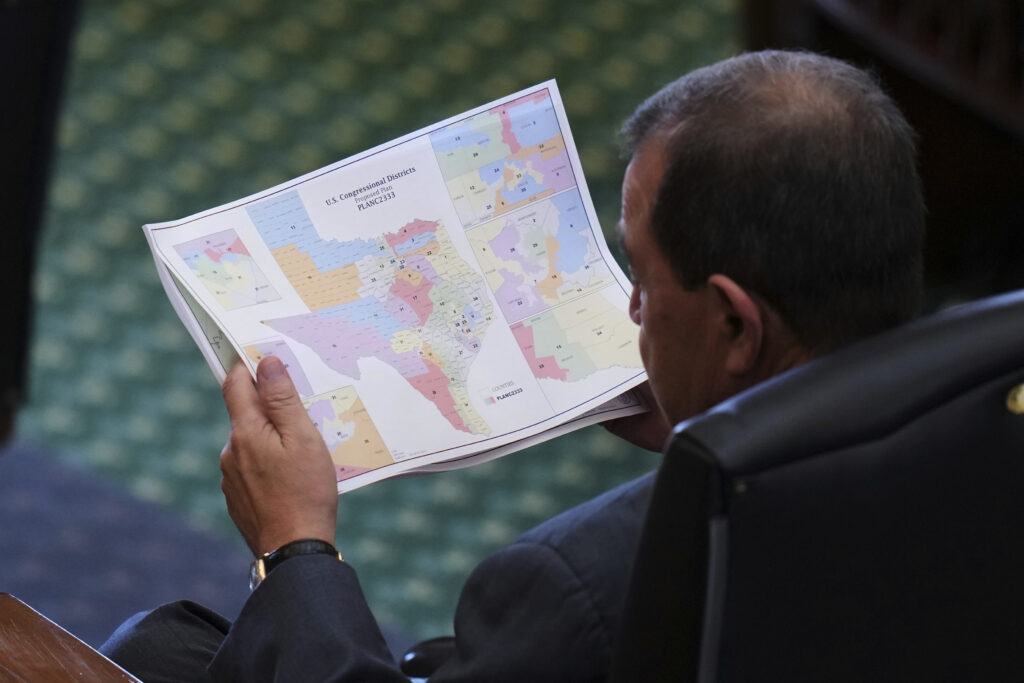
Texas filed a request Friday asking the U.S. Supreme Court (SCOTUS) to pause a court order blocking the state from using its new gerrymandered congressional map in 2026.
A panel of three federal judges ruled 2-1 Tuesday against the map, finding substantial evidence that Texas racially gerrymandered its new congressional districts. The ruling delivered a major blow to President Donald Trump’s national effort to create more GOP-friendly seats in 2026 at the expense of minority voters.
Get updates straight to your inbox — for free
Join 350,000 readers who rely on our daily and weekly newsletters for the latest in voting, elections and democracy.
Texas was the first state to bend to Trump’s unusual mid-decade redistricting demand, setting off a national gerrymandering arms race that is still unfolding in state capitols and courtrooms across the country. Minority voters* and voting advocates swiftly challenged the Texas gerrymander in court.
In a majority opinion, Judge Jeffrey Brown, a Trump appointee, issued a scathing rebuke of the state’s redistricting scheme. Notably, he found that multiple Republicans who took the stand during a nine-day hearing on the map – mapmaker Adam Kincaid and State Sen. Phil King, who led the Senate’s redistricting committee – were not credible witnesses.
Brown wrote that it was “extremely unlikely” Kincaid could have drawn the 2025 districts “blind to race,” as the mapmaker had claimed. He also identified numerous inconsistencies in Kincaid and King’s testimonies about their communications with one another.
Judge David C. Guaderrama, an appointee of President Barack Obama, joined Brown’s opinion. Judge Jerry E. Smith, who was appointed by President Ronald Reagan, responded by writing a blistering dissenting opinion filled with personal insults aimed at Brown and more than a dozen references to philanthropist George Soros, a common bogeyman for the right.
Texas quickly filed notice with the district court that it would appeal the ruling to the Supreme Court. The state then asked the district court to pause the preliminary injunction blocking the gerrymander. A group of plaintiffs in the case filed a brief Thursday opposing that request. On Friday, the court denied Texas’ motion for a stay pending appeal.
In its emergency application to the Supreme Court, Texas leans heavily on timing, invoking the Purcell principle — a doctrine that warns courts not to disrupt elections close to voting deadlines.
“The district court’s last-minute replacement of the State’s congressional map violates Purcell,” the state wrote. “It changed 37 of the State’s 38 districts midway through the filing period and should be stayed for that reason alone.”
The state argues that the injunction itself would destabilize the election cycle.
“The chaos caused by such an injunction is obvious,” Texas said. “Campaigning had already begun, candidates had gathered signatures and early voting was only 91 days away.”
Texas claims the lower court’s intervention would damage voter confidence.
“The preliminary injunction will lead to disruption and unfair consequences,” the filing wrote. “It invites confusion and chaos and erodes public confidence in electoral outcomes.”
Texas also argues that the district court ignored the Supreme Court’s most recent racial-gerrymandering precedent, Alexander v. South Carolina State Conference of the NAACP, which heightened evidentiary standards for challengers.
“The majority failed to hold Plaintiffs to their demanding burden to disentangle race and politics,” the state wrote. “When partisanship and race correlate, a partisan map can look similar to a racial one.”
Texas further claims the plaintiffs’ case lacked a crucial component: an alternative map.
“The majority excused Plaintiffs’ failure to submit an alternative map,” the filing said. “This Court has made clear that such an omission would be clear error.”
The state also attacks the district court’s factual findings as implausible and illogical.
“The district court’s conclusion is implausible,” Texas argued. “To state such a conclusion is to falsify it.”
Finally, Texas returns to the testimony of its mapmaker, Adam Kincaid, insisting that his statements prove the map was political, not racial.
“If Kincaid’s testimony does not conclusively demonstrate a non-racial, partisan explanation,” the state wrote. “It is difficult to imagine what evidence could suffice.”
Texas is now betting on conservative SCOTUS justices to greenlight its gerrymander.
The request goes first to Justice Samuel Alito, who oversees emergency appeals from the Fifth Circuit Court. He can issue a stay on his own or refer the decision to the full court.
Alito has previously been sympathetic to Republican arguments in redistricting and voting rights disputes.
Late Friday, Justice Samuel Alito entered an administrative stay, temporarily pausing the district court’s order while the Supreme Court considers Texas’ request for emergency relief.
In a short order, Alito “administratively stayed” the injunction blocking the 2025 map and directed the plaintiffs to file a response by Nov. 24 at 5 p.m. EST.
The administrative stay does not signal how the court will ultimately rule but effectively pauses the district court ruling while the court considers the stay application.
Yunior Rivas contributed to this report.
*Some Texas voters are represented by the Elias Law Group (ELG). ELG firm chair Marc Elias is the founder of Democracy Docket.