Despite Supreme Court ruling, the battle over birthright citizenship is just beginning
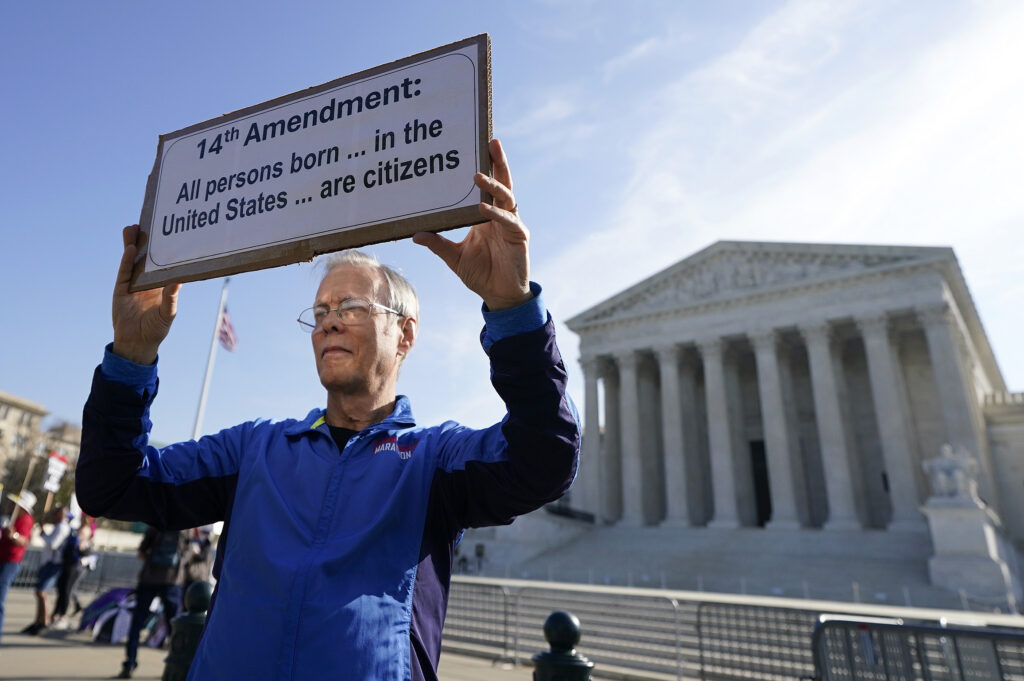
Though the Supreme Court may have struck down President Donald Trump’s executive order attacking birthright citizenship Tuesday, the razor-thin majority that ruled against the president gave legal scholars and immigration advocates little cause for celebration.
Indeed, for many, it marked a near disaster for birthright citizenship.
While the Court broke 6-3 against the president’s order in Trump v. Barbara, technically only five of the nine justices agreed that the 14th Amendment’s Citizenship Clause confers automatic citizenship to children born to parents unlawfully or temporarily present in the country.
Get updates straight to your inbox — for free
Join 350,000 readers who rely on our daily and weekly newsletters for the latest in voting, elections and democracy.
That should also worry anyone concerned about voting rights: A successful bid to restrict birthright citizenship would supercharge efforts to restrict access to the ballot, raising enormous questions about how to prove one’s citizenship and right to vote.
Experts are already sounding the alarm.
“The fact that four justices endorse the ahistorical, atextual, anti-constitutional reading of the 14th Amendment means that this issue will not die today,” David Bier, an immigration expert at the Cato Institute, said on social media after the ruling.
“While this outcome provides welcome relief, it shows how fragile even our most foundational constitutional guarantees have become,” Kica Matos, president of the National Immigration Law Center, said in a statement.
Republicans’ reactions aren’t giving anyone cause for comfort. Rather than taking the order as a complete loss, Trump and his GOP allies recognized that they were within one vote of severely weakening birthright citizenship, which had long been considered a settled question in American jurisprudence.
Perhaps indicative of how close the ruling was, Trump didn’t erupt at the Court as he had with its other rare rulings against him. Instead, the president called the decision “too bad” and ordered congressional Republicans to act.
“Congress should start TODAY to work on ending expensive and unfair to our Country, Birthright Citizenship,” Trump wrote on social media, adding that congressional Republicans “will have my Complete and Total Support!”
Though it was explicitly a ruling on birthright citizenship, the Court’s decision was also a close call for the right to vote. Because while Trump’s order was part of his across-the-board attack on all forms of immigration, it also could have served as a force-multiplier for his crackdown on voting.
As Chief Justice Roberts noted in the Court’s majority opinion, citizenship is “the right to have rights.” And chief among those, Roberts noted, is the right “to freely participate in our political community.”
In attempting to deny automatic citizenship to children born in the U.S. to non-citizen parents, Trump was also attempting to shape the future electorate, influence the demographic makeup of electoral districts and suppress civic participation.
Many Republicans — including Trump — have latched onto Justice Brett Kavanaugh’s opinion in the case as giving the GOP a roadmap to end birthright citizenship.
While he agreed with the court’s majority that Trump’s order was unlawful, Kavanaugh, whom Trump appointed during his first term in office, said he disagreed that the 14th Amendment should automatically give citizenship to children born to parents in the country unlawfully or temporarily.
Kavanaugh objected to Trump’s order only because it violated 8 U.S.C. 1401, a federal law that codified the Citizenship Clause and the Supreme Court’s landmark 1898 decision in U.S. v. Wong Kim Ark.
However, he added that Congress could take the thrust of Trump’s order and amend that law or pass new legislation “establishing exceptions to birthright citizenship for children born to foreign citizens unlawfully or temporarily in the country.”
“But Congress has not yet done so,” Kavanaugh wrote.
Now, in the wake of the ruling, Republicans say they want to do just that.
“The majority tried to constitutionalize unlimited birthright citizenship. But Justice Kavanaugh MAY have left Congress a door,” Sen. Eric Schmitt (R-Mo.) — who has previously articulated an alarming vision of exclusionary, blood-and-soil American nationalism — said in a social media post. “I’m filing legislation to walk through it.”
Others tied Kavanaugh’s ruling to the SAVE America Act, Trump’s sweeping voter suppression bill.
“Kavanaugh is telling Congress they can pass a bill to fix birthright citizenship and it wouldn’t violate the 14th Amendment. Just add this to the SAVE Act and pass it all,” Jack Posobiec, a far-right influencer, also said in a post.
Those legislative attempts are unlikely to succeed — in large part because an amendment or a new statute would probably also be challenged as a violation of the 14th Amendment. Given Tuesday’s ruling, it’s unclear whether the Roberts Court would uphold a legislative attempt to restrict birthright citizenship.
However, a future — potentially more conservative — court could. In an effort to produce such a Court, some conservatives proposed refashioning Barbara into a new test for future judicial nominees.
“Easy test now: ‘Do you agree that Trump v. Barbara was correctly decided by the Supreme Court?’ Those who answer yes should not be nominated,” suggested Gene Hamilton, the president of America First Legal, a legal nonprofit founded by White House aide Stephen Miller.
“I just want dumb justices who will fall in line,” Mike Davis, a conservative attorney who is heavily involved in vetting Trump’s judicial nominees, said on a far-right podcast while discussing efforts to remake the Supreme Court in light of the new ruling.
Tuesday’s ruling preserved birthright citizenship. But it also laid bare the far right’s goal to significantly pare back the longstanding practice — an effort they may just be starting to organize around.
As Justice Clarence Thomas wrote in a dissenting opinion Tuesday, “I am not sure that today’s opinion will stand the test of time.”