Supreme Court strikes down Trump’s attempt to eliminate birthright citizenship
 Prefer us on Google
to see more of our voting rights news coverage when you search.
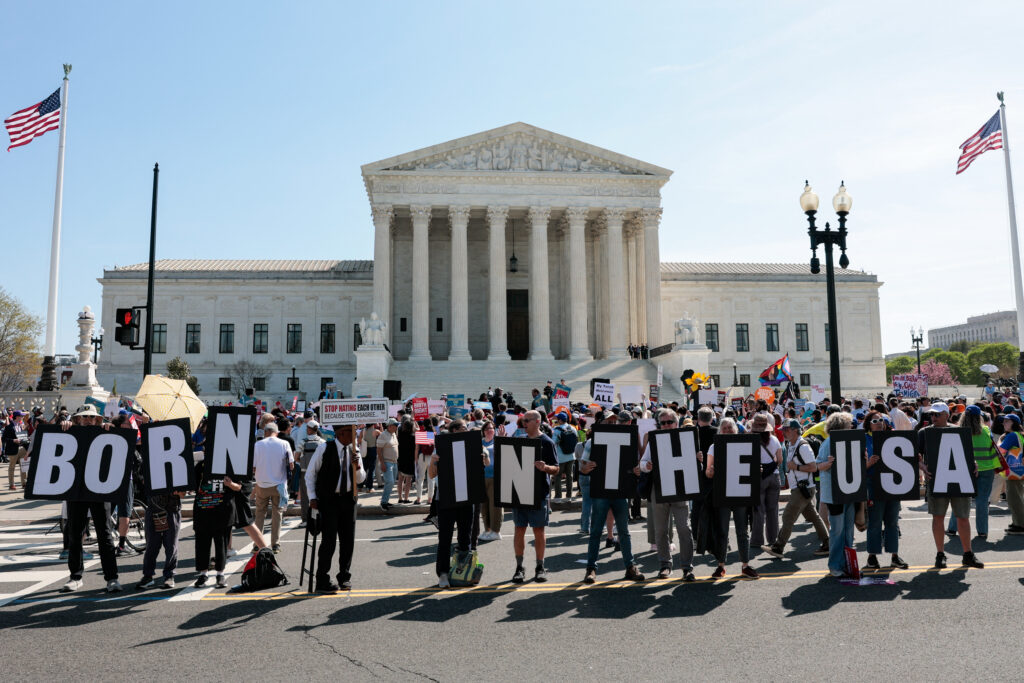
The Supreme Court Tuesday struck down President Trump’s attempt to unilaterally deny citizenship to children born in the United States to foreign nationals, a plan that would have sharply altered who can vote in American elections.
In a 6-3 ruling, the Court said Trump’s executive order aimed at ending birthright citizenship violated the 14th Amendment. It sided with a class of babies and expecting parents who would be affected by Trump’s order.
Get updates straight to your inbox — for free
Join 350,000 readers who rely on our daily and weekly newsletters for the latest in voting, elections and democracy.
The Court’s majority opinion, written by Chief Justice John Roberts, held that children born in the country to parents unlawfully or temporarily present are “subject to the jurisdiction” of the U.S. and are citizens at birth under the Fourteenth Amendment’s Citizenship Clause.
“Citizenship, then and now, was the right to have rights — to freely participate in our political community. The Framers of the Fourteenth Amendment extended that promise to ‘every free-born person in this land,'” Roberts wrote. “We keep that promise today.”
Justices Amy Coney Barrett, Elena Kagan and Ketanji Brown Jackson joined Roberts’ opinion. Jackson also wrote a concurrence that Justice Sonia Sotomayor joined. Justice Brett Kavanaugh concurred in part, disagreeing with the Court’s conclusion that Trump’s order violated the 14th Amendment.
Justices Samuel Alito, Neil Gorsuch and Clarence Thomas filed dissenting opinions.
The ruling was surprisingly close considering that birthright citizenship has long been considered a settled question in American jurisprudence.
Trump’s executive order came as the opening salvo in his across-the-board attack on all forms of immigration. But it also had grave implications for voting.
Denying automatic citizenship to children born in the U.S. to non-citizen parents would allow Trump to shape the future electorate, influence the demographic makeup of electoral districts, and suppress civic participation.
Signed on his first day in office, Trump’s order directed federal agencies to deny Social Security numbers and U.S. passports to babies whose parents lack permanent legal status or citizenship.
The order directly contradicted the 14th Amendment’s Citizenship Clause, which states: “All persons born or naturalized in the United States, and subject to the jurisdiction thereof, are citizens of the United States and of the State wherein they reside.”
The order never took effect. Lower courts unanimously ruled that it violated the 14th Amendment and breached federal immigration law and Supreme Court precedent.
Though Kavanaugh disagreed with the Court’s conclusion on the 14th Amendment, he said he believed the order was still unlawful because it violated federal law.
In his dissenting opinion, Alito claimed that the Court’s interpretation of the Citizenship Clause was “not only contrary to the original meaning of the Fourteenth Amendment” but also “produces grotesque results.”
Both he and Thomas claimed that it enabled “birth tourism,” the extremely rare practice of foreign nationals traveling to the U.S. for the sole purpose of giving birth so their baby can automatically become an American citizen.
The Trump administration centered birth tourism in its campaign against the guarantee of birthright citizenship, including in its arguments before the Supreme Court.
While the Court’s decision is a tremendous blow for Trump, it was a largely expected one.
During oral arguments earlier this year, a majority of justices appeared deeply skeptical of the order. At one point, Chief Justice John Roberts described the Department of Justice’s defense as “quirky.”
Trump appeared to sense beforehand that the case would likely not go his way. After the arguments, which he attended in person, Trump preemptively railed against the Supreme Court on social media.
In one post, he claimed justices were “dumb,” and the U.S. “stupid,” for allowing the longstanding practice, which is enshrined in the Constitution.
While the Supreme Court upheld a lower court’s determination against Trump’s directive, it previously ruled in legal proceedings against the order that individual district court judges could no longer block executive actions throughout the country through “nationwide” or “universal” injunctions.
Following that ruling, civil rights and immigration organizations countered with several class-action lawsuits representing babies and expecting parents who would be affected by Trump’s order.
This story has been updated with additional opinions throughout.