Supreme Court guts Voting Rights Act, greenlights GOP gerrymanders
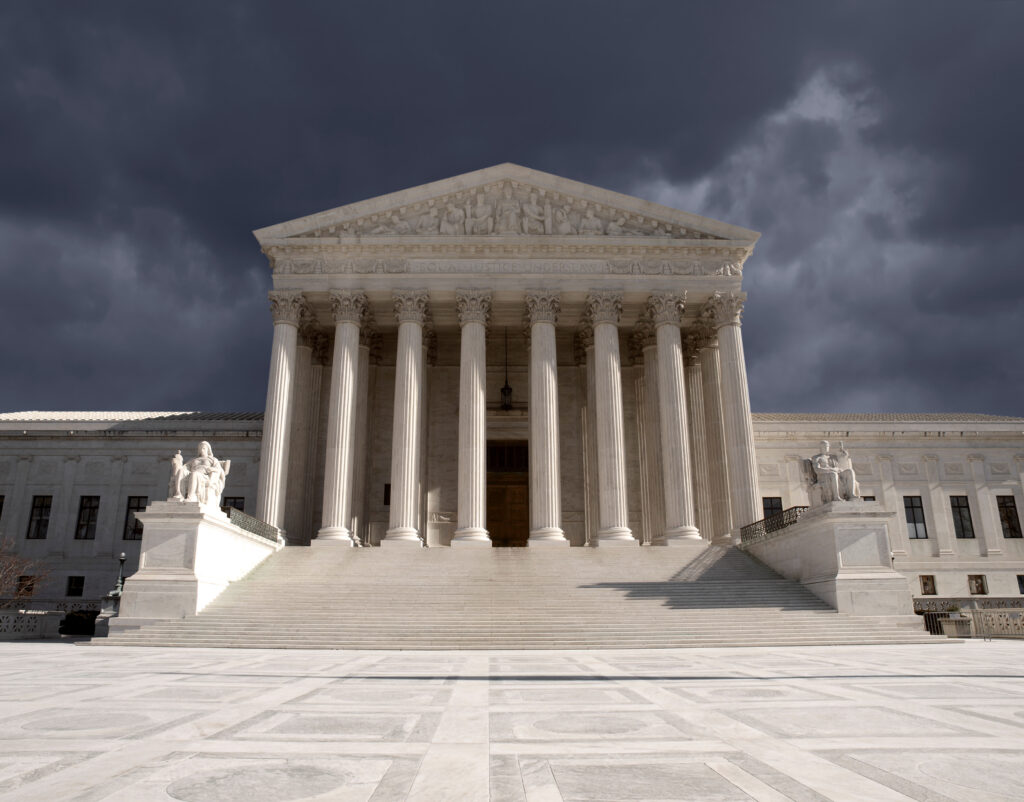
In a 6-3 decision, the U.S. Supreme Court kneecapped the Voting Rights Act (VRA), the landmark civil rights law that restricted racial gerrymandering and racial discrimination in voting for sixty years.
Writing for the majority in Callais v. Louisiana, Justice Samuel Alito wrote that the court was not striking down Section 2 of the VRA, but rather “properly” interpreting it as “impos[ing] liability only when circumstances give rise to a strong inference that intentional discrimination occurred.”
Justice Elena Kagan, in dissent, accused the majority of making changes that “eviscerate the law.”
The ruling effectively invalidates Section 2 of the VRA as it has been understood for four decades without explicitly striking down the statute. It now will require proof of intentional discrimination — something Congress did not write into the law and that’s extremely difficult for plaintiffs to show.
“On the ‘totality of circumstances’ inquiry, the focus must be on evidence that has more than a remote bearing on what the Fifteenth Amendment prohibits: present-day intentional racial discrimination regarding voting,” Alito wrote. “Discrimination that occurred some time ago and present-day disparities characterized as ongoing ‘effects of societal discrimination’ are entitled to much less weight.”
Kagan, joined in dissent by Justices Sonia Sotomayor and Ketanji Brown Jackson, called the ruling the “latest chapter in the majority’s now-completed demolition of the Voting Rights Act.”
“The Voting Rights Act is — or, now more accurately, was— ‘one of the most consequential, efficacious, and amply justified exercises of federal legislative power in our Nation’s history.’ It was born of the literal blood of Union soldiers and civil rights marchers. It ushered in awe-inspiring change, bringing this Nation closer to fulfilling the ideals of democracy and racial equality,” Kagan wrote. “And it has been repeatedly, and overwhelmingly, reauthorized by the people’s representatives in Congress. Only they have the right to say it is no longer needed—not the Members of this Court.”
States may now draw district lines in ways that undercut the political power of minority voters with virtually no limit. While arriving too late in the election cycle to significantly affect November’s midterms, the decision gifts Republicans an advantage in the fight for control of Congress. By allowing for the dismantling of minority districts currently held by Democrats, the ruling could provide the GOP enough additional seats to lock in the party’s control of the House for a generation.
Signed into law just weeks after civil rights marchers were beaten in Selma, Alabama on “bloody Sunday,” the VRA codified the 15th Amendment’s voting protections for the first time. Reversing a 1980 Supreme Court decision, Congress amended Section 2 of the VRA in 1982 to ban laws — and electoral maps — that were effectively racially discriminatory, even if they weren’t deliberately so.
Kagan alluded to that congressional rejection of the court’s 1980 interpretation of the VRA, writing that “the majority now demands that vote-dilution plaintiffs muster proof of racially discriminatory motive. In that way, the decision echoes an earlier one of this Court, which also held that Section 2 should function as an intent test.”
In the decades since, Section 2 of the VRA has allowed plaintiffs to challenge electoral maps that have discriminatory impacts, as long as some specific factors suggest that race played a role.
Wednesday’s ruling comes after four years of litigation. After Louisiana lawmakers drew a congressional map in 2022 where Black voters could elect their candidate of choice in only one of the state’s six districts, even though they make up about a third of the population, some sued. Those plaintiffs argued the map diluted the power of their votes — a violation of the VRA’s Section 2. A federal court agreed, ordering a new map with two majority-Black districts. Then, in response to that map, a group of “non-African American voters,” recruited by conservative, anti-VRA lawyers filed their own lawsuit, contending that the law’s remedy for a racially discriminatory map — drawing a new, more equitable one — was itself a form of racial discrimination.
The majority held that the district court below erred in ordering the new map. The plaintiffs “failed to show an objective likelihood of intentional discrimination, instead relying on historical evidence and evidence that failed to disentangle race from politics,” Alito wrote.
In theory, a new map could still be ordered for a violation of Section 2. But under the new standards, not only would it be hard to demonstrate the “likelihood of intentional discrimination,” but the remedial map would also need to accommodate the original mapmakers’ “nonracial goals” including their “political goals.”
Combined with the Supreme Court’s 2019 decision in Common Cause v. Rucho, which held that courts cannot block partisan gerrymandering, the Callais decision effectively declares all gerrymandering constitutional. While Rucho held that partisan gerrymandering is merely a nonjusticiable political question, Callais goes further, essentially blessing the practice by making it illegal for a court order to unintentionally undermine politically-motivated electoral maps.
“Today… the majority straight-facedly holds that the Voting Rights Act must be brought low to make the world safe for partisan gerrymanders,” Kagan wrote in dissent.
Calling out Callais
Wednesday’s ruling was met with immediate outrage from civil rights leaders and election experts.
“Today’s decision is a devastating blow to what remains of the Voting Rights Act, and a license for corrupt politicians who want to rig the system by silencing entire communities. The Supreme Court betrayed Black voters, they betrayed America, and they betrayed our democracy,” NAACP President Derrick Johnson said in a statement. “This ruling is a major setback for our nation and threatens to erode the hard-won victories we’ve fought, bled, and died for.”
Kagan alluded to those worries in her dissent. “I will be interested to see… whether time will vindicate the majority’s view that the ‘great strides’ made in African American office-holding, ‘particularly in the South,’ will hold up after the issuance of this opinion,” she wrote. “My own guess is not.”
“It is hard to overstate what an earthquake this will be for American politics,” wrote UCLA Law professor Rick Hasen.
Republicans, meanwhile, celebrated. “For decades the left has spent hundreds of millions of dollars seeking to divide Americans along racial lines in a cynical pursuit of partisan power masquerading as civil rights enforcement,” Adam Kincaid, president of the National Republican Redistricting Trust, wrote on X. “Today’s decision rebukes that divisive and unconstitutional effort.”
The Court originally heard oral arguments in Callais last spring, but then ordered a rehearing over the summer on the specific question of whether creating a second majority-minority congressional district violated the 14th or 15th Amendments, which respectively ensure equal protection under the law for all and the right to vote, regardless of race, for citizens.
While the Section 2 and 15th Amendment will still invalidate an intentionally racist electoral law, a shadow docket decision in December suggests it will be exceedingly difficult for challengers to prove that the racism was deliberate.*
After a lower court panel found that Texas’ mid-decade redistricting had been motivated by race, the Supreme Court stayed the ruling. The district court opinion, penned by a Trump appointee, noted that Texas launched the redistricting effort shortly after receiving a letter from the Department of Justice critical of the prior map’s race-based districts.
The unsigned order set aside that fact finding, saying it “failed to honor the presumption of legislative good faith by construing ambiguous direct and circumstantial evidence against the legislature.”
In another unsigned order this week, the court summarily reversed the Texas court’s decision, “[f]or the reasons set forth,” in the majority’s stay order, effectively setting aside a detailed, 160-page opinion with two paragraphs of unsigned analysis.
The pale of Callais
Over the years, the Roberts court has chipped away at the legal levee holding back a gerrymandering deluge. With today’s decision, that dam will now completely burst, ushering in a new era of elected politicians picking their voters instead of voters picking their politicians.
The erosion began in 2013, when Shelby County v. Holder struck down the VRA’s “preclearance” provisions, which had required certain jurisdictions with discriminatory pasts to get the federal government’s ok before amending election laws. The 5-4 opinion penned by Roberts cleared the way for Southern states to implement a host of electoral changes making it harder to cast a ballot, like voter ID laws — as well as more local changes that often flew below the media radar.
After falling for decades after the VRA’s enactment, the racial turnout gap started increasing again since Shelby — especially in counties once covered by preclearance.
The dam sprung another leak in 2019, after SCOTUS’ decision in Rucho. While the court maintained that partisan gerrymandering was illegal, the majority concluded it was a nonjusticiable question that courts were ill-equipped to resolve. By essentially declaring partisan gerrymandering to be beyond the reach of the judiciary, Rucho enabled today’s spate of mid-decade redistricting efforts.
“The majority… invites States to embark on a new round of partisan gerrymanders — and makes an already bad precedent into one still worse,” the dissent wrote. “It is not enough that Rucho has harmed the whole body politic. Now, that decision also becomes the cudgel to diminish the rightful voting influence of its minority citizens.”
Section 2’s prohibition on racially discriminatory maps was, until now, the last remaining legal check on the partisan impulse to draw wildly contorted and disjointed electoral districts. And while voters overwhelmingly say they hate gerrymandering and support independent mapmaking commissions, partisans — Democrat and Republican alike — usually support lawmakers who adopt maps benefitting their own party.
“The consequences are likely to be far-reaching and grave,” wrote Kagan. “Today’s decision renders Section 2 all but a dead letter. In the States where that law continues to matter — the States still marked by residential segregation and racially polarized voting — minority voters can now be cracked out of the electoral process.”
The coming flood of race-based redistricting
The Court’s ruling Wednesday provides Republicans little room to redraw legislative maps ahead of the 2026 midterms. Had the decision come out earlier in the term, there would have been more time to draft new districts and make all of the accompanying changes, like changed election deadlines, ahead of November’s contests.
A recent analysis by Issue One found that “fewer states would be able to pursue redistricting without risking election administration breakdowns,” at this point. Florida is already in the middle of a special legislative session to redraw its congressional map to give Republicans a shot at flipping four seats. Besides Florida, the only southern state that hasn’t already started mailing ballots out for the primaries is Tennessee, and its map is already aggressively skewed toward the GOP, giving them eight representatives to the Democrats’ one.
However, Section 2 was the last roadblock preventing a truckload of GOP gerrymanders across the South ahead of the 2028 elections. According to an analysis by Fair Fight Action and Black Voters Matter, the Callais ruling could eventually lead to a redistricting wave down in Dixie that could help Republicans flip as many as 19 majority-minority seats currently held by Democrats.
Another analysis by NPR found that the gerrymandering unleashed by Wednesday’s decision could lead to white candidates winning 15 House seats that are currently represented by a Black member of Congress, leading to a level of racial revanchism not seen since the end of Reconstruction.
Even though Democrats would also be able to redraw maps in the states they control, they have fewer easier pickups available and would face more opposition from the party’s base. While GOP-led Florida is currently looking to redistrict ahead of 2026 — joining Texas, Missouri, North Carolina, and Ohio, which already have — the only Democratic states that tried to counter them are California and Virginia.
The decision’s impact will be felt far beyond Congress. In recent years, Section 2 has been used to restore democracy to local elections in a small, majority-Black Alabama town where white mayors had picked their (always white) successors, help Hispanics win city council representation for the first time in a Washington city where they make up a third of the population, and led to three Native Americans winning seats in the North Dakota legislature. While congressional redistricting cases receive the most attention, the VRA has been used mostly at the state and local level to strike down racist laws hampering minority representation.
“At this last stage, the Court’s gutting of Section 2 puts that achievement in peril,” Kagan wrote. “I dissent because Congress elected otherwise. I dissent because the Court betrays its duty to faithfully implement the great statute Congress wrote. I dissent because the Court’s decision will set back the foundational right Congress granted of racial equality in electoral opportunity. I dissent.”
In that last sentence, Kagan left out a word that’s usually included: “respectfully.”
This is a breaking news report that may be updated.
Adeline Tolle, Maya Bodinson, and Ashley Cleaves contributed to this report.
Democracy Docket is dedicated to one beat: voting and elections in the courts. Our expert coverage is free for everyone thanks to readers who believe this work matters. Add your support and keep it that way.