‘We are ON IT!’: Trump DOJ vows to weaponize Supreme Court ruling against minority voters
 Prefer us on Google
to see more of our voting rights news coverage when you search.
The Trump administration is already moving to use the Supreme Court’s gutting of the Voting Rights Act to dismantle protections for Black and Latino voters ahead of the 2026 midterms.
U.S. Sen. Eric Schmitt (R-Mo.) Thursday urged the Department of Justice (DOJ) to review maps nationwide and identify districts “improperly drawn using race,” singling out California’s 2026 congressional map — created in response to Texas’ Trump-ordered gerrymander — for “immediate review.”
“This is what oversight is for,” Schmitt wrote. “The Civil Rights Division should enforce the VRA as an anti-discrimination law — not as a racial districting mandate. The Constitution prohibits sorting Americans by race. DOJ should act accordingly.”
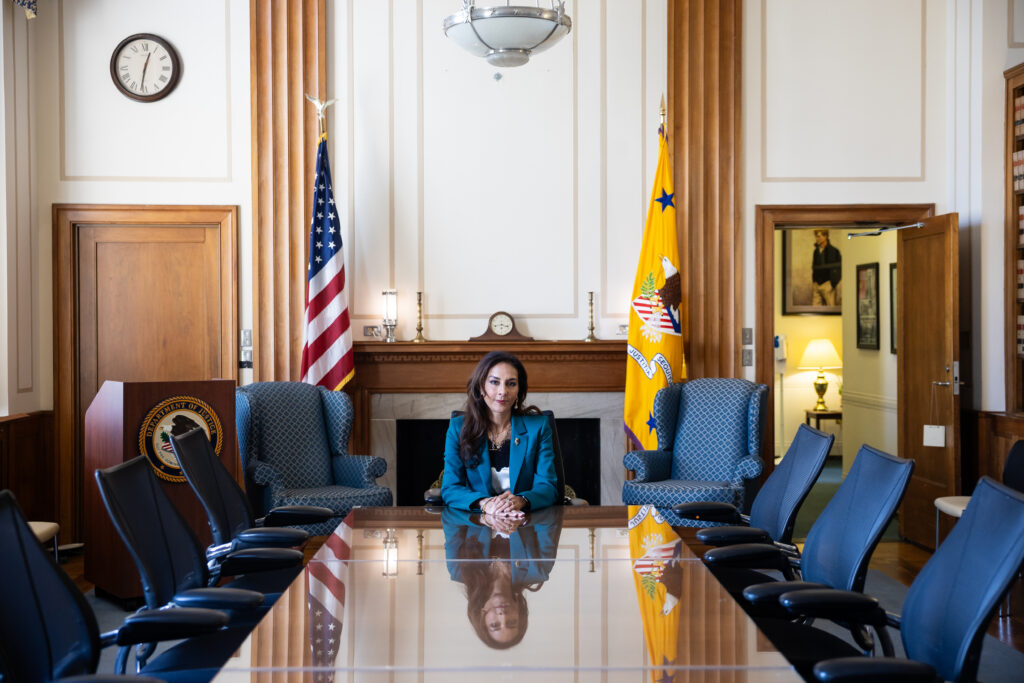
Within minutes, Harmeet Dhillon — who leads the DOJ’s Civil Rights Division — made clear the administration is ready to attack districts where minority voters have had the opportunity to elect the candidate of their choice.
“Senator — we are ON IT!” Dhillon wrote. “This Justice Department under Acting Attorney General Todd Blanche continues to prioritize equal protection of the laws for ALL Americans, be it in employment, housing, education — and VOTING!”
Get updates straight to your inbox — for free
Join 350,000 readers who rely on our daily and weekly newsletters for the latest in voting, elections and democracy.
Schmitt’s demand followed the Supreme Court’s ruling in Louisiana v. Callais, which severely limited how the Voting Rights Act can be used to challenge discriminatory maps.
The exchange signals a rapid and aggressive shift.
The Justice Department — which once enforced the Voting Rights Act to protect minority voters — is now vowing to use the Supreme Court’s decision to challenge the very districts created to ensure those voters have a voice.
In a formal letter, Schmitt asked the department to go further — calling on officials to issue guidance implementing the ruling, reopen or review every Section 2 redistricting case and compile a nationwide list of districts that may have been drawn with race as a factor.
He specifically flagged California’s map, arguing it “warrants immediate review,” a move that could put Democratic-held districts directly in the crosshairs.
The focus on California is not new. The Trump DOJ has already tried — and failed — to block the state’s congressional map, which voters overwhelmingly approved in 2025 as part of a broader effort to counter Republican gains in states like Texas.
The DOJ joined a lawsuit brought by California Republicans, arguing the map was an unconstitutional racial gerrymander because it allegedly considered Latino voting strength in drawing district lines.
But a federal court rejected that challenge, finding no basis to block the map and allowing it to remain in place for the 2026 elections.
Now, the Supreme Court’s decision in Callais — which makes it significantly harder to justify race-conscious districting — appears to give the administration a new legal pathway to revive those arguments and target Democratic maps that had previously withstood scrutiny.
Voting rights advocates have warned districts designed to comply with the Voting Rights Act — including majority-Black and Latino districts — could now be challenged as unconstitutional, potentially unraveling decades of legal protections against racial discrimination in elections.
The Supreme Court’s decision in Callais effectively ended one of the last remaining tools to fight discriminatory maps. The DOJ’s response suggests the ruling will not just limit those protections — it may be used to dismantle them.
The move also intensifies a growing redistricting battle between Republican and Democratic states, but with a critical difference — with the federal government now signaling it may actively intervene to challenge maps in blue states, raising the stakes of an already escalating fight over fair representation.