Equal rules don’t produce equal opportunity
 Prefer us on Google
to see more of our voting rights news coverage when you search.
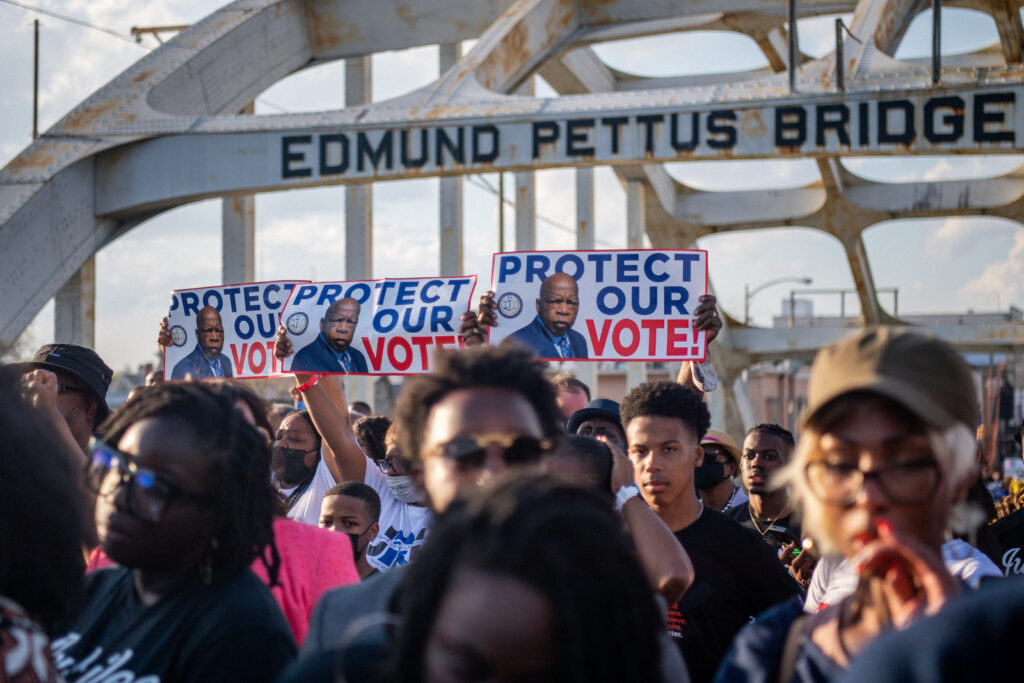
Today marks the anniversary of Bloody Sunday. On this day in 1965, at the Edmund Pettus Bridge in Selma, Alabama, protesters — many of them women and children — were brutally attacked by police with tear gas, whips, clubs, and even horses. The marchers knew this would happen, and they marched anyway, sacrificing safety to secure something deemed more sacred: their voting rights.
The blood on that bridge forged the Voting Rights Act. But as we mark the anniversary of Bloody Sunday, a pending Supreme Court case, Louisiana v. Callais, threatens to squander the sacrifice.
Get updates straight to your inbox — for free
Join 350,000 readers who rely on our daily and weekly newsletters for the latest in voting, elections and democracy.
Specifically, the Court will soon decide whether Louisiana’s creation of a second majority-Black district is unconstitutional. The case could determine whether Section 2 of the Voting Rights Act — which is applied to prevent minority voting power from being diluted through redistricting — is constitutional. If the court finds it unconstitutional, states may be free to draw electoral maps that drown out minority voters. As a result, up to 30% of the Congressional Black Caucus could lose their seats.
Defenders of Section 2 point to the history of racial discrimination as a reason to maintain it. Critics instead demand “colorblindness” in policy. Both sides miss a hidden reality.
To understand why, imagine a scenario with both visions realized: no historical discrimination and fully colorblind policies. Would outcomes then be fair? My economics research demonstrates that the answer is no — equal rules don’t produce equal opportunity.
We know that people are more likely to form connections with others like themselves (i.e., “birds of a feather flock together”), a tendency most strongly shaped in America by race and ethnicity. But when one group is larger, its members enjoy more connections — along with the opportunities that flow through them — even in colorblind settings with an otherwise level playing field. Minorities, simply by being a smaller share of the population, receive systematically fewer opportunities. I call this phenomenon social network discrimination. Social network discrimination extends far beyond economics to anywhere informal connections matter. Including politics.
Social network discrimination does not just affect one part of the political process, it compounds across stages. On an otherwise level playing field, minorities are systematically less likely to form the connections needed to run for office. Even if they do, they are still less likely to effectively fundraise. Even if they raise that money, they are still less likely to mobilize sufficient votes to win. And even if they win elections, they are still less likely to form effective coalitions in office.
The 15th Amendment guaranteed Black people the right to vote. Section 2 of the Voting Rights Act has ensured that right meant something. But if Section 2 is invalidated, redistricting will not become “neutral”— it will instead revert to a dangerous tool to restrict the political power of the very same Americans the 15th Amendment was originally designed to protect.
Colorblindness in a structurally unequal society does not produce fairness or merit — it entrenches inequality.
Political mobilization is often organized through neighborhoods, congregations and local communities. These networks cluster geographically, meaning that district boundaries dictate whether such connections translate into political power. Majority-minority districts can directly counteract social network discrimination by concentrating political power that would otherwise be diluted by network effects.
Social network discrimination adds justification to Section 2 — that in a nation in which connections most strongly form along racial lines, political opportunity may as well. And such political representation should not depend on rare, extraordinary political candidates, but on everyday local communities. This is not stereotype, it is structure.
To be sure, some claim the constitution must be applied through a fully colorblind lens, including federal laws like the Voting Rights Act, and that doing so moves our nation closer to justice. But such “justice” has no firm foundation. As my research shows, colorblindness in a structurally unequal society does not produce fairness or merit — it entrenches inequality. Social network discrimination reveals that fulfilling the promise of this nation requires not neutrality but action. Not passivity, but proactivity. Not ignoring race, but confronting it.
After the Court issues its decision, we do not know what will remain of the Voting Rights Act. And so few of the courageous who bled on that bridge remain today. But we remain — and so must our resolve. Martin Luther King Jr. reminded us that the arc of the moral universe is long, but it bends toward justice. It does not bend on its own. We bend it.
Chika Okafor (@drchikaokafor) is an assistant professor of law and an economist at Northwestern University who teaches constitutional law. His research on social network discrimination is published in the Journal of Law and Economics and has been covered by NPR’s All Things Considered and the Chicago Tribune. He has written for the Boston Globe and Newsweek.