Callais just gutted the promise of equal representation. But we need to keep fighting for multiracial democracy
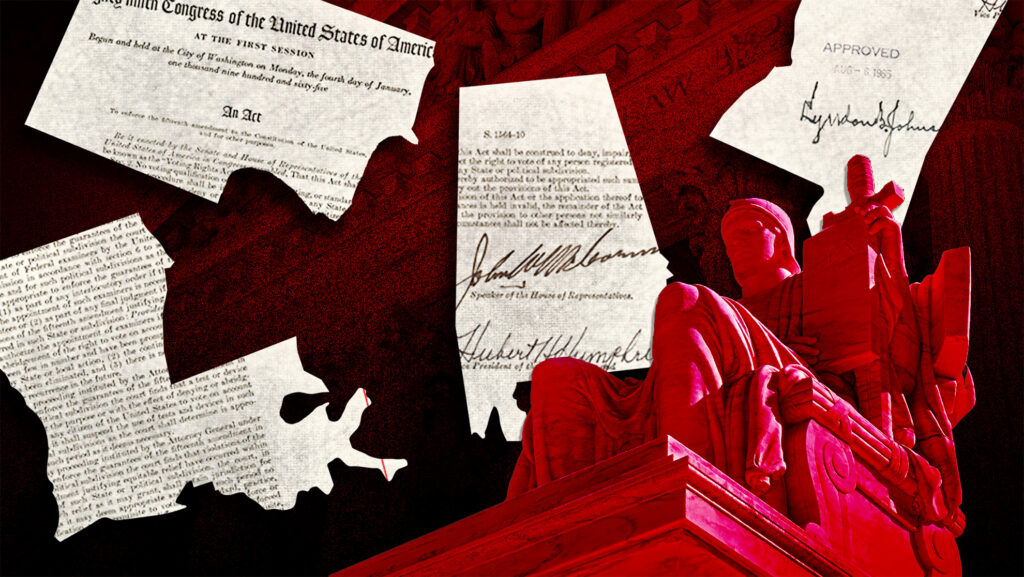
After the Supreme Court’s decision in Louisiana v. Callais, the fallout was immediate. The ruling, which eviscerated Section 2 of the Voting Rights Act, gave the greenlight for blatant racial discrimination in voting.
In less than a month, Tennessee and Alabama enacted racially gerrymandered maps. Louisiana Gov. Jeff Landry cancelled an ongoing primary election to dilute the power of Black voters in the state, announcing that votes already cast would be simply “discarded”. South Carolina Republicans tried to follow suit, though for now the effort has failed.
Get updates straight to your inbox — for free
Join 350,000 readers who rely on our daily and weekly newsletters for the latest in voting, elections and democracy.
The damage won’t end here. We will feel the effects of Callais into 2028 and beyond. Because the decision doesn’t just redraw maps, it erases the promise of equal representation.
In the wake of the court’s disastrous ruling, the door is now wide open for states across the country to enact discriminatory maps with virtual impunity. It was, in the words of NAACP Legal Defense Fund (LDF) president Janai Nelson, “a day of infamy for the court” and “a day of devastation for our democracy.”
To understand the magnitude of this loss, it’s important to understand the function of Section 2 of the VRA. Section 2 was the core protection against racial discrimination in voting, including redistricting. It is the legal tool communities of color have used when states or local governments split minority neighborhoods to minimize the political power of Black people and others. Over four decades, Section 2 resulted in wins in more than 450 federal cases that remedied real, documented harm. And it deterred far more harm than LDF and others ever had to litigate.
The results were tangible. In 1965, fewer than 1,400 Black elected officials held office in the entire country. Within 30 years, that number had grown to 10,000. In Louisiana, every Black member of Congress and every member of the state legislature had been elected from districts created in response to VRA litigation.
The VRA was not a relic of a distant past. It was the active infrastructure holding the line, cycle after cycle, against legislatures that never stopped looking for ways to dilute Black political power.
And that infrastructure has now been dismantled.
Callais was, from the time reargument was set, a manufactured case. When it was first argued in March 2025, it was a straightforward racial gerrymandering claim, a constitutional question. But when the Justices found the case insufficient to achieve their ideological aims, they did something extraordinary: they ordered reargument and reframed the entire litigation around the constitutionality of Section 2 itself.
That is not jurisprudence.
The VRA question was never litigated at the district court level. It was raised for the first time in the Appellees’ merits brief on appeal, with no evidentiary record beneath it. Appellate courts exist to review what lower courts decided, not to launch new constitutional inquiries from scratch. You cannot legitimately raise a claim for the first time on appeal. There is no record to examine, no factual foundation to stand on. The Court manufactured the question it wanted to answer, and then answered it.
The VRA was not a relic of a distant past. It was the active infrastructure holding the line, cycle after cycle, against legislatures that never stopped looking for ways to dilute Black political power.
What makes this even more troubling is that the Supreme Court already had cases pending before it that actually raised the constitutionality of Section 2 — cases that had been properly developed in district courts, with full evidentiary records built for exactly that purpose. The Court set those aside. Callais, with its thin record and procedural shortcuts, was simply more malleable. It was easier to contrive.
This is how the Voting Rights Act died: not in a fair fight, but in a case engineered to produce a predetermined result.
The majority opinion written by Justice Samuel Alito is contrivance and camouflage. He did not claim to be overturning Section 2. He claimed to be merely “updating” the framework laid out in the 1986 Thornburg v. Gingles case. This is a fig leaf, a flimsy cover for avoiding the headlines that lay bare what the Court is actually doing.
What the Court did was resurrect the very intent test that Congress explicitly rejected when it amended the VRA in 1982. That amendment was a hard-won triumph, enacted in direct response to the Supreme Court’s 1980 decision in Mobile v. Bolden, which had required proof of intentional discrimination as part of the analysis. Congress understood 40 years ago what remains true today: that intent is easy to disguise and nearly impossible to prove. The effects test closed that loophole.
And the Court just reopened it, while pretending they haven’t.
The consequences are not abstract. At least 40 House districts stretching from Louisiana to North Carolina are now at risk of elimination, districts currently represented by Black congressmembers that were protected under Section 2. Before this ruling, there were 63 majority-Black House members, representing roughly 14% of the House. Losing even a handful could mark the largest single-session drop in Black congressional representation since the end of Reconstruction. This number does not even cover the massive amount of state and local positions that will be affected.
And just this month, the Supreme Court vacated its opinion in Allen v. Milligan, returning the case — which had found Alabama’s 2023 redistricting plan intentionally discriminatory — to the district court. That court found this week that Alabama was still barred from using its racially discriminatory map, because intentional racial discrimination remains unconstitutional. Alabama has appealed back to SCOTUS — and a ruling greenlighting the map would confirm that, after Callais, the court is unwilling to enforce even the absolute minimum standard of protections for Black voters.
We cannot say we were not warned. We cannot say we did not know what was being built, case by case, year after year, in the marble halls of First Street. We watched Shelby County strip the preclearance shield — the most effective plank of the VRA — back in 2013. We watched Rucho give cover to partisan gerrymanderers six years later. We watched Brnovich close the courthouse door on voting access cases in 2021. And now, with Callais, we have seen the final shoe drop.
Section 2 of the VRA was born of the blood of Union soldiers and civil rights marchers, as Justice Elena Kagan wrote in her dissent. It was the codified memory of Selma, of literacy tests and poll taxes, of state police on the Edmund Pettus Bridge. Its gutting deserves not just our grief, but our fury and our action.
The Court has declared, in the plainest possible terms, that the promise of a multiracial democracy is ours to fight for. It is ours to win.
Sara Rohani is Assistant Counsel at the Legal Defense Fund, where she litigates voting rights cases nationwide at the trial and appellate levels, including before the U.S. Supreme Court. She has been counsel in the redistricting litigation against Louisiana’s racially discriminatory congressional map since 2022.