After GOP gerrymanders and the backlash they sparked, the South is the new battleground for voting rights
 Prefer us on Google
to see more of our voting rights news coverage when you search.
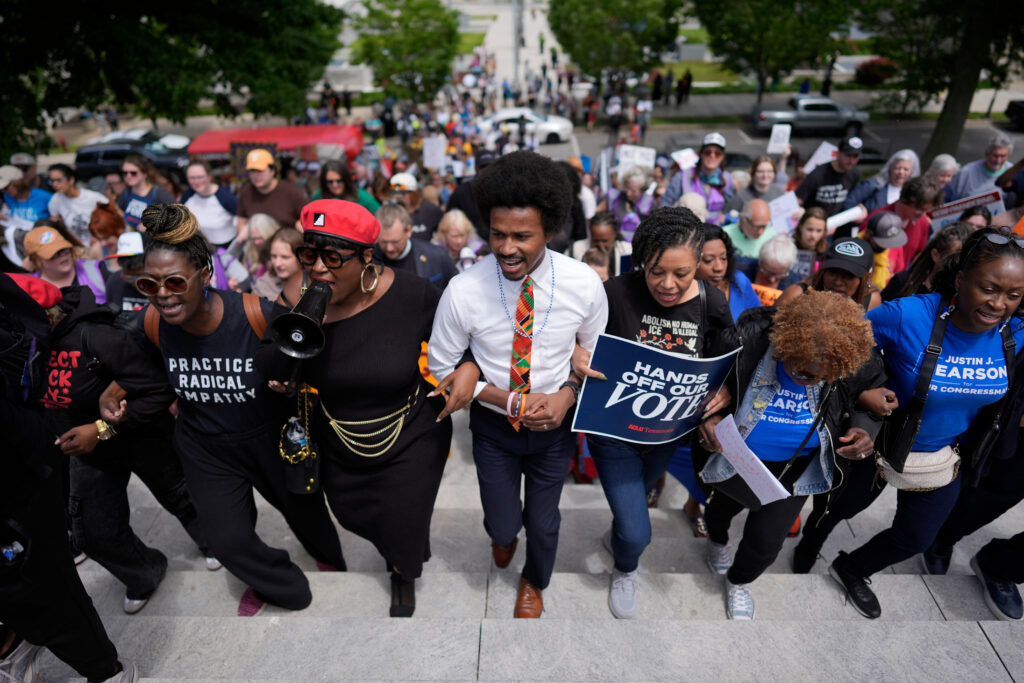
When the Supreme Court gutted the Voting Rights Act in Louisiana v. Callais earlier this year, the Republican Party launched an aggressive attack on Black voting power.
Legislators in Alabama, Florida, Louisiana, and Tennessee quickly moved to redraw congressional maps, the impending primaries be damned. Their goal was to split Black communities apart and pack them into fewer districts — an attempt to erase their votes and push Democratic members of Congress out of their districts.
But the effort sparked massive protests and furious showdowns in state legislatures. And not every gerrymander succeeded.
The response points to a simple, undeniable fact: America’s new political battleground is the South. And it also shows what Southern organizers can do: mobilize quickly, increase turnout, and force politicians to reconsider what they believed they could get away with.
Now, Democratic leaders must recognize that the centuries-long fight to secure full citizenship and fair representation for Black Americans is inseparable from the fight to break the GOP’s stranglehold on the region.
Get updates straight to your inbox — for free
Join 350,000 readers who rely on our daily and weekly newsletters for the latest in voting, elections and democracy.
For decades, Republicans have used facially racially neutral, yet viciously racially targeted strategies including gerrymandering, voter suppression, and a stacked judiciary to diminish Black voting power and lock in dominance across the region.
However, evidence that this system can be challenged has been visible for anyone paying attention.
After the Callais decision, thousands came out to protest the states’ redistricting sessions. The resistance peaked on May 16, when 6,500 people gathered in Alabama for massive rallies.
In South Carolina, hundreds protested at the legislature and Republican state senators joined Democrats to block the proposed map. In Mississippi, thousands rallied after special session plans were canceled. In Georgia, hundreds showed up in protest and successfully pressured Republican leaders to back down.
Moreover, the region is changing — as is our country.
From 2020 to 2025, the South added 7.6 million people — more than the rest of the country combined — and it was the only region to grow across every age group. Some Midwest and Northeast states are projected to see population decreases.
Meanwhile, the United States is on track to become majority-minority in 2045, and the South is where most Black Americans live. Yet, across the region, large Black electorates — and growing communities of color — remain systematically underrepresented.
The political atmosphere is shifting, too. For the first time in nearly two decades, a Fox News poll found voters trust Democrats more than Republicans on the economy. Rising gas prices, the Iran war, and the widening gap between Trump’s promises and families’ cost of living have sunk his approval.
VoteHub’s analysis of primary elections in Louisiana, South Carolina, Alabama and Georgia after Callais showed turnout in majority-Black counties averaged 32%, six points above the statewide average.
Tennessee’s August primary confirmed this shift. In the majority-Black Shelby County, turnout reached 20% in three Democratic primaries — more than double compared to similar 2024 races. Democrats also flipped a school board in a +20 Trump county, and made gains across Middle Tennessee. In May, Louisiana voters rejected five constitutional amendments backed by Gov. Jeff Landry for a second time.
Opportunities are numerous across the South this year. Georgia Democrats are defending Sen. Jon Ossoff, running Keisha Lance Bottoms for governor, and sit within 10 seats of flipping the state House.
In North Carolina, former Gov. Roy Cooper leads public polling in his Senate race. In Tennessee, the Democratic Congressional Campaign Committee just added Justin Pearson’s congressional campaign to its Red-to-Blue target list, which is reserved for contests the committee believes it can win.. And in Mississippi, Scott Colom’s underdog Senate campaign is gaining steam.
If Democrats understand that winning races like these is key to securing voting rights for Black Americans, they have to act like it — by investing in long-term organizing and infrastructure that can break GOP control and make national democratic reform possible.
The year 2026 presents a major opportunity to elect a Democratic Congress that can restore voting rights protections and ban partisan gerrymandering. Communities that have organized against rigged maps for years could finally compete on fairer ground.
For decades, Republicans have played the long game, thinking well beyond the next election. Those who believe in fair representation must do the same.
Carolyn Hugley is Minority Leader in the Georgia House of Representatives and member of the New Southern Strategy Coalition.
Lauren Groh-Wargo is CEO and co-founder of Fair Fight, a voting rights advocacy and research organization.