Far-right Georgia lawmakers want to strip incoming Democratic governor of power
 Prefer us on Google
to see more of our voting rights news coverage when you search.
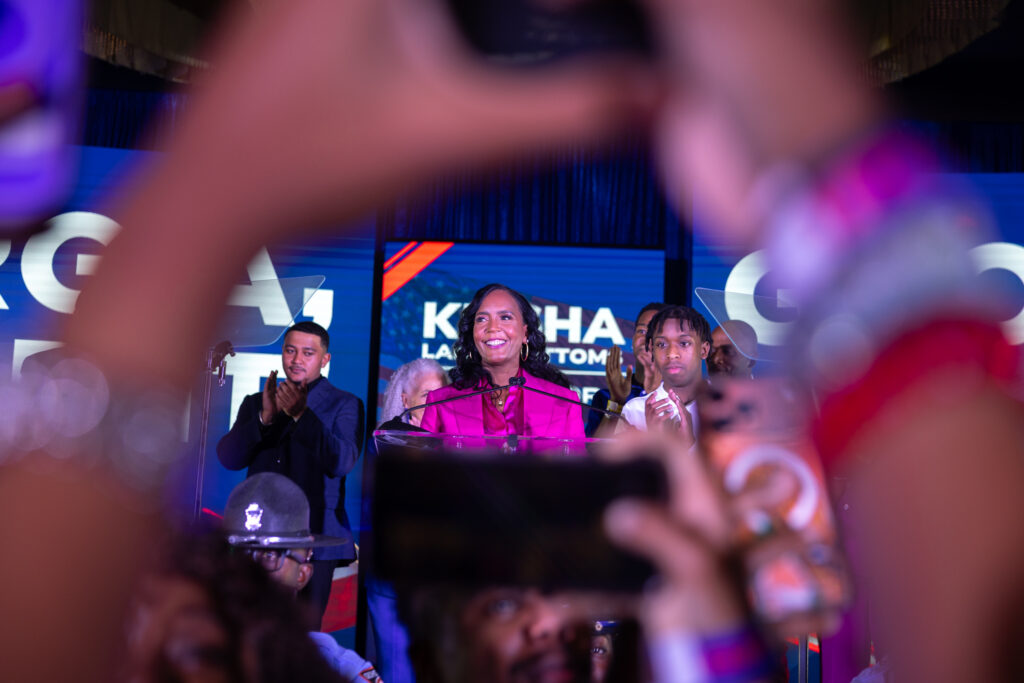
In the wake of Democrats’ blowout victory in Georgia’s midterm elections, far-right members of the state legislature are calling for a special session to redraw the state’s legislative maps and kneecap the executive powers of incoming Democratic Gov. Keisha Lance Bottoms.
“Georgia is facing the prospect of an incoming radical leftist Governor,” Rep. Charlice Byrd (R), the chairwoman of the state’s far-right Freedom Caucus, said in a statement Wednesday.
Byrd said that Georgia’s executive branch has “extensive power,” and that, following the U.S. Supreme Court’s Callais decision, the state will need to draw new maps. “We should address these issues now to prevent Gov.-elect Bottoms, who has proven not to be an effective executive, from abusing the powers of the Governor’s office, we should redraw our racially gerrymandered legislative maps to ensure they are fair and legal,” she added.
Byrd’s gambit is unlikely to succeed, but it represents the latest GOP attempt to subvert the will of the voters after the party’s catastrophic midterm loss.
She and the Freedom Caucus face a major obstacle to a special session: the state’s outgoing Gov. Brian Kemp (R), who has said he won’t call one after the Democratic sweep in the midterms.
“I will not be calling a special session of the Georgia General Assembly in order to curtail executive branch powers or debate redistricting changes,” Kemp said in a statement a day after the election. “The voters of our state have spoken. As long as I’m governor, we will always respect the results of secure, accessible, and fair elections, and also abide by the laws and constitution of our state.”
Get updates straight to your inbox — for free
Join 350,000 readers who rely on our daily and weekly newsletters for the latest in voting, elections and democracy.
Under Georgia law, a special session can be called either by the governor or through a petition signed by three-fifths of legislators in both chambers of the General Assembly.
Though Republicans currently have a majority in both the state House and Senate, it’s not big enough to bypass a unanimous Democratic objection.
In addition to Bottoms winning the race for governor, Democrats flipped enough House seats to secure a narrow 92-87 majority, with one race scheduled for a runoff election. The party also reduced the GOP’s Senate majority to just two seats.
Democrats also flipped the offices of the lieutenant governor, attorney general and secretary of state.
The victories come at a crucial time for voting rights in the Peach State. Following the U.S. Supreme Court’s decision in Louisiana v. Callais earlier this year, which gutted Section 2 of the Voting Rights Act, Georgia Republicans considered redistricting to net them more seats in Congress.
But Georgia House Speaker Jon Burns (R) decided against a mid-decade redraw, citing the immense backlash and protest by Black political leaders and civil rights activists.
“Since this process has the potential to impact every voter, it deserves the same responsible, fact-driven approach that guides every policy we consider as lawmakers, especially as we seek to understand the full implications of the U.S. Supreme Court’s decision in Louisiana v. Callais,” Burns wrote in a letter to Kemp in June.