Gerrymandering backlash helped power Democrats’ blue wave
 Prefer us on Google
to see more of our voting rights news coverage when you search.
Republicans’ gerrymandering overreach this year was one of the most animating factors bolstering the Democratic blue wave, according to data from political scientist Dana R. Fisher.
In a national survey Fisher’s team conducted with YouGov in the two weeks leading up to Election Day, 42% of voters said “gerrymandering” concerned them “a good deal” or “a fair amount” when asked about how democracy is functioning in the U.S.
The data shows how President Donald Trump’s insistence on a congressional map-rigging scheme meant to cement Republican control of Congress backfired spectacularly, handing Democrats total control of both chambers.
Get updates straight to your inbox — for free
Join 350,000 readers who rely on our daily and weekly newsletters for the latest in voting, elections and democracy.
Among Democrats, gerrymandering only trailed Trump’s brutal immigration crackdown and violent response to pro-immigration protests among their top concerns. Gerrymandering was also a top concern among a third of independents polled. That shows Republicans’ overreach was a turnoff for swing voters who can decide elections.
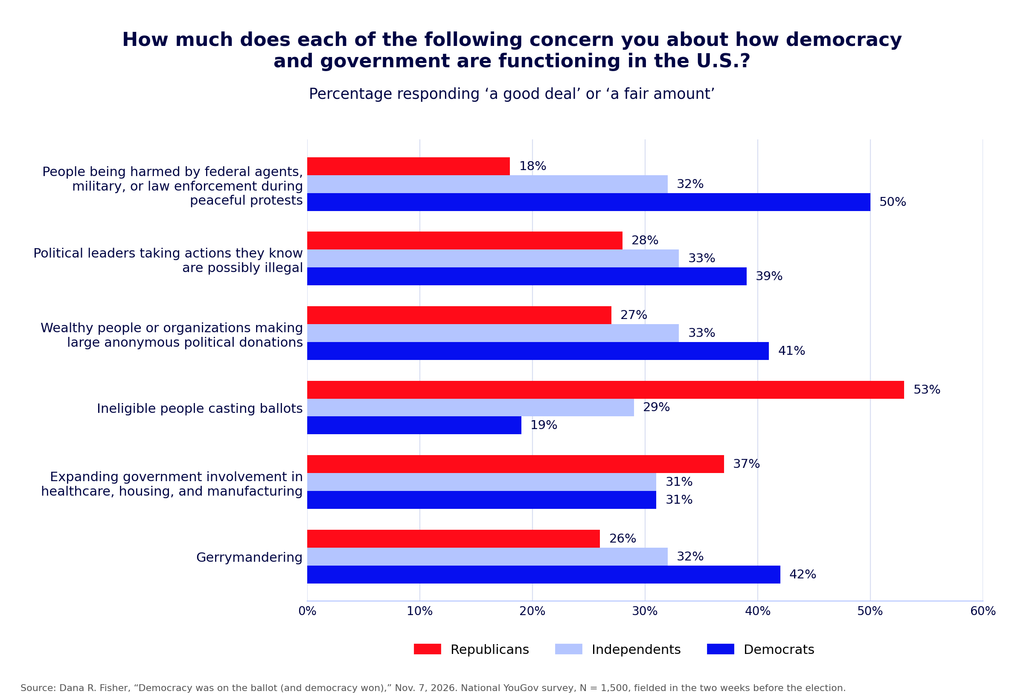
Fisher’s survey also tracks with other polls showing that protecting democracy was a primary issue for voters in this year’s midterms as they flipped Congress and many state legislatures from red to blue.
After the U.S. Supreme Court gutted the Voting Rights Act, Republicans immediately modified states’ congressional maps to eliminate minority-held districts.
Voters’ backlash powered ballot measures in Colorado and Maryland that would allow lawmakers to redraw maps in those states to add more Democratic seats in response to Republican gerrymanders.
In Missouri, voters rejected a ballot measure that would allow Republicans to use a gerrymandered map that eliminates a Black, Democratic-leaning district in Kansas City in future elections.
The blue wave could cool off the gerrymandering wars Republicans instigated. In Georgia, Gov. Brian Kemp (R) abandoned plans for a special session for Republican gerrymandering after Democrats swept statewide offices and flipped the legislature’s House blue.
Mississippi Gov. Tate Reeves (R) made plans earlier this year for a gerrymander ahead of the 2027 elections. But that’s now up in the air given how Democrats and Black voters showed up in this year’s midterms – a 35% surge since the last midterms, which may now earn the state its first Black U.S. Senator since Reconstruction.
Some Democrats also appear willing to call a truce. New Jersey considered doing its own redistricting in response to Republican gerrymanders, but this week Gov. Mikie Sherrill (D) decided not to after Democrats’ midterm wins suggested it wasn’t needed.