Voting rights groups sue to block Ohio law that purges voters without warning
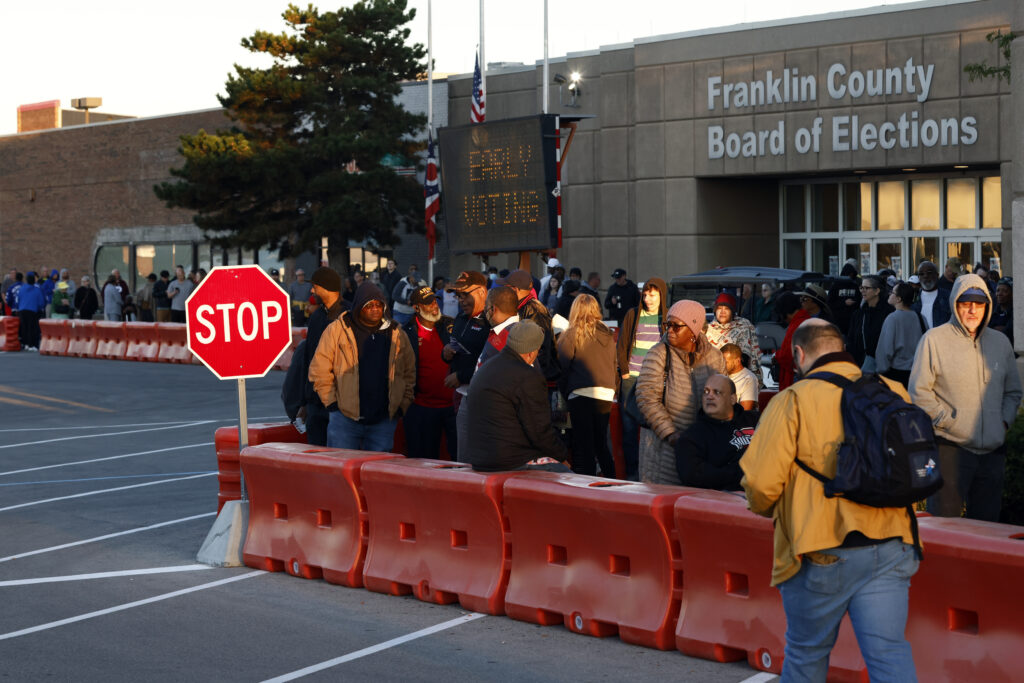
Voting rights groups filed a federal lawsuit Friday challenging Ohio’s sweeping new voter purge law.
They warn the measure could strip eligible citizens, especially naturalized citizens, from the rolls without notice, right before elections.
Get updates straight to your inbox — for free
Join 350,000 readers who rely on our daily and weekly newsletters for the latest in voting, elections and democracy.
The League of Women Voters of Ohio and the Council on American-Islamic Relations–Northern Ohio sued Ohio Secretary of State Frank LaRose (R), seeking to block enforcement of Senate Bill 293 (SB 293) before it takes effect in March.
SB 293, passed in December, requires the secretary of state to conduct monthly comparisons of Ohio’s voter rolls against data from the Bureau of Motor Vehicles and the federal immigration database, SAVE. If a voter is flagged as a potential noncitizen, county boards of elections must cancel that registration.
Voting rights advocates say the system is built on outdated and error-prone data — and allows the state to remove voters without any warning.
“Individuals flagged under these citizenship-check requirements will have their voter registrations cancelled without prior notice and an accompanying opportunity to respond, even on the eve of an election,” the plaintiffs wrote. “Only after the voter’s registration has been cancelled do they receive notice and an opportunity to respond. Thus, both the notice and any opportunity to respond occur only after the individual has been deprived of their interest in being registered to vote.”
The pro-voting plaintiffs stress that under SB 293, voters may only learn they’ve been removed after the cancellation has already happened.
The lawsuit contends the practice of purging voters without notice violates the Constitution’s guarantee of due process — the principle that the government must give people notice and a fair chance to respond before taking away a protected right.
It also argues the law runs afoul of the National Voter Registration Act (NVRA), a landmark federal law designed to make it easier to get and stay on the rolls. The law includes a 90-day “quiet period” before federal elections during which states cannot conduct systematic voter removals, meaning broad list-cleaning programs that risk sweeping up eligible voters.
SB 293, meanwhile, requires monthly checks year-round, including during that protected window.
“SB 293 requires practices that violate the NVRA’s quiet period, which will irreparably harm voters by leading them to be removed from the rolls without the amount of time Congress has deemed necessary to rectify improper removal before the next election, and thus will likely deprive them of their right to vote,” the lawsuit alleges.
The lawsuit places particular emphasis on the risk to naturalized U.S. citizens. Ohio has just over 7.9 million registered voters. About 4% — roughly 300,000 people — are naturalized citizens.
The plaintiffs say those voters face heightened danger because state driver’s license records and federal immigration databases are not automatically updated when someone becomes a U.S. citizen.
“Many Ohioans who registered to vote as naturalized citizens are still recorded as noncitizens in the BMV database. Both the BMV database and SAVE system rely on stale citizenship data, which frequently misclassify naturalized citizens as ineligible to vote,” the complaint reads. “SB 293’s Purge Program targets and will disproportionately sweep in naturalized citizens subjecting them to an additional and significantly greater risk of disenfranchisement from which U.S.-born citizens are shielded because the Purge Program was designed to rely on stale data.”
The lawsuit asks the court to declare the law unlawful and permanently block enforcement of the purge provisions before the May primary.
At stake, the plaintiffs argue, is nothing less than the fundamental right to vote.
“All eligible citizens, including naturalized citizens, have a fundamental constitutional right to vote and a constitutionally protected liberty interest in doing so,” the plaintiffs wrote. “In enacting Ohio Senate Bill 293, the Ohio Legislature has doubled down on its discriminatory treatment of naturalized citizens and other Ohio citizens who will inevitably be swept up in this law’s grips.”