Mississippi made thousands of valid voters inactive ahead of critical Senate race
 Prefer us on Google
to see more of our voting rights news coverage when you search.
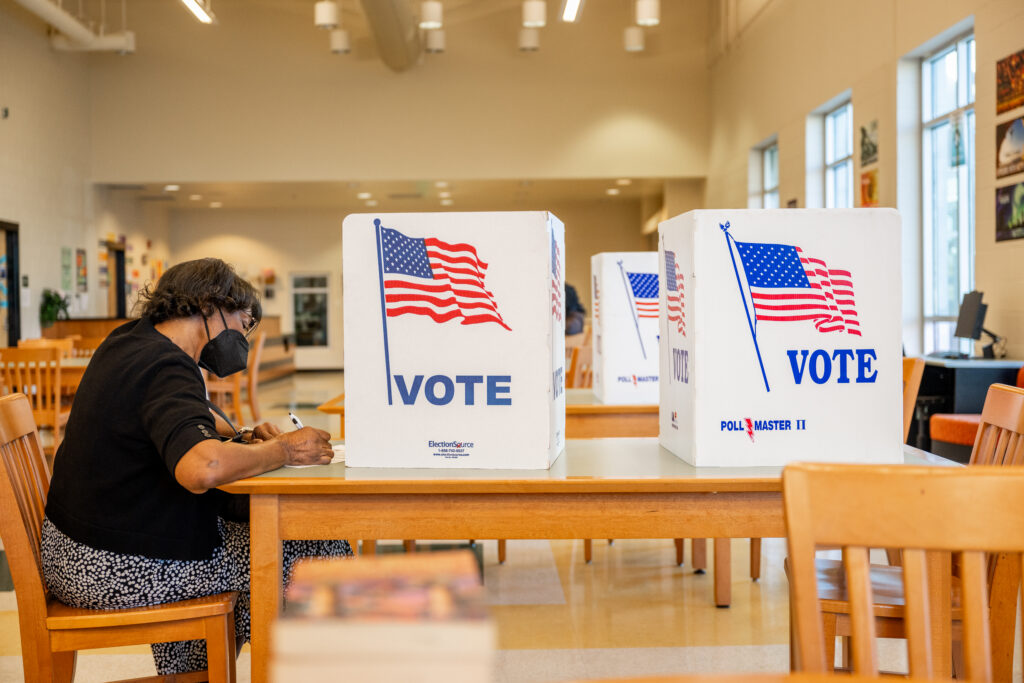
Clint Lowery left work around 4 p.m. in Alabama to make sure he would have enough time to get back home to Harrison County, Mississippi to vote before polls closed.
He checked the secretary of state’s website the night before to look up his polling place. He checked his voter registration status, too.
When he arrived at St. Martin Community Center, Lowery waited in line for hours before he made it inside, where he described around 100 people snaking through the building. Then Lowery, a registered Mississippi voter of five years, was told he wasn’t on the precinct’s voting list.
Get updates straight to your inbox — for free
Join 350,000 readers who rely on our daily and weekly newsletters for the latest in voting, elections and democracy.
“It just kind of blew me away,” Lowery said. “And a few people I was in line with to get the affidavit, they felt the same way. They had all been registered to vote there. One guy next to me said he’s been voting there for 30 years.”
Lowery said the last time he checked online today, his vote was still marked as unprocessed.
Thousands of Mississippians like Lowery — whose votes may decide a critical U.S. Senate race, in which Democrat Scott Colom holds a slim lead over Sen. Cindy Hyde-Smith (R) — are still waiting to have their ballots counted. That’s because of the Republican secretary of state’s contract with Experian, a global credit reporting agency whose data has been described as riddled with errors, that threw thousands of voters into “inactive” status in the months leading up to the general election.
In highly populated DeSoto County, over 15,000 people were removed as active voters in the time between the primary and general election, according to an analysis from Mississippi Today with data from the state.
Other counties with high rates of inactive voters include Jackson with 14,063 and Harrison, where Lowery votes, with 28,921. For many of these voters showing up to the polls on Tuesday, this was a shock.
Lowery said in all the states he’s lived and voted in, he’s never had to cast a provisional ballot. He heard from others he chatted with, over the more than three hours he spent waiting to vote, that the snafu had been impacting voters all day.
Others took to social media to share similar experiences.
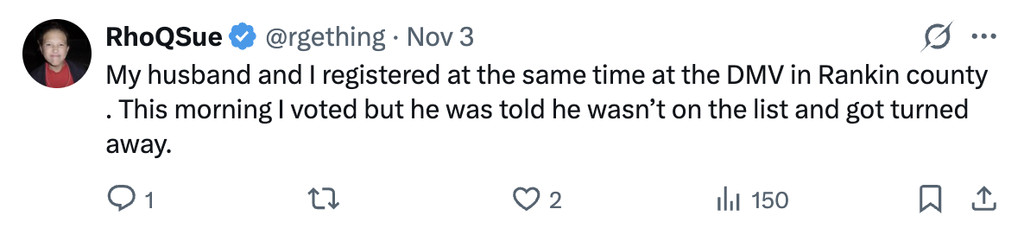
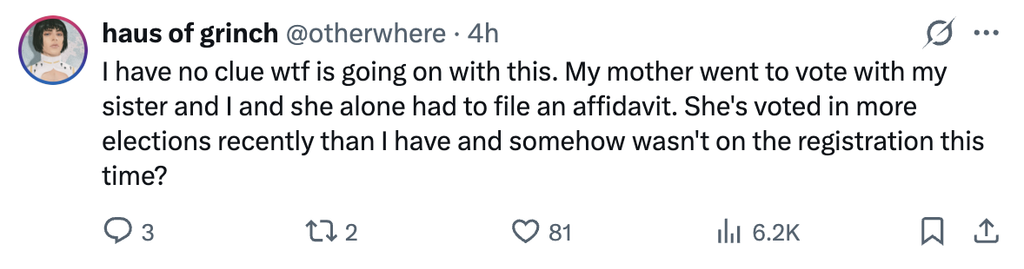
Secretary of State Michael Watson (R) acknowledged the mayhem Tuesday, but defended the inactivations as a “cornerstone of election integrity.”
“We’re getting multiple calls about people not showing up as active voters, so we wanted to share a few details,” Watson wrote in a social media post. “Our office obtains data for the entire state and sends it down to the counties. The election commissioners receive the information and are charged with verifying it before updating. Thankfully, affidavit voting is used to catch any errors or those who live in the same county but forgot to update their info.”
Watson concluded that the “extra few minutes” it takes a voter to vote provisionally are “well worth the election integrity added by having cleaner voter rolls.”
Lowery said he waited in line for his affidavit ballot with dozens of other voters for an hour and 15 minutes. Because Lowery had a valid form of photo identification with him, that was sufficient to validate his vote. Voters without photo identification must verify their identity within five days for their affidavit ballot to count.
Technology and elections experts have denounced the state’s deal with Experian as wildly irresponsible.
Thessalia Merivaki, who researches elections at Washington State University, said that while states often partner with outside agencies to help keep their voter rolls up to date, this comes with significant challenges when data is not accurate — as it appears to be with Experian.
“We have evidence that some of the data are not reliable because eligible voters have been erroneously inactivated and then they never received the mail alert because it was sent to the wrong address, because the data were faulty,” Merivaki told Democracy Docket.
“It’s such a close election where literally every vote counts,” Merivaki added. “And my assessment is these affidavits are gonna really make or break who wins this election.”
Now, it’s up to local election officials who are working around the clock to determine the fate of the contentious Senate seat. Merivaki said election canvassing boards will review all affidavit votes to check them against existing voter files for those deemed “inactive.”
But there likely shouldn’t have been thousands of affidavit votes to check to start with, Merivaki explained. And if officials are relying on the already faulty Experian data to cross-check voter files, errors are almost certain.
“I’m not making the claim that the election officials are disenfranchising, but if you rely on faulty data, some mistakes will be made because of the faulty data that may result in eligible voters not having their votes counted,” Merivaki said.
Other democracy experts echoed this sentiment, calling out the state for an irresponsible contract.
“Credit bureau data was never intended to be used to maintain voter rolls, and using the wrong data for the wrong purpose can lead to serious harm. In this case, Mississippi undermined access to voting, a fundamental right, by inexplicably using the data broker Experian’s data to ostensibly maintain voter rolls,” Center for Democracy & Technology’s Sydney Saubestre said in a Wednesday statement.
“Now voters are on the hook to identify and fix the issue themselves, even though this problem stems from the government’s decision to rely on data not fit for purpose,” Saubestre added.
Lowery said that while he’s glad he got to eventually cast his ballot, he’s worried about its fate as a defining vote in a nationally consequential race. He’s concerned too about the systems that threw his vote into limbo this midterm season.
“I used to understand how the system worked, right?” Lowery said. “And it just seems like it’s broken.”