In Georgia primaries, voting rights take center stage
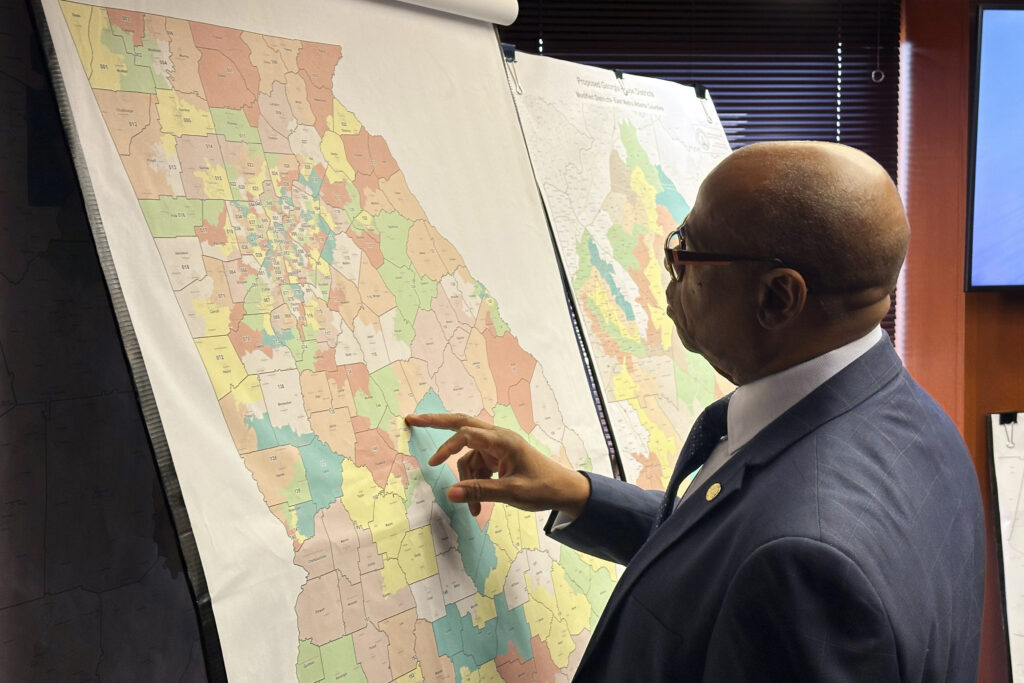
Voting rights have become one of the most pressing issues facing Georgia voters as they head to the polls Tuesday to cast their ballots in the state primaries.
Georgia remains one of the few southern states that hasn’t moved to immediately eliminate its majority-Black, Democrat-leaning congressional districts since the U.S. Supreme Court gutted the Voting Rights Act last month through a ruling in the case Louisiana v. Callais.
But this week Gov. Brian Kemp (R) did call a special session to redistrict before the 2028 elections, emphasizing that gerrymandering is very much on the state GOP’s agenda.
At stake Tuesday are a series of races for offices that will determine whether unfair map redraws that advantage Republicans and dilute the power of Black voters become a permanent feature of Georgia’s political landscape.
Get updates straight to your inbox — for free
Join 350,000 readers who rely on our daily and weekly newsletters for the latest in voting, elections and democracy.
‘I will not let this stand’
Former Atlanta Mayor Keisha Lance Bottoms, the Democrats’ frontrunner in the gubernatorial primaries, recently planted her flag in the issue by releasing a 10-page plan that, as its centerpiece, calls for a state-level Voting Rights Act.
The law “will make clear that Georgia will not allow politicians to use redistricting to turn back the clock on civil rights,” the plan states. “Georgia should not follow other states backward. Georgia should be a national leader in protecting fair representation.”
Her rivals are also speaking out against states pushing to redraw maps heavily in favor of predominantly white and Republican districts.
Former state representative and Georgia Labor Commissioner Mike Thurmond said in a Facebook post that, as governor, he would lead a court fight “immediately to reapportion the reapportionment” — meaning he’d work to undo any redistricting that Republicans might conduct that would reduce Georgia Democrats’ share of four congressional seats.
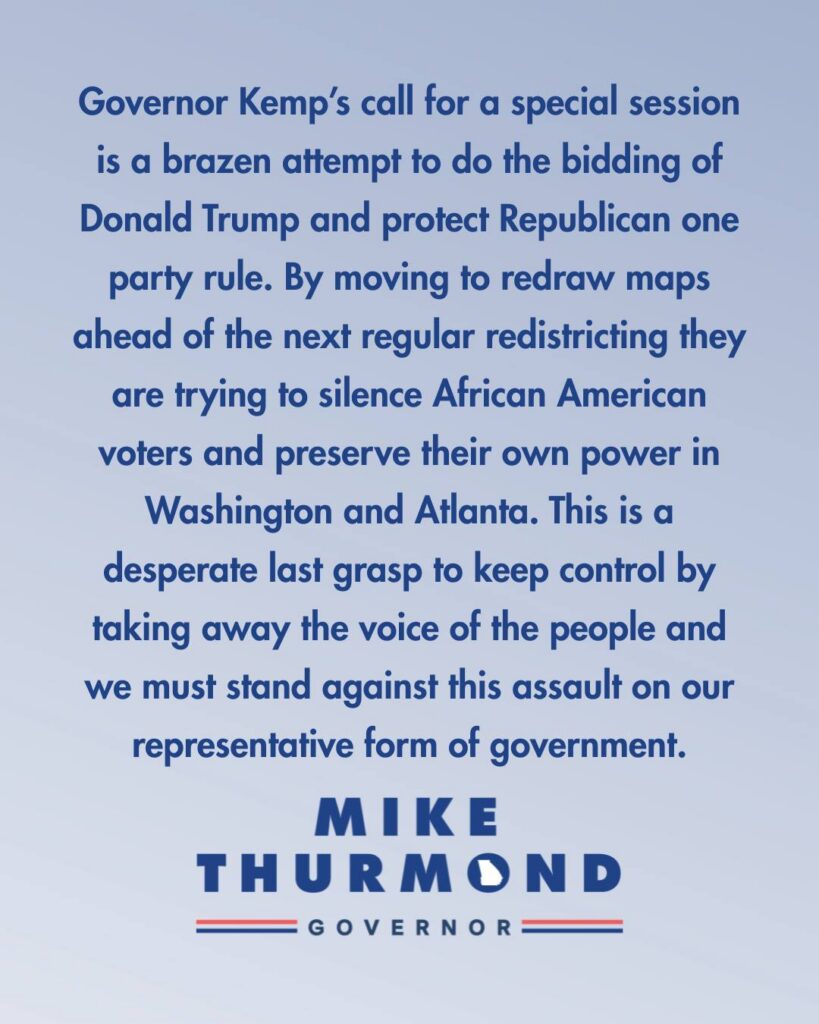
“Governor Kemp’s call for a special session is a brazen attempt to do the bidding of Donald Trump and protect Republican one-party rule,” Thurmond wrote in a post. “By moving to redraw maps ahead of the next regular redistricting they are trying to silence African American voters and preserve their own power in Washington and Atlanta.”
Former state senator Jason Esteves framed the decision to plan a future redistricting session in Georgia as an attempt to appease Trump.
“Governor Kemp’s call for a special session to gerrymander Georgia’s maps is yet another display of Republicans’ unwavering loyalty to Donald Trump and a clear maneuver to dilute the voting power of Black voters in Georgia,” Esteves wrote in a Facebook post. “Make no mistake — Brian Kemp and [Lt. Gov.] Burt Jones are rushing this through during Kemp’s lame-duck year because they know that Democrats are poised to win the governor’s office this November. Republicans want to rig the elections because they can’t win on their own policies.”
Former Lieutenant Governor Geoff Duncan, who switched parties from Republican last year and is now running as a Democrat, held a press conference this week in front of a mural honoring civil rights activist John Lewis to stake his claim in the voting rights cause.
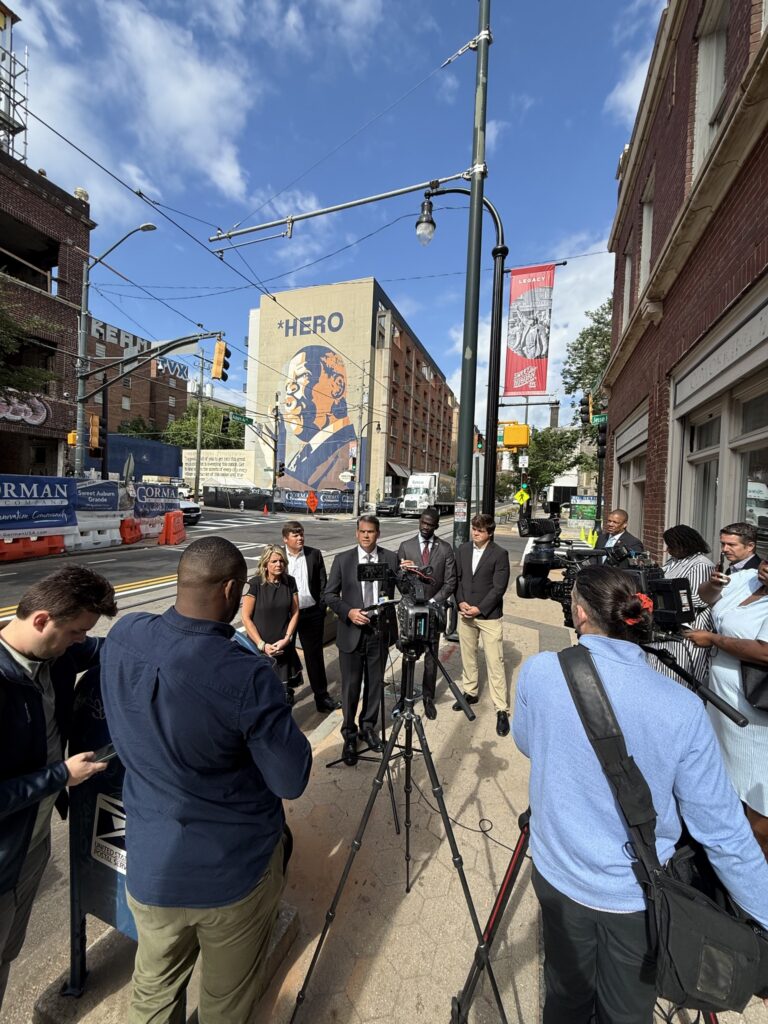
Standing with former Georgia NAACP state conference president James “Major” Woodall, who endorsed him, Duncan said that “democracy is on life support” after the Supreme Court’s recent Voting Rights Act decision.
“And now MAGA Republicans have announced a special session to redraw maps in Georgia and disenfranchise Black voters,” said Duncan. “As governor, I will not let this stand.”
A New Voting Rights Act for Georgia?
Like Thurmond and Lance Bottoms, Duncan announced plans to protect Georgia’s majority-Black districts from the ramifications of the Callais ruling. In his “Agenda for Black Georgia,” Duncan pledged to push for a constitutional ban on partisan gerrymandering and establish an independent redistricting commission.
“The Supreme Court just gave Republicans a green light to disenfranchise Black voters with extreme gerrymandering,” reads his campaign site. “So if a MAGA sockpuppet like Burt Jones becomes our next governor, we might as well give Donald Trump the pen and paper to redraw Georgia’s maps. When I’m Georgia’s Democratic governor, I won’t stand for it. I’ll veto any bill gerrymandering our maps before the ink even dries, because it’s the right thing to do.”
Lance Bottoms said her state-level Voting Rights Act proposal would ban maps that “crack,” — i.e. split — Black communities up across districts in ways that prevent them from electing candidates of their choice. It also would prohibit any maps or voting rules that reduce Black voters’ chances at having fair or equal participation in elections.
“Keisha will veto any map that dilutes minority voting power, weakens Black representation, or undoes the progress generations of Georgians fought to secure,” reads the plan. “She will also use the full power of the governor’s office to challenge maps that crack, pack, divide, or silence communities for partisan advantage. That includes any attempt to target congressional districts where Black voters have built meaningful political power, including rural communities that have too often been ignored, divided, or pushed out of power.”
Challenges ahead
However, Democratic candidates’ plans for protecting minorities from the gerrymandering currently sweeping across the South could meet tough challenges due to the Supreme Court’s Callais ruling.
The decision restructured the Voting Rights Act such that any redistricting that uses race to draw districts has been deemed unlawful. A right-wing group recently sued Illinois over its similarly constructed state Voting Rights Act.
Lance Bottoms told the Atlanta Journal-Constitution that, if elected governor, she would try to enact most of her voting rights plans via executive order. However, in Georgia it’s the state legislature, not the governor’s office, that draws districts — though, as governor, she could veto maps, provided they aren’t passed with veto-proof majorities.
This year’s midterms will determine what that redistricting regime looks like. Besides the governor’s race, the midterms will also select the next secretary of state, who is the state’s chief elections officer, and all 236 seats in the state legislature, the body responsible for the next round of redistricting. The midterms will also determine the next lieutenant governor and attorney general, who both have a role to play in enforcing voting rights.
A Democratic sweep of statewide offices could help make Georgia the South’s sole outlier in Republicans’ post-Callais wave of gerrymandering.