Trump nominates as ambassador a former election official who claimed Democrats need ‘illegal citizens’ to win elections
 Prefer us on Google
to see more of our voting rights news coverage when you search.
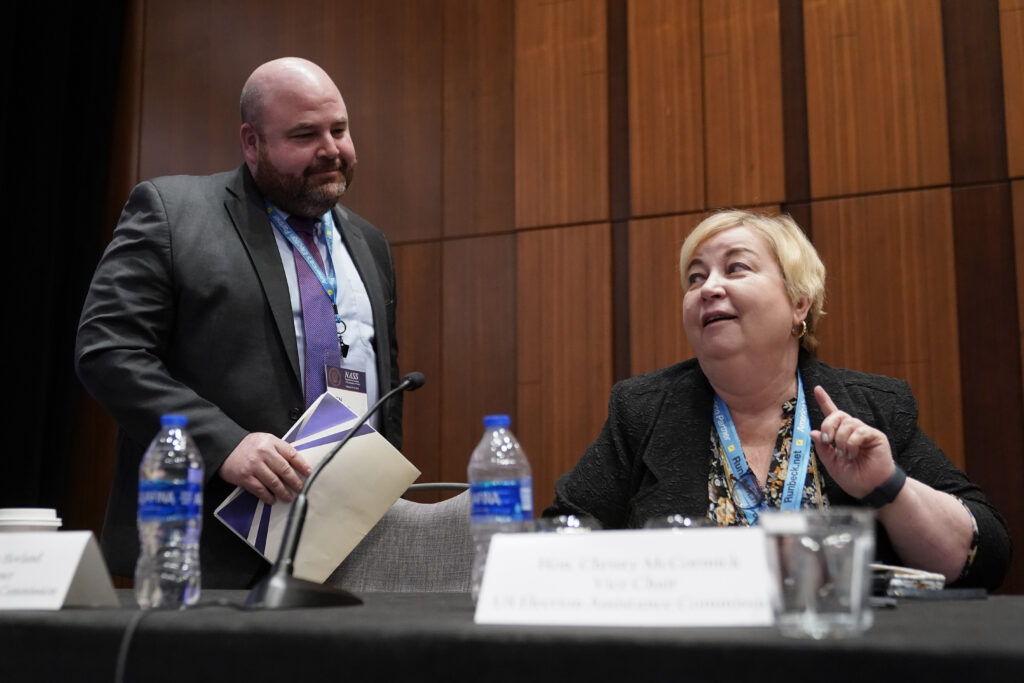
President Donald Trump nominated former federal election official Christy McCormick to serve as U.S. ambassador to North Macedonia, months after she faced calls to resign and revealed she was under investigation over inflammatory comments falsely accusing Democrats of relying on noncitizens to win elections.
The nomination, announced in a White House notice Monday, comes four months after McCormick departed the U.S. Election Assistance Commission (EAC), an independent, bipartisan federal agency that helps states administer elections, when Trump fired its remaining commissioners.
McCormick, a Republican who served on the EAC for more than a decade, drew widespread criticism last year after Democracy Docket first reported that she used an appearance in her official capacity at a Trump-aligned event to promote baseless claims about Democrats and noncitizen voting.
Get updates straight to your inbox — for free
Join 350,000 readers who rely on our daily and weekly newsletters for the latest in voting, elections and democracy.
During an October 2025 panel discussion hosted by the America First Policy Institute (AFPI), McCormick was asked why she believed Democrats opposed measures to tighten voting rules.
“They need the votes. They’re losing ground,” McCormick said. “Everybody is seeing how people are going toward the right.”
“They need open borders, they need illegal citizens to increase their votes,” she continued. “And this is why they’re fighting so adamantly against us.”
The accusations echoed a longstanding right-wing conspiracy that Democrats encourage noncitizens to vote to gain an electoral advantage. There is no evidence of widespread noncitizen voting in federal elections, where voting by noncitizens is illegal.
McCormick’s remarks were especially troubling given her position at the EAC.
Her comments prompted immediate calls for her removal, including from Oregon Secretary of State Tobias Read (D), who accused her of undermining public trust in elections.
McCormick also faced criticism from Senate Democrats and other state election officials, who questioned whether she could continue serving on a commission designed to operate independently of partisan politics.
In December 2025, the Democracy Defenders Fund, a legal advocacy organization, filed a complaint with the U.S. Office of Special Counsel, asking it to investigate whether McCormick’s remarks violated the Hatch Act, a federal law restricting certain partisan political activities by government employees.
Months later, McCormick revealed to Democracy Docket that her comments were under investigation.
“I’m not going to get into that. It’s under some sort of investigation,” McCormick said in April when asked whether she regretted or wanted to clarify her statements.
She declined to identify the investigation or provide further details. The status and outcome of that investigation remain unclear.
The following day, Read renewed his demand that McCormick step down, arguing that her statements were incompatible with the EAC’s nonpartisan mission.
“If that’s how she really feels, she should not be in this role,” Read told Democracy Docket at the time.
McCormick ultimately left the agency in July, when Trump forced out its three remaining commissioners ahead of the midterm elections. The administration fired the two Democratic commissioners while McCormick was permitted to resign.
The departures left all four seats on the commission vacant, depriving the agency of the quorum needed to carry out some of its core responsibilities as Trump sought greater control over federal election administration.
Despite the controversy surrounding her tenure, McCormick would represent the United States abroad if confirmed by the Senate.
McCormick previously worked in the Department of Justice’s Civil Rights Division and served at the U.S. Embassy in Baghdad, where she worked on election-related matters.
She was first confirmed to the EAC in 2014.
The White House announcement offered no explanation for Trump’s decision to nominate her.
Her nomination now heads to the Senate, giving lawmakers an opportunity to question her about her false claims, the investigation she acknowledged earlier this year and her departure from the federal agency charged with helping safeguard American elections.