Trump DOJ voter roll grab echoes ‘poll taxes and literacy tests,’ civil rights group warns
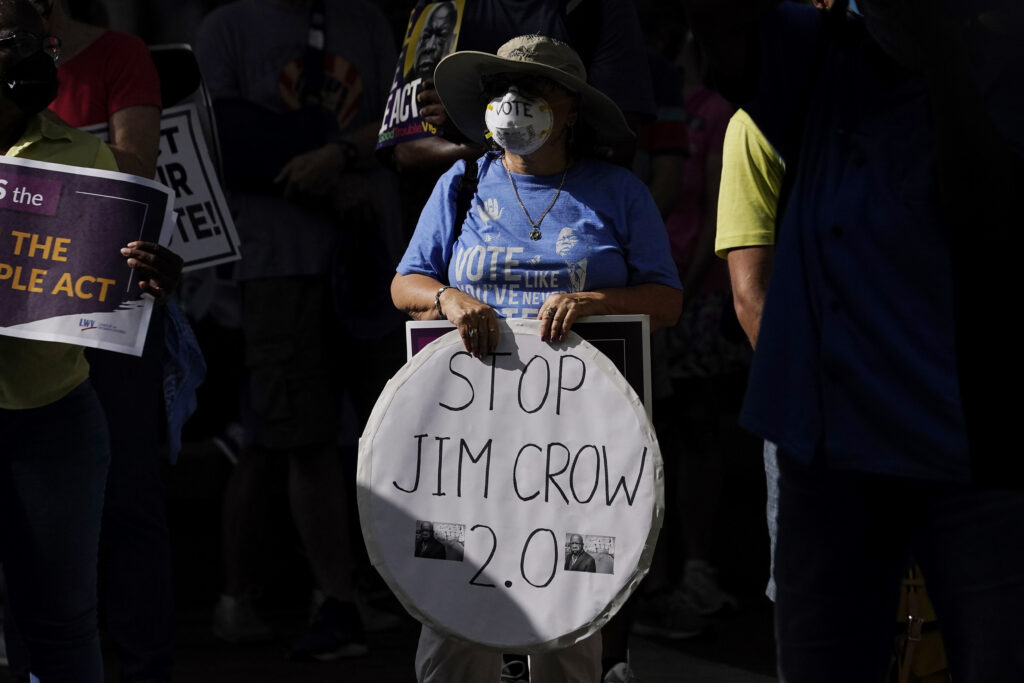
A civil rights coalition is warning a federal court that the Trump Justice Department’s demand for unredacted statewide voter rolls is not just a privacy threat — it is a modern revival of a long racist history of using voter registration data to intimidate Black voters.
“Poll taxes and literacy tests may be gone,” the United Black Agenda (UBA), a coalition of Black-led and allied groups in New Jersey, argued in a brief filed Thursday supporting New Jersey’s effort to dismiss the Justice Department’s lawsuit seeking access to the state’s voter registration list. “But while the means of intimidation may change, the ends stay the same.”
The filing argues that the Trump administration is trying to repurpose a civil rights law designed to protect Black voters into a tool for mass voter surveillance.
Get updates straight to your inbox — for free
Join 350,000 readers who rely on our daily and weekly newsletters for the latest in voting, elections and democracy.
The case is part of the Trump Justice Department’s nationwide campaign to obtain state voter rolls, including sensitive personal information.
In New Jersey and 30 other states, the department is demanding unredacted statewide voter files, including full names, birthdates, home addresses, driver’s license and the last four digits of Social Security numbers.
So far, DOJ has had no success. The department has not won a single case, while eight federal courts have dismissed its lawsuits. DOJ has appealed some of those losses.
In its filing, UBA warned that the request turns the history and purpose of the Civil Rights Act of 1960, specifically Title III, upside down.
That law gave the federal government power to inspect voting records so it could uncover racial discrimination and protect people who were being blocked from registering to vote. Now, the group wrote, the same law is being used to justify a sweeping demand for millions of voters’ private information.
“This request effectively transforms Title III from a shield into a sword in an attempt to weaponize the law designed to protect against this very type of conduct,” UBA wrote.
The group’s argument gives the opposition to DOJ’s voter roll grab a sharper civil rights frame.
The danger is not only that private voter data could be exposed, breached or misused. It is that, for Black voters, the government collection of voter information has often been a precursor to retaliation, intimidation and suppression.
“We need not theorize as to whether bulk data collection and mass challenges harm the communities that Title III aims to protect: we know that they do,” UBA wrote. “Poll taxes and literacy tests may be gone. But while the means of intimidation may change, the ends stay the same.”
The brief traces that warning back to Mississippi, where Black citizens who tried to register to vote once had their names published in local newspapers. UBA wrote that the requirement may have looked like a neutral administrative rule, but in practice it exposed Black registrants to retaliation from employers, landlords, banks and vigilantes.
“That publication requirement, dressed as a neutral administrative act, was meant to intimidate,” UBA wrote. “By making registrants’ names and addresses public, registrars made it easier for employers to fire registrants, landlords to evict them, banks to deny them credit, and vigilantes to threaten or assault them.”
The brief also points to the Mississippi State Sovereignty Commission, a state agency created after Brown v. Board of Education that surveilled civil rights activists and shared information with officials and private actors who used it to retaliate. When the commission’s files were later made public, they showed records on more than 87,000 people, according to the filing.
For UBA, that history is not distant. The group argues that today’s tools may look more technical — database matching, mass eligibility challenges and federal data sharing — but they can produce the same chilling effect.
“History shows that when such data are gathered and shared, it does not merely collect dust,” UBA wrote. “Again and again, when voter records have been compiled and exposed beyond their original purpose, the same consequence has followed: the empowerment of weaponization against voters, whose rights the recording system is meant to serve.”
UBA also challenged DOJ’s legal theory, arguing that Title III was meant for targeted investigations of specific voting rights violations — not a nationwide dragnet. The brief contrasts the Trump administration’s request with historic civil rights enforcement cases in which the federal government sought local records to investigate officials accused of discriminating against Black voters.
Instead, the group wrote, DOJ is seeking the private data of more than 6 million New Jersey voters based on broad claims about list maintenance — the process states use to keep voter rolls accurate.
“Title III does not authorize such overbreadth,” UBA wrote. “Title III is not a dragnet to build a broad voter database but is rather a scalpel for investigating specific voting-rights violations.”
The brief warns that a centralized federal voter database could fuel mass challenges to voter eligibility, especially if voter rolls are checked against federal immigration databases or other government records. Data matching systems are often flawed because records may be outdated, incomplete or inconsistent across agencies.
When those errors are used to flag voters, eligible people can be forced to prove they have a right to vote — or be wrongly removed from the rolls.
UBA wrote that these burdens often fall hardest on voters of color.
“Voter data is the fuel for mass eligibility challenges,” UBA wrote. “Putting every state’s full voter file into one federal database would dramatically amplify these challenges.”
The group also warned that the mere existence of a federal voter database could discourage people from registering or voting, particularly in communities that have long histories of being targeted by government surveillance.
“A federal database of every American voter’s identifying information, subject to cross-database matching and mass challenges, is itself intimidating,” UBA wrote. “Fear of misuse keeps people away from the polls just as surely as past forms of intimidation did.”
UBA is urging the court to reject DOJ’s demand and dismiss the lawsuit entirely.
“Over six decades after the passage of Title III, it should be true—but it is not—that voter intimidation and harassment are remnants of the past,” UBA wrote. “It should be true—but it is not—that the right to vote is not a data collection tool to mine and weaponize.”