Trump DOJ doubles down on claim that states can purge voters right before elections
The Trump Justice Department is doubling down on an argument that, if accepted, could open the door for the administration — and anti-voting groups — to create lists of voters and send them to states for removal right before elections.
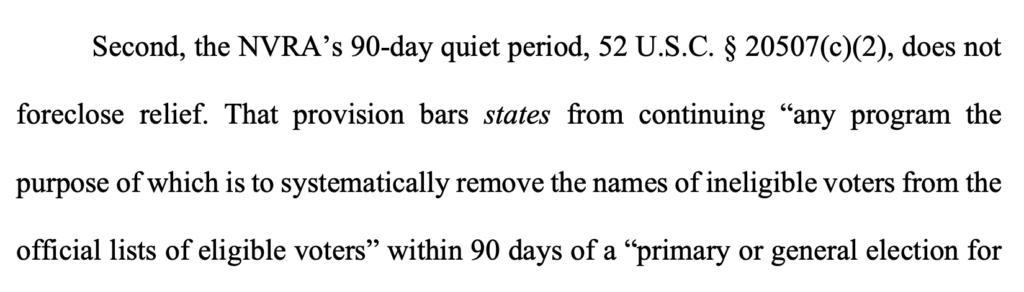
In a new filing Tuesday in its lawsuit seeking Georgia’s unredacted statewide voter registration list, DOJ again argued that the National Voter Registration Act’s (NVRA) 90-day “quiet period” does not block states from purging individual voters if they’ve been flagged as potentially ineligible.
Get updates straight to your inbox — for free
Join 350,000 readers who rely on our daily and weekly newsletters for the latest in voting, elections and democracy.
The quiet period is one of the NVRA’s central protections for voters, barring states from carrying out systematic voter removals within 90 days of a federal election. That safeguard is meant to prevent eligible voters from being wrongly kicked off the rolls too close to Election Day, when they may not have enough time to challenge their removal.
But DOJ’s latest filing suggests it may be laying the groundwork to argue for a workaround — one which, if accepted by courts, could make it much easier to purge voters.
“That provision poses no barrier to non-‘systematic’ methods of removal by a state,” DOJ wrote. “That provision would not prevent a state like Georgia from investigating and removing ineligible people in an individualized fashion if the United States alerted the State of the possibility that particular individuals on their rolls were ineligible to vote, even assuming for the sake of argument that the United States was engaged in a systematic review.”
In other words: DOJ is claiming that the federal government or private groups could conduct the systematic review, identify voters they believe may be ineligible and pass those names on to Georgia, which could then remove the voters.
That may be why DOJ, in its filing, italicizes the word “state” — in order to draw a distinction between systematic removals carried out by states, which are barred during the 90-day window, and systematic reviews conducted by the federal government or potentially outside groups, whose lists could then be handed off to states for voter removals.
The filing came after Democracy Docket first reported that DOJ was arguing Georgia could conduct last-minute voter removals based on their referrals, despite federal voter protections.
Tuesday’s filing sharpens that argument.
DOJ is no longer simply saying Georgia may remove voters one by one if federal officials flag them as potentially ineligible. It is now arguing that Georgia may do so even if DOJ’s own process for identifying those voters is systematic.
The Georgia case is part of the Trump administration’s nationwide effort to obtain sensitive voter registration data from states. DOJ says it needs the records to investigate whether states are properly maintaining their voter rolls.
Election officials have warned that the demands exceed DOJ’s authority, threaten voter privacy and could fuel improper purges of eligible voters.
For voting rights advocates, the concern may not only be that Georgia could remove voters during the 90-day quiet period. It is that DOJ’s theory could let federal officials and anti-voting groups do the list-building work first, then pressure states to carry out the removals individually — potentially weakening one of the most important federal safeguards against last-minute disenfranchisement.