Trump DOJ falsely tells court it doesn’t want voter data to purge rolls
The U.S. Department of Justice told a federal court Tuesday that it does not intend to use sensitive voter data it collects to remove people from voter rolls — even as its own agreements with states suggest otherwise.
During a hearing in New Mexico over DOJ’s attempt to seize the state’s voter rolls, department attorney James Tucker pushed back on claims that the federal government is trying to take over how states maintain their voter lists.
“One of the other points that was made was that counsel, at times, have suggested that the United States wants to engage in list maintenance. That is simply not true,” Tucker said. “The purpose of doing this is for the purpose of assessing whether or not the state is engaged in reasonable list maintenance procedures.”
Get updates straight to your inbox — for free
Join 350,000 readers who rely on our daily and weekly newsletters for the latest in voting, elections and democracy.
But attorneys for pro-voting parties* opposing the request pointed to the DOJ’s own memoranda of understanding — agreements states have signed while turning over voter data — arguing they tell a different story.
Under those agreements, states are required to act on issues identified by DOJ.
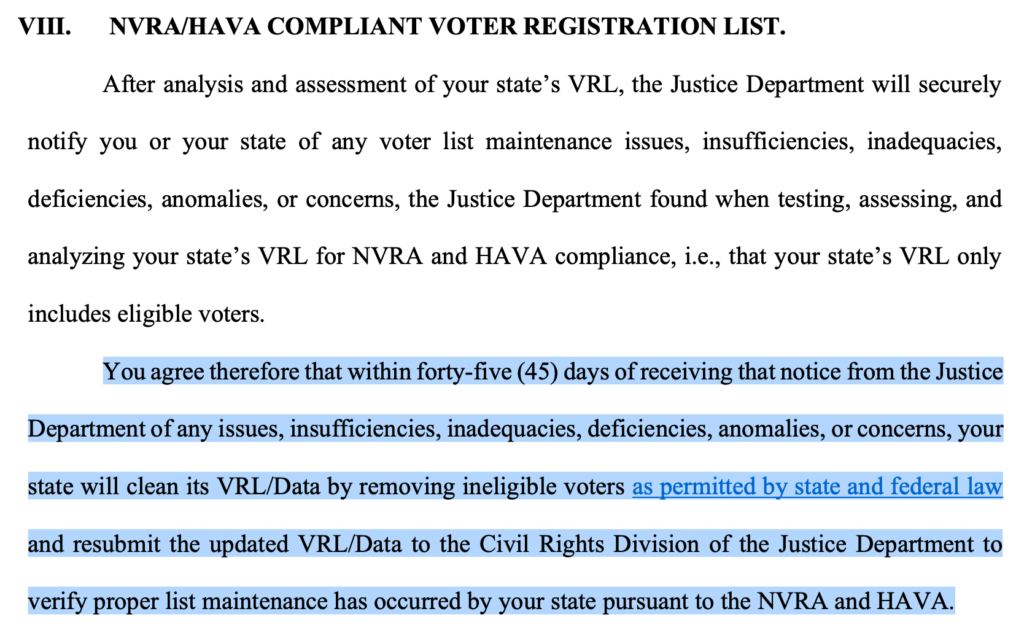
The language suggests DOJ is not just reviewing voter rolls, but attempting to identify problems and directing states, under deadline, to remove voters — a role critics say amounts to federal involvement in list maintenance.
“We heard twice that the DOJ does not want to engage in list maintenance,” one attorney for the pro-voting parties said during the hearing. “That is directly contradicted by the memorandum of understanding that DOJ has been proffering to various states.”
DOJ has consistently framed its nationwide push for voter data as routine oversight under federal law, arguing it is only assessing whether states are properly maintaining their rolls.
But the agreements indicate the department can flag “deficiencies” and require states to “clean” their data — including by removing voters — raising questions about how limited that role actually is.
DOJ is seeking unredacted voter data from nearly every state, including sensitive personal information, as part of that effort.
The issue surfaced during the New Mexico hearing, where district judge Judith Herrera pressed DOJ on whether it had provided a sufficient “basis” — a factual reason — for demanding the state’s data.
Unlike other hearings — where DOJ admitted it had no evidence of election officials failing to maintain their voter rolls — in New Mexico, DOJ pointed to patterns it said raised concerns, including low rates of duplicate registrations and voter removals.
The judge repeatedly questioned whether that amounted to a sufficient basis under the law.
“How did you meet the basis requirement? I’m looking at your letter … and it was a letter written by Ms. Dillon and I see on page two the purpose of this request is to ascertain New Mexico’s compliance with the list maintenance requirements of the NVRA and HAVA,” Herrera said. “I don’t see any reference … to the basis … Where would I find anything that suggests a concern with New Mexico’s compliance?”
Furthermore, across multiple lawsuits, DOJ has insisted it is not trying to “federalize” voter list maintenance, but pro-voting advocates also pointed to reports and statements by DOJ admitting they plan to share data with other agencies.
“DOJ, in their papers here, says that they will not use New Mexico’s list and the list from other states to create a national voter database. But just a few weeks ago, the President issued an executive order that requires states to create a list of confirmed citizen voters in every state, and directs the US Postal Service not to send any mail ballot to people who are not on that list,” one of the pro-voting parties said. “There’s also an inconsistent statement between the various reporting and between statements made in one court versus another, about whether there’s any reason to think that this information would actually be used as well for immigration enforcement purposes, as opposed to just compliance with these two federal election statutes.”
As courts continue to review DOJ’s statements and its agreements with states, the question on whether the department is simply evaluating voter rolls or positioning itself to influence who stays on them is becoming harder to ignore.
*The Elias Law Group (ELG) is representing the intervenor-defendants in the case. ELG Firm Chair Marc Elias is the founder of Democracy Docket.
Maya Bodinson contributed to this reporting