Georgia primaries: Will election deniers be running the state’s next presidential vote?
 Prefer us on Google
to see more of our voting rights news coverage when you search.
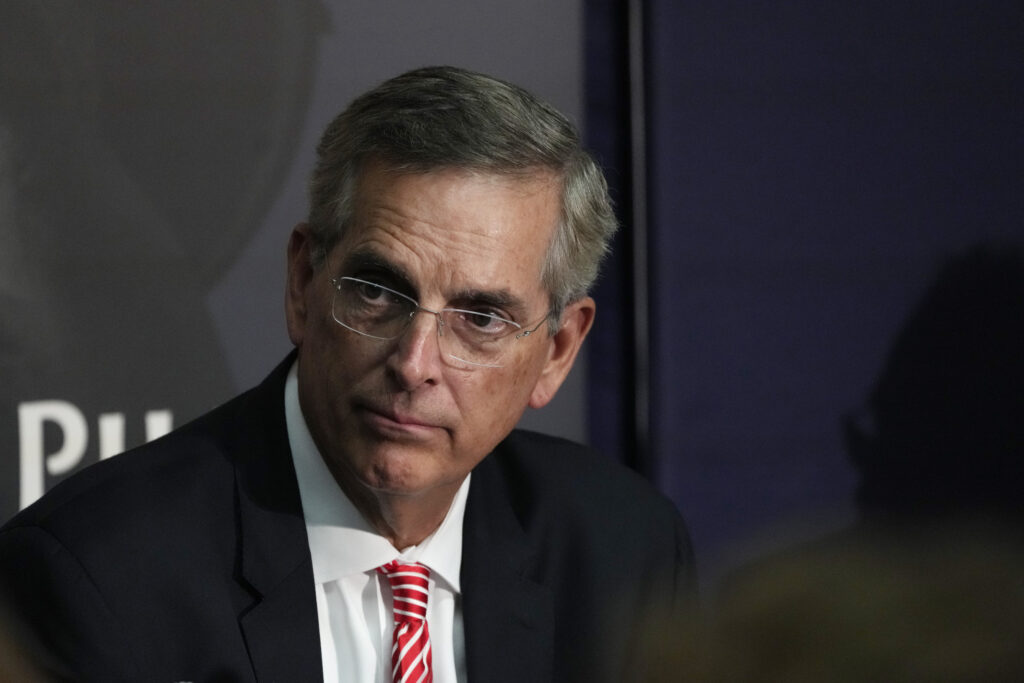
Tuesday’s GOP primaries for Georgia governor and secretary of state could help determine whether election deniers will be running elections in a key swing state in 2028 — potentially allowing them to restrict voting and put a thumb on the scale for Republicans.
The two top Republican governor candidates have both questioned or denied the 2020 election outcome — as have several of the GOPers fighting for the secretary of state nomination.
Get updates straight to your inbox — for free
Join 350,000 readers who rely on our daily and weekly newsletters for the latest in voting, elections and democracy.
Leading the polls in the race for the GOP governor nomination are two far-right candidates, Rick Jackson, a billionaire corporate executive, and Lt. Gov. Burt Jones. Jones carries President Donald Trump’s endorsement, while Jackson has been claiming in campaign ads that he is the true MAGA candidate.
Jackson, who is narrowly ahead in polling, has run ads attacking another candidate, Secretary of State Brad Raffensperger (R), for defying Trump’s effort to overturn 2020.
“That was totally ridiculous what happened in 2020 and our people really let us down,” Jackson has said when asked about the issue.
Jackson also has also spread falsehoods about Fulton County’s voter roll maintenance.
And Jackson pressured Gov. Brian Kemp (R) to schedule a special session to gerrymander the state’s congressional maps after the Supreme Court gutted the Voting Rights Act.
Jones, for his part, also pushed to redistrict Georgia in light of the Supreme Court’s ruling, and previously applauded the FBI seizure of Fulton County’s 2020 election ballots when it happened in January — part of a Trump administration probe into fictitious claims of voter fraud in the state.
At the time of the 2020 election, Jones was a state senator who joined the alternate slate of electors for Trump, in the effort to de-legitimize the certification of the vote for Biden.
Also running is Raffensperger, who famously stood up to Trump’s effort to pressure him to “find” the votes Trump needed to win Georgia in 2020, but also has been an aggressive advocate for restrictive voting policies.
The next governor could play a key role in the state’s gerrymandering push if it extends into next year. And they could have a major influence on voting access in the state, in 2028 and beyond.
In the Democratic primary, Keisha Lance Bottoms, the former Atlanta mayor and a staunch Trump opponent, is the favorite.
In the secretary of state race, Gabriel Sterling, a top Raffensperger aide who has backed his boss in standing up to Trump over 2020, is a leading candidate for the GOP nomination.
At least three of Sterling’s opponents are on the record as believing the 2020 election was either stolen or rife with fraud.
Among those is Vernon Jones, previously a Democrat, who now casts himself as a MAGA Republican. The former state lawmaker lists “ensuring only citizens vote” and “strengthening photo vote ID requirements” as two major components of his platform.
“I stand with those who believe there was election fraud,” he’s said of the 2020 election. During a recent debate, Jones questioned claims that there was no widespread fraud in that election, saying, “Well, people want to know how wide was the wide?”
The remaining candidates, state Rep. Tim Fleming and conservative activist Kelvin King, are both pushing to overhaul the state’s election system in more restrictive ways.
Fleming, the state legislature’s election procedures committee chair, is campaigning on stricter voter ID laws, deporting “any illegals attempting to vote in Georgia,” and making “it impossible for the Left to cheat in our elections.”
There remains no evidence that widespread fraud has occurred in Georgia or any other state.
King’s wife, Janelle King, is a GOP member of the state election board. The pro-voting group All Voting Is Local has deemed the board’s Republicans some of “the most dangerous election deniers” in the state.
Kelvin King said he thinks the 2020 election results are “still in question,” during a debate earlier this month.
“The bottom line is this: we haven’t had a clean election over the last several elections,” said King at the debate.
In fact, nearly a dozen investigations and audits conducted over the past few years have found no significant voting irregularities.
On the Democratic side, Fulton County Commissioner Dana Barrett, who has stood up to efforts by Republicans to advance false claims about voter fraud, is among the leading candidates. All of the major Democratic candidates have pledged to ensure free and fair elections.
Among the myriad voting issues the next secretary of state will have to contend with: Enforcing rules around access to election hubs, polling places and vote-counting centers. Amateur poll watchers in the state – many of whom are election conspiracists – have become more aggressive in their demands to observe the ballot counting process.
A bevy of Republican politicians and operatives sued Raffensperger Monday for access to his office to watch how today’s vote unfolds.