Trump administration makes it harder for some overseas voters to request a ballot
 Prefer us on Google
to see more of our voting rights news coverage when you search.
The Trump administration has quietly removed a key option from the federal form used by overseas voters to register and request mail ballots, eliminating a checkbox for U.S. citizens who were born and are living abroad.
It’s the latest step in an ongoing effort by the administration and the national GOP to make voting more difficult for — or in some cases, to outright disenfranchise — certain groups of overseas voters who are thought to support Democrats.
Get updates straight to your inbox — for free
Join 350,000 readers who rely on our daily and weekly newsletters for the latest in voting, elections and democracy.
The change affects the Federal Post Card Application (FPCA), a standard form used by military and overseas voters to register to vote from abroad, request absentee ballots and update contact information. The form is administered through the Federal Voting Assistance Program (FVAP) and is meant for absent uniformed service members, their families and U.S. citizens residing outside the country.
The previous version of the form asked voters to choose from several categories, including: “I am a U.S. citizen living outside the country, I have never lived in the United States.”
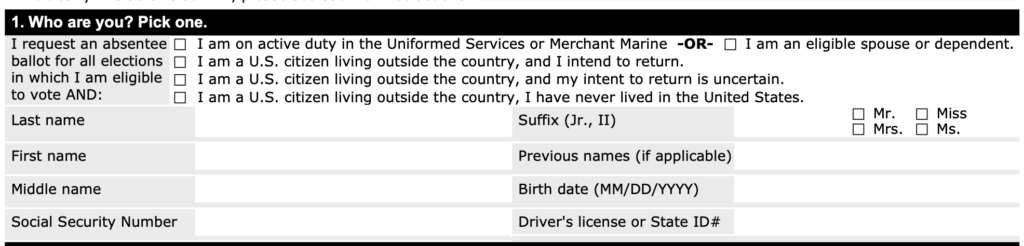
The revised August 2026 version removes that option entirely.
The new form still allows voters to identify themselves as active-duty uniformed service members or eligible spouses or dependents, U.S. citizens living outside the country who intend to return, or U.S. citizens living outside the country whose intent to return is uncertain. But it no longer includes a box for citizens abroad who have never lived in the United States.

The Department of Defense, referred to in the letters as the “Department of War,” sought emergency approval for the change in August, arguing in a letter to the Office of Management and Budget that the existing forms “may confuse voters” about what information they are required to provide under federal law and whether they are eligible to use the forms to register and vote.
The department said the next federal election was fewer than 90 days away, leaving “insufficient time” to modify the forms through the standard Paperwork Reduction Act process.
In its emergency justification letter, the department specifically identified the “never lived” checkbox as a line that would be removed “to avoid applicant confusion.”

“Individuals who are not in the uniformed services and who have never resided in the United States are not within the class of voters specifically defined by UOCAVA and therefore may not be able to use the FPCA or the FWAB,” the department wrote, referring to the Federal Write-In Absentee Ballot, a backup ballot for military and overseas voters.
But the revision could create new uncertainty for U.S. citizens born abroad who are eligible to vote under state law through a parent or other family connection to a state. While the Uniformed and Overseas Citizens Absentee Voting Act (UOCAVA) sets federal protections for military and overseas voters, states also determine voter eligibility rules and voting residence requirements.
That means some U.S. citizens who have never lived in the country are eligible to vote in certain states, even though the federal form no longer gives them a clear category to select.
The Department of Justice says UOCAVA requires states and territories to allow certain citizens to register and vote absentee in federal elections, including absent uniformed service members and overseas citizens. Most states and territories also have their own laws allowing UOCAVA-covered voters to register and vote absentee in state and local elections.
The revised form still tells voters to check their state’s guidelines at FVAP.gov. But by removing the “never lived” option, the form no longer plainly reflects the category of citizens born abroad who may be eligible in some states.
The change comes amid a broader fight over voting rights for U.S. citizens born abroad.
Republicans have filed lawsuits in several states challenging laws that allow some of these citizens to vote through family ties to a state. Those lawsuits are not the direct cause of the form change, but they target the same group of voters whose category has now been removed from the federal form.
The department said no new collection of information was being proposed and described the changes as “minor modifications” to existing forms.
The practical question now is how eligible U.S. citizens born and living abroad, and who can vote under state law, are supposed to complete a federal form that no longer names them.