Texas county Republicans sue to block election certification unless every ballot is hand counted
 Prefer us on Google
to see more of our voting rights news coverage when you search.
A Texas county Republican Party is asking a federal court to stop certification of the state’s upcoming election results unless officials first hand count every paper ballot in the state. The extraordinary request rests on speculative claims about artificial intelligence, foreign-made voting machine components and the possibility of undetected hacking.
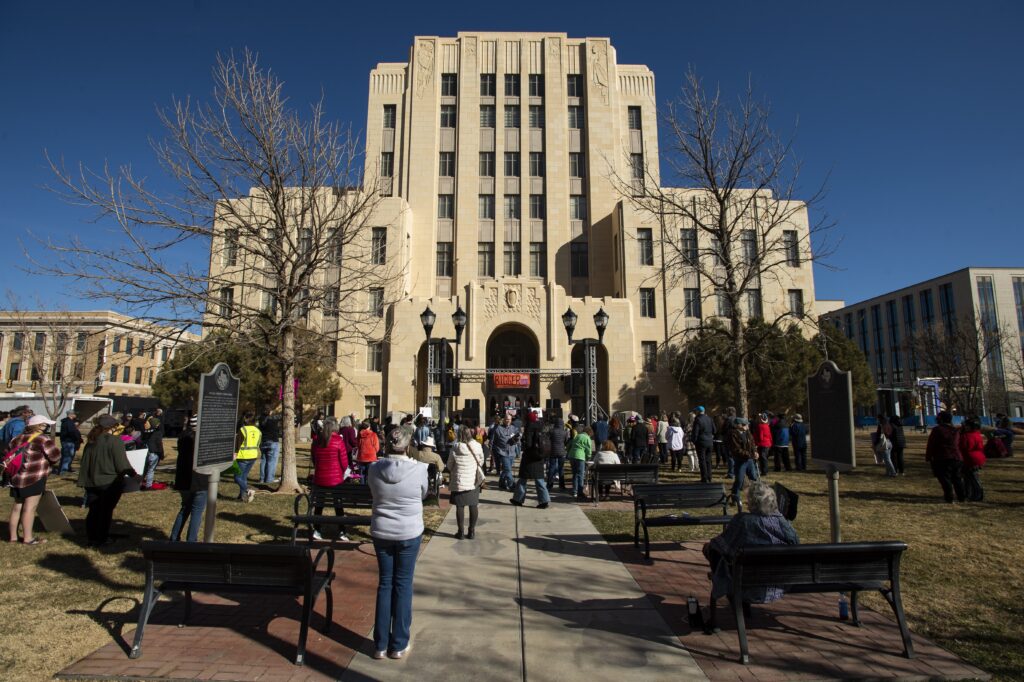
The Potter County Republican Party and its chairman, Daniel Rogers, filed a federal lawsuit Tuesday against Potter County Elections Administrator Christy Benge seeking to prevent certification of the Nov. 3 election until officials conduct a hand count of every paper ballot cast in every Texas precinct.
The case was filed in the Amarillo Division of the U.S. District Court for the Northern District of Texas, where it is assigned to U.S. District Judge Matthew Kacsmaryk, a Trump appointee who has presided over a series of high-profile conservative legal challenges.
Kacsmaryk was confirmed to the federal bench in 2019.
His Amarillo courtroom has drawn scrutiny over judge shopping because the division has historically allowed litigants filing there to reliably land before Kacsmaryk.
The lawsuit does not allege that voting machines in Potter County — or anywhere else in Texas — have actually changed votes. In fact, the plaintiffs explicitly concede that they are not claiming any previous Potter County election was altered or inaccurately reported.
Get updates straight to your inbox — for free
Join 350,000 readers who rely on our daily and weekly newsletters for the latest in voting, elections and democracy.
Instead, the 27-page complaint argues that the possibility of hacking, software errors and manipulation by increasingly sophisticated artificial intelligence makes Texas’ existing election safeguards constitutionally inadequate. The plaintiffs want the court to require a 100% statewide hand count before results for federal races can be certified.
The lawsuit attempts to turn a case against one county official into a statewide challenge by asking the court to certify a class of Texas county election administrators, with Benge serving as their representative.
“Plaintiffs do not seek to prevent voting, postpone Election Day, invalidate lawfully cast ballots, or require wholesale replacement of voting equipment before the November 3, 2026, general federal election,” the complaint says. “Plaintiffs do seek prospective relief directed to the post-election verification and certification process to confirm the accuracy of the Vote tabulation final counts by the election machines utilized by most jurisdictions in the State of Texas.”
In practice, however, the relief the Republicans are requesting would stop the normal certification process unless counties perform a new procedure that Texas law does not currently require: a complete hand count of paper ballots across the state.
Texas already requires post-election hand-count audits when electronic voting systems are used. The complaint acknowledges that requirement but argues the audit — which samples a portion of ballots — is insufficient.
The plaintiffs ground much of their case in cybersecurity concerns. They point to foreign-manufactured components in voting equipment, the potential for hostile actors to compromise election systems and what they describe as the ability of AI programs to infiltrate systems while concealing their activity.
Those claims lead to one of the lawsuit’s central weaknesses.
The complaint repeatedly moves from the existence of a theoretical vulnerability to the conclusion that Texas’ election procedures violate the U.S. Constitution.
The plaintiffs invoke the Fourteenth Amendment, claiming that certifying electronically tabulated results without a full hand count would violate voters’ due process and equal protection rights. But they identify no instance in which Rogers’ vote has been improperly counted and no compromised Texas machine that would affect him. Their alleged injury rests instead on what could happen if a machine were successfully hacked, if that hack altered votes and if existing safeguards failed to detect it.
The complaint itself acknowledges the lack of evidence of an actual miscount.
“The federal conditions do not, alone, establish with certainty that any particular Texas voting machine has miscounted votes in the past, nor do Plaintiffs allege that any past Potter County election results were altered, or inaccurately reported,” the plaintiffs wrote.
That concession could create a basic problem known as standing — the constitutional requirement that someone bringing a federal lawsuit show a concrete injury rather than a generalized fear that something might go wrong.
The requested remedy also goes far beyond some of the evidence the plaintiffs cite.
The complaint points to federal election security conditions that call for proof of a 5% manual audit for certain federal grant funding, then argues that the U.S. Constitution requires Texas officials to manually count 100% of the paper ballots before certification.
At the same time, the Republicans say they are not asking the court to invalidate any provision of the Texas Election Code. Instead, they want a federal judge to effectively impose an additional statewide election procedure on top of the system enacted under Texas law.
Their requested injunction would bar election officials from completing certification until “all paper election records or ballots in all precincts in Texas” have been hand counted. The plaintiffs also want the hand-count totals to determine the results if they differ from the electronic count.
The lawsuit was filed just seven days before Election Day, leaving the court to consider an extraordinary request to overhaul Texas’ post-election procedures on the eve of voting.