Supreme Court Asked to Decide If Citizens Can Still Enforce Voting Rights Act
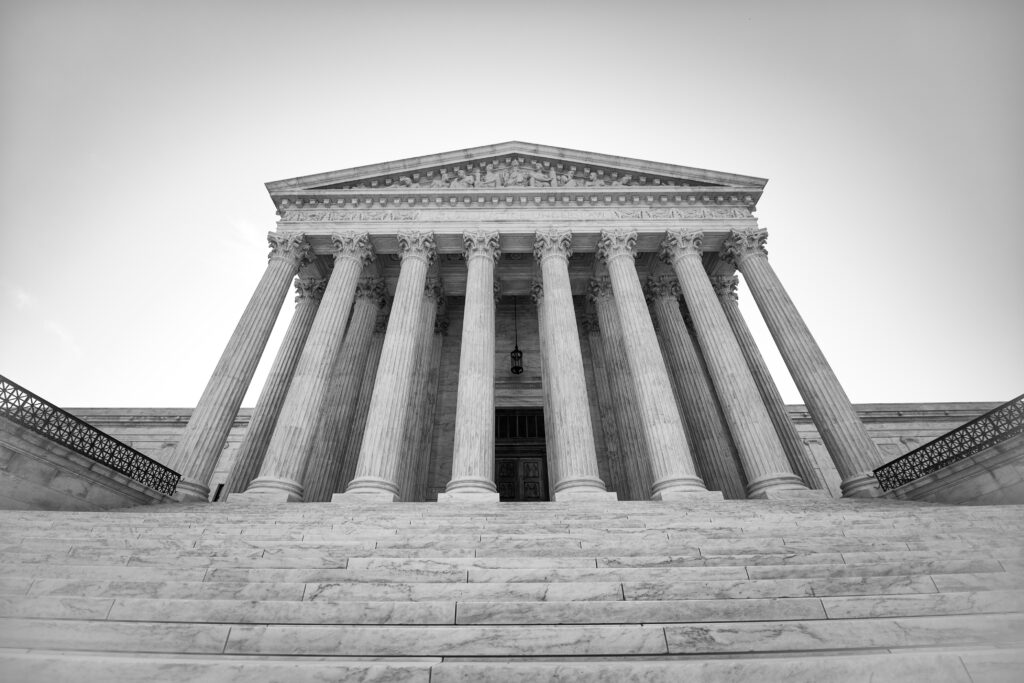
The U.S. Supreme Court is being asked to decide if citizens can still enforce the Voting Rights Act, after a federal appeals court ruled that only the government — not private citizens — can sue to enforce protections against racial discrimination in voting.
In a petition filed Tuesday, Native American voters and tribes urged the justices to overturn an Eighth Circuit Court of Appeals ruling that stripped voters and organizations of the ability to bring cases under Section 2 of the Voting Rights Act — the law’s core protection against racially discriminatory voting laws.
“Section 2 is, and always has been, enforced primarily by private litigants,” the petition argues. “Congress enacted the VRA to enforce the rights-creating guarantees of the Fourteenth and Fifteenth Amendments, and crafted Section 2 in explicitly rights-creating terms.”
The case stems from North Dakota’s 2021 redistricting plan, which “cracked” Native communities into multiple districts, diluting their voting power. A federal district court struck down the map under Section 2, but the appeals court reversed — not on the facts, but on the grounds that private plaintiffs cannot enforce Section 2 at all.
The petition notes that private plaintiffs have brought over 86% of all Section 2 cases since 1982 and argues the Department of Justice lacks the resources and capacity to replace that role.
The justices have already signaled the urgency of the case. In July, they temporarily paused the Eighth Circuit’s ruling from taking effect, keeping private enforcement alive in the seven states it covers — Arkansas, Iowa, Minnesota, Missouri, Nebraska, North Dakota and South Dakota — while the court decides whether to hear the case.
The filing also highlights the open circuit split. While the Eighth Circuit said only the federal government can enforce Section 2, every other federal court to address the issue — including the 5th, 6th and 11th Circuits — has ruled the opposite.
“Everywhere else in the nation, private plaintiffs can rely on an unbroken line of Supreme Court and circuit precedent to enforce the individual rights given to them by Congress in the Voting Rights Act,” the petition states. “The Eighth Circuit became the first and only court of appeals to hold that Section 2 is not privately enforceable.”
The petition further cites the Supreme Court’s own precedent, including Morse v. Republican Party of Virginia (1996), where it recognized Section 2 as enforceable by private plaintiffs.
If the Supreme Court upholds the Eighth Circuit’s ruling nationwide, it would mark the most significant rollback of voting rights since Shelby County v. Holder in 2013 — eliminating the main pathway voters and voting rights groups have used for decades to challenge gerrymanders and racially discriminatory voting laws.