New GOP lawsuit aims to restore Missouri’s gerrymandered map
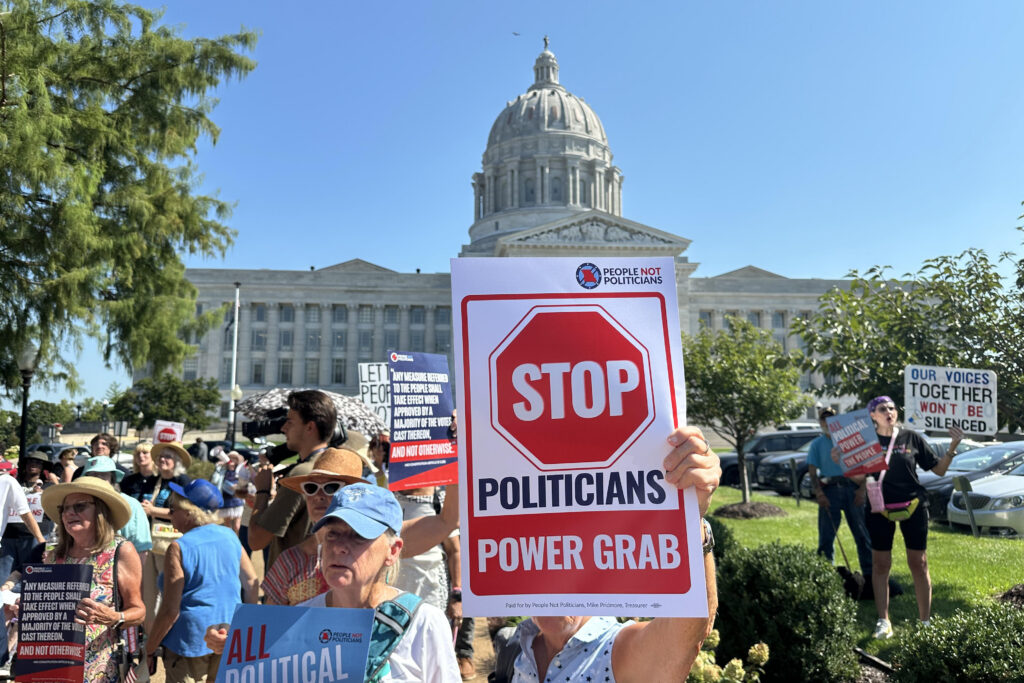
Missouri Republicans filed a new federal lawsuit Friday night aimed at reviving the state’s congressional gerrymander for the midterms.
The effort comes after the Missouri Supreme Court Thursday unanimously ruled that the gerrymander, which would give Republicans an additional seat in Congress, cannot go into effect unless approved by voters in a referendum this fall.
Get updates straight to your inbox — for free
Join 350,000 readers who rely on our daily and weekly newsletters for the latest in voting, elections and democracy.
“The entire State of Missouri has now been plunged into legal and electoral uncertainty over which Congressional maps govern Missouri’s 2026 general election and which candidates represent whom,” declares the lawsuit, filed by Rep. Bob Onder (R-Mo.) and a second Republican congressional candidate, as well as two voters,
The plaintiffs asked for a temporary restraining order and preliminary injunction to require that the gerrymandered map be used.
Separately, state officials asked the U.S. Supreme Court Friday night to stay Thursday’s ruling and reinstate the gerrymander.
The GOP gerrymander eliminated a majority-Black congressional district in Kansas City, which would have increased the GOP’s edge in the state’s congressional delegation from 6-2 to 7-1. It was part of President Donald Trump’s nationwide push for red states to redraw their maps to give his party an unearned advantage in the midterms.
Missouri’s constitution contains a “citizen veto” provision, which allows citizens to stop legislation from going into effect by gathering enough signatures to put a veto measure on the ballot. If that happens, the legislation must then be greenlit by voters.
Opponents of the gerrymander last year submitted enough signatures to block it from going into effect, and to put the veto measure on the ballot, the state Supreme Court ruled.
But the GOP lawsuit argues that the U.S. Constitution vests authority in state legislatures to set election rules — and that this isn’t undone simply by the state constitution’s citizen veto provision.
It’s a modified version of the Independent State Legislature Theory, a legal doctrine that has largely been rejected by the U.S. Supreme Court.
The lawsuit also notes that the primaries already were conducted under the gerrymandered map, so suspending the map could cause confusion for voters.
“As the Supreme Court has repeatedly recognized, ‘[l]ate judicial tinkering with election laws can lead to disruption and to unanticipated and unfair consequences for candidates, political parties, and voters.’”
That’s a reference to the “Purcell principle,” which counsels against courts making late changes to election rules, in order to avoid confusion for voters.
But Purcell has been applied only to late changes by federal courts, not state courts — something lawyers for GOP state officials acknowledged in their separate brief to the U.S. Supreme Court.
“Admittedly, this Court has not addressed whether the Purcell principle can ever independently justify a state court’s last-minute alteration to federal election rules,” they wrote. “However, the primary rationale underlying Purcell v. Gonalez (sic) —preventing chaos in a federal election —squarely fits this case.”