In Missouri and Texas, Republicans make opposite arguments on whether redistricting maps can change after a primary
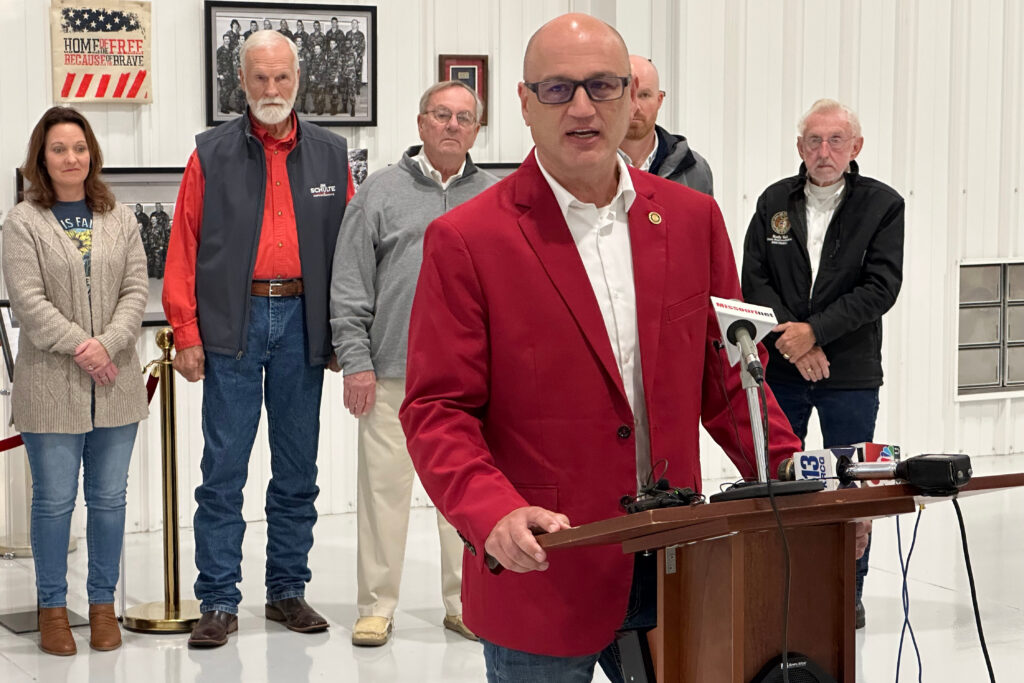
Texas and Missouri are serving up opposite arguments about the impacts of swapping election maps between their primaries and the midterms, but whether that’s allowable or a constitutional crisis depends on which state you’re in and whether Republicans will benefit.
Missouri’s GOP state officials say they are taking the extraordinary step of asking the U.S. Supreme Court to overrule a unanimous Missouri Supreme Court decision Thursday barring the state from using its newly gerrymandered congressional map for the upcoming election.
Missouri Attorney General Catherine Hanaway and other state GOP figures are crying foul, saying reverting to the original House of Representatives districts will be confusing for voters who will now see different candidates in the general election than they did in the primaries.
In Texas, it’s the opposite. There, the Republicans redrew local voting maps for Galveston County after the Supreme Court gutted the Voting Rights Act despite already holding the primary.
Get updates straight to your inbox — for free
Join 350,000 readers who rely on our daily and weekly newsletters for the latest in voting, elections and democracy.
A ‘crisis’ in Missouri
After the Missouri Supreme Court blocked the gerrymandered maps until after voters have a chance to hold their own veto referendum, Hanaway, who was appointed by Gov. Mike Kehoe (R), called the result “a full‑fledged constitutional crisis.” She has vowed to take the case to the U.S. Supreme Court.
It’s clear from the ruling that Missouri Supreme Court judges anticipated the meltdown Republicans are now having. In upholding voters’ right to veto the map, they also completely dismissed complaints from Missouri Secretary of State Denny Hoskins (R) claiming that it’s now too late to stop the state from using the new map in November.
They wrote that not only is that concern “irrelevant” to the legal question before the court, but “these arguments are particularly misplaced given the secretary’s delay created the confusion, expense, and practical difficulties of which he complains.”
People Not Politicians, the group leading the redistricting referendum effort, also pointed a finger squarely at Hoskins himself for the delays and obstructions that led to Missouri’s last-minute election confusion.
Richard von Glahn, executive director of People Not Politicians, told reporters Thursday the Missouri Supreme Court made it “abundantly clear” in its prior ruling in May that Hoskins would be taking on this exact risk if he ordered local election officials to use the new map in the primary.
“The judges are fully aware that the secretary of state attempted to create chaos and confusion through delay,” von Glahn said. “But delay does not change Missourians’ constitutional rights.”
That hasn’t stopped Hoskins from complaining that the state is now in “nothing short of a Constitutional crisis.”
As they press forward with their fight to get the ruling overturned, Missouri Republicans are coalescing around the argument that the state can’t run the primary and November elections under different maps.
“The Missouri Supreme Court just invalidated the meaning of the August primary,” state Sen. Rick Brattin, the Republican running for the congressional seat at the center of the gerrymander fight, argued in a social media post Thursday. “No American court has ever flipped congressional lines after a primary and before the general. Voters were asked to vote in one district in August and another in November.”
An attorney representing the Republican National Committee (RNC) stressed the same point during oral arguments earlier this week, telling the Missouri Supreme Court that changing the map now would sow “confusion among the electorate” and “erode public confidence in the integrity of the state’s elections.”
The RNC said in a statement Thursday that it is “evaluating every option to challenge this decision.”
An opportunity in Texas
As Missouri Republicans sort out their self-made, self-proclaimed “constitutional crisis,” Republicans in Texas are arguing the exact opposite: They insist they can redraw district boundaries when and how they see fit.
Pro-voting advocates are asking the Texas Supreme Court to block Galveston County’s 11th-hour move to change local district maps between the primary and November elections.
The fight has statewide consequences. If the Texas Supreme Court sides with Galveston County, it would greenlight a new, unprecedented partisan strategy that could be copied across the state to undermine the will of the voters, emboldening other Texas jurisdictions to tweak election maps based on primary results.
Not only that, but the broader GOP interest in the boundary-pushing strategy is clear: The county is represented by the Public Interest Legal Foundation, a leading anti-voting law firm based in Washington D.C., that files voter roll purge cases across the country.
Galveston officials have made no secret of their partisan reasons for changing the maps at the last minute, arguing in a recent legal brief: “Practically, there are many reasons why a county’s commissioners may adopt changed precinct boundaries between a primary and general election. They may want to increase partisan performance (as here), address new laws, or comply with population requirements.”
Notably, the county did not offer any comparable example of a court ever allowing officials to switch a voting map after the primary.
So far, a Texas appeals court has denied the emergency effort to stop the map change. With the arguments now fully briefed at the Texas Supreme Court, a final decision could come at any time.