New Details Emerge in Federal Court About Texas’ Secretive Redistricting Map
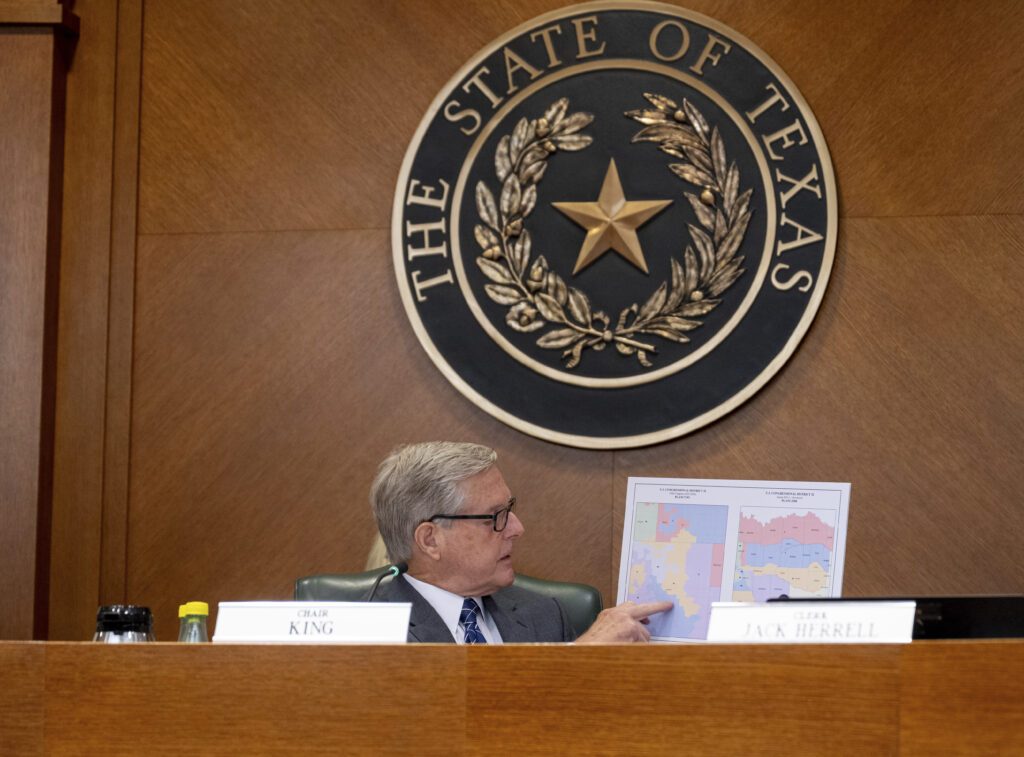
EL PASO, TEXAS — The Texas Senate redistricting committee chair repeatedly told Democratic lawmakers this summer he didn’t know who drew the state’s new congressional map, while Texas House members held public hearings to gather feedback on a map Republicans hadn’t released yet and provided no details about.
In federal court Thursday, information about the secretive process started to come into focus as Republican leadership filled in some of the blanks.
Texas Republicans passed the new map in a rushed redistricting process, refusing to answer basic questions from Democratic lawmakers and the public, such as who drew the map and when it would be released.
Minority voters* and voting advocates are asking a federal court to block the state from using the new map in the 2026 election, saying it’s a racial gerrymander that discriminates against minority Texans. State attorneys are defending the map, arguing it was drawn only for partisan gain.
State Sen. Phil King (R), who led the Senate’s redistricting committee, began his testimony Tuesday, but due to scheduling conflicts he returned Thursday for more questioning.
In between King’s days in court, the judges heard testimony from state Sen. Adam Hinojosa (R) and Adam Kincaid, who drew the new Texas map and serves as director of the National Republican Redistricting Trust. Kincaid revealed Tuesday he was hired by the Republican National Committee (RNC) to draw the Texas map.
By the time King returned to the stand, some inconsistencies had appeared.
One of the few insights into the state’s new map came when King previously testified he ran into Kincaid at a conference in mid-July and said he told Kincaid not to tell him anything about the map. Later, in Kincaid’s telling, King did, in fact, ask him about the map – he asked Kincaid whether the GOP could really pick up five seats in Congress, and Kincaid testified he said yes.
It turned out they weren’t the only ones talking about the map. Hinojosa testified he, too, was part of that conversation with King and Kincaid – but when asked what they discussed, he wouldn’t answer, claiming the information was privileged.
When King was asked Thursday if anyone else was part of the conversation he had with Kincaid, he said evasively, “There might have been someone else.” And when pressed about Kincaid’s claim that King asked about picking up seats, he responded: “It’s either incorrect or I am recalling it incorrectly.”
Attorneys for the plaintiffs showed the court video clips from the legislative special sessions of House and Senate Republicans evading questions.
State Rep. Todd Hunter (R), the author of the redistricting bill, wasn’t on the state’s list of witnesses. But in a video clip from Aug. 1, he told Democrats that Kincaid wasn’t the map-drawer. In another clip, King told Democrats – after he met with Kincaid – he didn’t know who drew the map. In a third clip, state Rep. Cody Vasut, the House redistricting committee chair, was asked at a July 26 hearing whether the map had been provided to him. He said no.
Kincaid testified this week he sent the map to the Texas Legislature three days before the hearing.
King’s evasive answers Thursday appeared to frustrate attorneys and the court. U.S. Circuit Judge Jerry Smith – one of three judges hearing the case – jumped in during questioning to demand King respond with yes or no answers.
Chad Dunn, an attorney for the plaintiffs, asked King, “Are you familiar with the concept of willful blindness?”
King said, “No.”
*Some Texas voters are represented by the Elias Law Group (ELG). ELG firm chair Marc Elias is the founder of Democracy Docket.