Missouri redistricting opponents file new lawsuit aimed at blocking GOP map for 2026 election
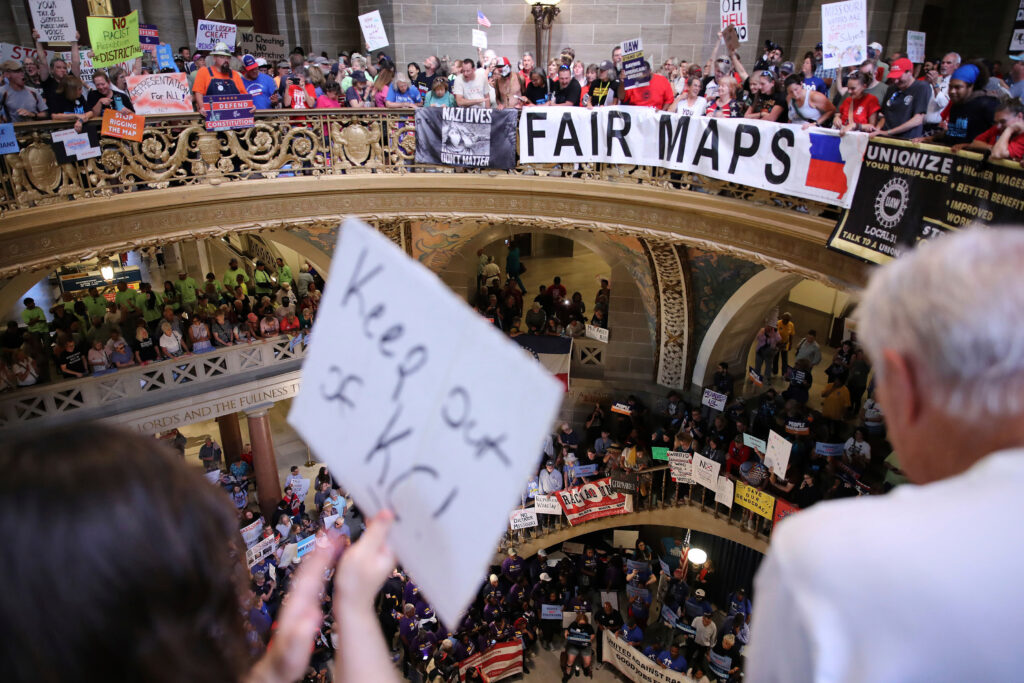
After months of legal battles, Missouri redistricting opponents are asking a court to stop state officials from using delay tactics to put a new gerrymander in place for the 2026 midterms.
Missouri’s GOP-controlled legislature passed a new map last year designed to dismantle a Kansas City district represented by a Democrat. The move was part of President Donald Trump’s national mid-decade redistricting push to keep Congress under Republican control after the 2026 elections.
Voters fought back, gathering more than 300,000 signatures to put the map to a statewide referendum vote. But Republican state officials are still on track to use the disputed map in 2026 even though voters have not yet had the opportunity to hold the referendum.
Now, referendum supporters are demanding a court intervene, accusing the state’s top election official of deliberately dragging his feet.
Get updates straight to your inbox — for free
Join 350,000 readers who rely on our daily and weekly newsletters for the latest in voting, elections and democracy.
“Local election officials on both sides of the political spectrum have requested Defendant [Secretary of State Denny] Hoskins to promptly issue a certification under Section 116.150, so the courts can conclusively determine what congressional districts will govern the 2026 elections and prevent electoral chaos,” People Not Politicians, the group leading the referendum effort, argued in its petition filed Monday.
In December, the organization turned in nearly three times the amount of petition signatures required to hold a referendum. Historically, at that point, Missouri officials have paused the legislation challenged by voters from going into effect until they have the chance to hold a referendum.
However, Hoskins, an elected Republican, reversed that precedent, arguing the map is not suspended until after the signatures have been verified and his office certifies the referendum — although whether he will, in fact, certify or reject it remains uncertain.
It has been nearly two months since local election officials verified enough signatures to qualify the measure for the ballot. But Hoskins plans to delay up until the Aug. 4 legal deadline — the same day the state holds its primary elections.
Last week, the Missouri Supreme Court unanimously ruled — less than six hours after hearing oral arguments — that filing the petition signatures did not automatically suspend the map.
The court also concluded that, because the secretary’s certification process is still ongoing, “it is impossible to say as of this opinion” whether the gerrymandered map is in effect.
Local election officials appear uncertain how to proceed, given this confusing guidance from the court.
Brianna Lennon, the county clerk for Boone County, has said she won’t update voter lists to match the new gerrymander until Hoskins either certifies or rejects the referendum.
Lennon previously filed an amicus brief with the Missouri Supreme Court, arguing local election officials need a clear answer on which map is in effect.
“Allowing the August primary to be conducted using districts that are likely to be stayed upon the referendum’s certification — which could occur a matter of weeks before the August primary — will result in chaos, confusion, and unnecessary expense,” she wrote.
Lennon isn’t the only Missouri election official asking Hoskins to hurry.
“We need the secretary of state to make a decision so the courts would give us a decision on which map is in effect,” St. Charles County elections director Kurt Bahr told the Columbia Missourian. “We don’t want to have confusion as well as a potential lawsuit if we are going from one election to another election with a different map.”
Missouri Attorney General Catherine Hanaway has threatened legal action against local officials like Lennon who won’t immediately implement the new gerrymander before certification is complete.
“Public officials who choose to ignore state law will be held accountable and could be subject to civil and criminal liability,” Hanaway said in a social media post.
In its latest court filing, People Not Politicians pushed back on Hanaway’s threat, arguing: “The Supreme Court did not say anything about whether election officials should enforce [the map] and, to the contrary, made clear it is impossible to say whether [the map] is even in effect.”
The group went on to argue that, if state officials bully local officials into running elections using a map that is later conclusively suspended, it will result in an “invalid election.”
However, even If Hoskins were to expedite the process, it remains unclear what the outcome would be: He has the ability to either certify the petition or reject it, irrespective of the number of signatures.
Republican state officials previously filed a federal lawsuit arguing the referendum violated the Missouri and U.S. constitutions. A judge dismissed the case, in part because he concluded Hoskins had the power to block the referendum on his own by declaring it unconstitutional and refusing to certify it.
If Hoskins rejects the referendum, it would open the door for yet another legal challenge — further delaying a conclusive answer on whether Missouri voters will get to exercise their state constitutional right to weigh in on the gerrymander.