California Supreme Court orders GOP sheriff to return seized ballots, affirms state’s power over local law enforcement
 Prefer us on Google
to see more of our voting rights news coverage when you search.
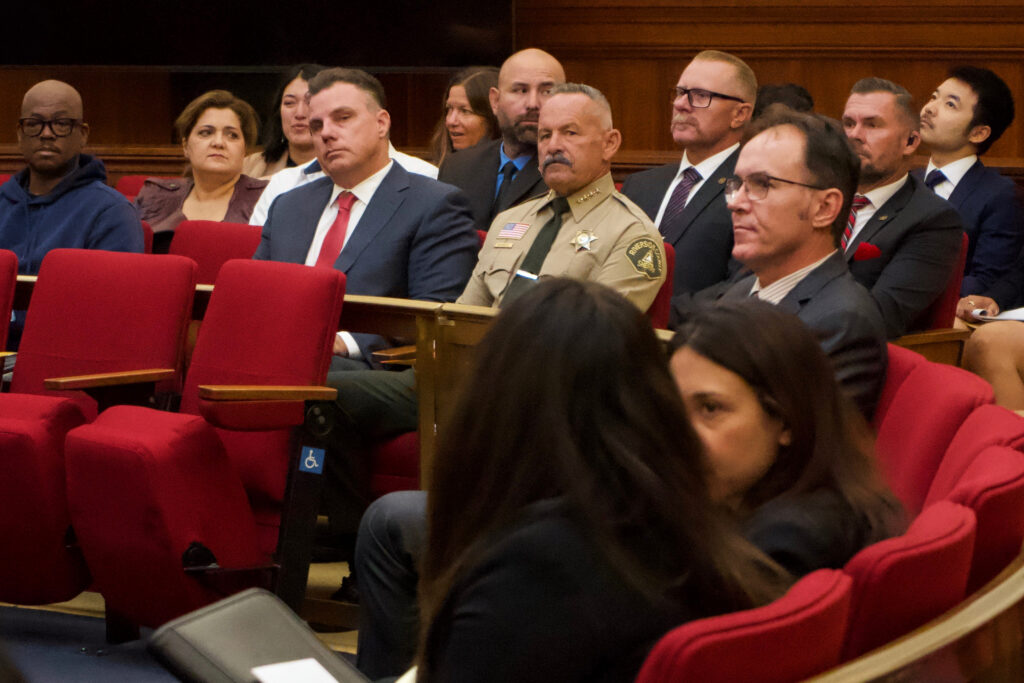
The California Supreme Court ruled Thursday that Riverside County Sheriff Chad Bianco (R) violated state law when he seized roughly 650,000 ballots from last year’s special redistricting election after pursuing debunked claims of a massive ballot discrepancy.
In a companion case brought by California Attorney General Rob Bonta (D), the court also unanimously rejected Bianco’s argument that the state’s chief law enforcement officer lacks authority to issue binding directions governing a county sheriff’s investigation.
The twin rulings stand to make it significantly harder for local law enforcement to create election chaos and use unsubstantiated fraud claims to seize ballots outside California’s established election procedures. It also reinforces the Golden State’s authority to intervene when a local elected official attempts to take control of election materials.
Get updates straight to your inbox — for free
Join 350,000 readers who rely on our daily and weekly newsletters for the latest in voting, elections and democracy.
Writing for the court, Chief Justice Patricia Guerrero held that Bianco’s seizure violated the “plain language” of the California Elections Code, which commands that “[i]n no event” may voted ballots be taken from the custody of an elections official. The court made clear that the protection applies even during a criminal investigation.
“We conclude that the authority vested in the Attorney General under the state Constitution and the Government Code includes the power to give binding directions to sheriffs regarding a particular investigation that are consistent with the Attorney General’s duty ‘to see that the laws of the State are uniformly and adequately enforced,’” Guerrero wrote. “To remedy this violation, we issue a peremptory writ of mandate directing Bianco to return the seized ballots to the registrar’s custody and to refrain from further handling of the ballots except as necessary to comply with our order.”
The court ordered Bianco to return all packages containing voted ballots to Riverside County Registrar of Voters Art Tinoco “forthwith.”
“In sum, the Elections Code contemplates that voted ballots remain in the continuous custody and control of elections officials from the moment the voter deposits them until the moment they are destroyed, Guerrero wrote.
The justices stressed that California law already provides established mechanisms for investigating allegations of election misconduct “that do not compromise the integrity of voted ballots — contrary to the means employed here.”
The ruling caps an extraordinary legal battle that began after Bianco obtained search warrants and seized roughly 1,000 boxes containing ballots cast in Riverside County’s November 2025 election on Proposition 50.
The California Supreme Court later halted Bianco’s efforts while it considered two challenges to the seizure.
At oral argument in August, the justices repeatedly tested the limits of Bianco’s fringe legal theories. One justice asked whether his expansive view of search-warrant authority could allow a sheriff to seize mail ballots before Election Day.
Another called a consequence of his interpretation of California’s ballot custody law “bizarre.”
The questioning grew even more pointed in the case brought by Bonta. When a justice asked whether the attorney general could stop a hypothetical sheriff who openly admitted targeting a political adversary as “payback,” Bianco’s attorney said no.
The justices also pressed his lawyer to explain how the state attorney general could be California’s “chief law officer” with “direct supervision” over sheriffs while lacking authority to order one to stop.
Bianco’s seizure stemmed from right-wing claims that Riverside County had counted roughly 46,000 more ballots than it received. County election officials said those allegations arose from activists’ misunderstanding of unofficial handwritten intake records and reported that the official ballot-tracking system differed from the final count by just 103 ballots.
In a final indignity for Bianco’s legal defense, the court used a footnote to rebuke his lawyers over AI-assisted errors in an earlier filing.
The justice said counsel had relied on a misquoted passage and an incorrect description of a prior ruling. She wrote that she “disapprove[d] of the improper use of artificial intelligence tools” that apparently contributed to the mistake, and was referring the matter to the State Bar of California to determine whether discipline is warranted.