U.S. attorney’s legal threats against Democrats are ‘meritless’ attempts to chill free speech, experts say
 Prefer us on Google
to see more of our voting rights news coverage when you search.
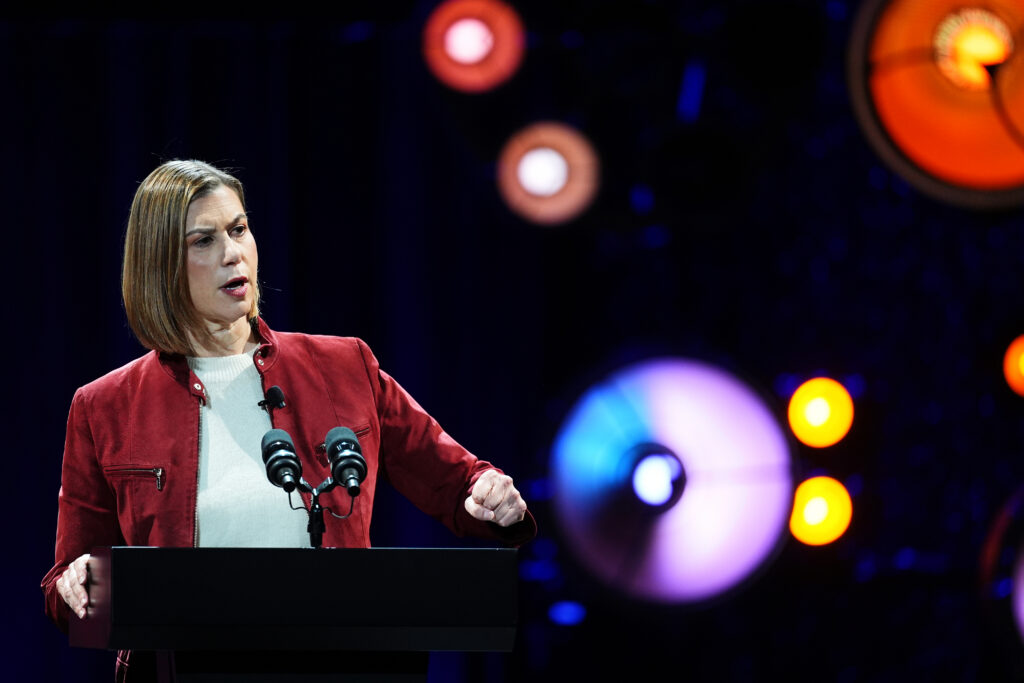
A day after publicly threatening one Democratic senator, U.S. Attorney Aaron Reitz went after another Thursday, warning Sen. Elissa Slotkin (D-Mich.) to preserve documents related to her public comments promising to “go hard on accountability.”
Reitz called those statements an attempt at “terrorizing” President Donald Trump’s supporters “with aggressive, harassing governmental action.”
“Your comments reflect soon-to-be-realized fantasies about weaponizing congressional investigations for the purpose of personal aggrandizement and punishment of people close to the President,” the U.S. attorney for the Southern District of Texas wrote. “In other words, your ‘oversight’ plans seem to have no legitimate legislative purpose and may therefore be unlawful.”
But congressional oversight and legal experts say Reitz’s letters to Slotkin and Sen. Richard Blumenthal (D-Conn.) make specious legal arguments that ignore the Constitution’s robust protections for political speech. Instead, they appear aimed at scaring the incoming Democratic majority out of investigating the Trump administration next year, the experts said.
In the letters, Reitz cites two statutes that criminalize attempts to deprive an individual of their constitutional rights through conspiracy or governmental action under the “color of law.”
“It’s a total misapplication of that law,” said Jenny Carroll, a criminal law and civil rights professor at Texas A&M University. “Ironically, those laws were really designed to protect citizens, like private citizens who were being abused by state actors.”
Get updates straight to your inbox — for free
Join 350,000 readers who rely on our daily and weekly newsletters for the latest in voting, elections and democracy.
“This is straight out of this Department of Justice’s playbook,” Carroll added. “They’re taking laws that were designed to protect marginalized people and designed to prevent abuses of state power against individual citizens, and they’re flipping it and using it to basically address anyone who is in disagreement with them, and that is not what those laws were designed to do.”
Notably, Reitz posted both letters on social media. And Slotkin’s letter went online before she received it, her office told Democracy Docket, suggesting that Reitz is more interested here in gaining publicity than winning a prosecution.
In his warnings, Reitz parroted a missive recently sent by White House Counsel William O. Scharf to Rep. Robert Garcia (D-Calif.), the incoming House Oversight Committee chair. While Scharf warned that Democrats’ pledges to hold the administration accountable could “cross the line into blatant criminality,” he did not cite any specific federal statutes that would support that assertion.
“These letters are meritless,” said Tim Stretton, director of the Congressional Oversight Initiative at Project On Government Oversight. “It completely flies in the face of the [Constitution’s] speech and debate clause. This is — very much — protected activity that these members of Congress are doing.”
Even if you take a narrow reading of that constitutional provision, which protects lawmakers from being “questioned” over “any Speech or Debate in either House,” Reitz’s investigations would still run into 1st Amendment issues.
“I think you’d be hard-pressed not to say this is protected speech,” Carroll said, noting that as a candidate, Trump repeatedly promised to lock up Hillary Clinton without triggering any criminal investigation.
Congress’ powers to investigate and oversee the executive branch are extremely broad, justifying subpoenas and hearings into nearly anything — provided that they further a “valid legislative purpose,” as the U.S. Supreme Court held in a 2020 decision. But the administration has no basis to make preemptive claims that lawmakers risk abusing those powers, Stretton said.
“There are legitimate constitutional limits on congressional oversight investigations, but those limits cannot be used as a blanket excuse for the executive branch to obstruct oversight,” said Stretton. “Investigating potential conflicts of interest or misuse of government authority is precisely the kind of work Congress is empowered to do.”
The real goal of the Reitz and Scharf letters isn’t to put Democratic lawmakers on notice of legitimate federal investigations, Stretton and Carroll both noted. Rather, “they’re designed to have a chilling effect,” Carroll said.
“This is an old trick, right?” Carroll said. “These investigation letters… are just designed to get someone to alter their behavior based on the threat of what could happen if they don’t.”
But rather than chilling the Democrats’ fervor to investigate, Reitz, a former staffer for Sen. Ted Cruz (R-Texas), appears to have only fanned their flames.
“The implied threat of an investigation is baseless,” Blumenthal said in a social media post. “As incoming Chair of the Permanent Subcommittee on Investigations, I will not be intimidated.”
A few days after the midterm elections saw Democrats win control of both chambers of Congress by historic margins, Trump took to Truth Social to order Attorney General Todd Blanche to investigate Democrats for promising oversight. His post called Slotkin out by name. Since then, Blanche has repeatedly suggested the DOJ would prosecute Democrats over their public statements.
The DOJ tried to indict Slotkin and five other Democratic lawmakers last year for sedition after they made a video telling members of the U.S. military that they could refuse to carry out illegal orders. But a grand jury refused to grant prosecutors an indictment.