Kansas GOP scheme could cancel election in bid to weaken voters’ power to elect U.S. senators
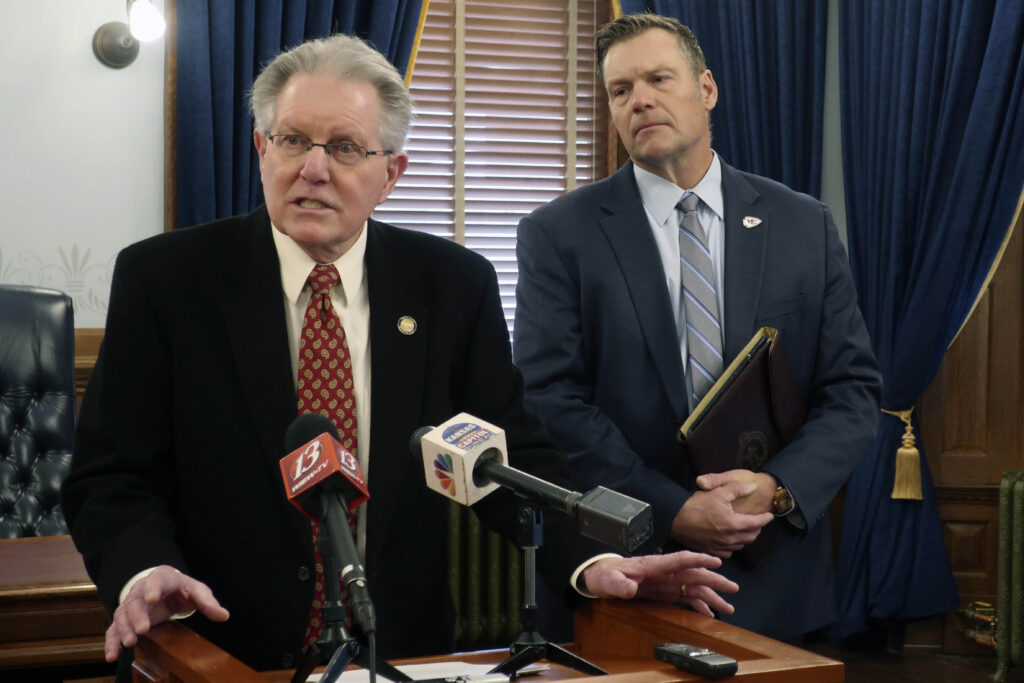
Kansas Republicans are facing growing scrutiny over a potential scheme that could deny voters a say in this year’s U.S. Senate race and let GOP state lawmakers silence voters’ voices on who represents them in Washington.
It comes as GOP lawmakers in the U.S. Congress introduced a stunningly anti-democratic measure Thursday that would let states end the direct election of senators, returning that power to state legislatures.
Get updates straight to your inbox — for free
Join 350,000 readers who rely on our daily and weekly newsletters for the latest in voting, elections and democracy.
The alarm in Kansas centers on U.S. Sen. Roger Marshall (R-Kan.), who is up for reelection this year, and a 2025 GOP-backed law that changed how Kansas fills U.S. Senate vacancies.
Marshall says he’s running, and Republicans deny any plan to replace him. But if his seat opened before Election Day, critics warn the new law could let partisan state officials steer the replacement process and leave voters waiting until 2028 to choose a senator.
The Republican architect of the law, state Sen. Mike Thompson, has called the 17th Amendment — the constitutional amendment that gives voters the power to directly elect U.S. senators — “a big mistake,” echoing a broader GOP push to shift power away from voters and back to state legislatures.
Under the 2025 law, Senate Bill 105 (SB 105), if Marshall were to resign before Oct. 2, Republicans in the Kansas legislature would control the process for choosing his successor and voters would not get to elect a senator until 2028.
That would be a stunning outcome in a state where voters are already preparing for a Senate election this year.
Since 1927, Kansas governors have had broad power to temporarily fill vacant U.S. Senate seats. But the 2025 law took that power away from the governor and handed state lawmakers more influence over the process.
Instead of allowing the governor to freely choose a temporary replacement, the law requires the governor to pick from three names produced through a Legislature-driven process.
Because Republicans control the Kansas legislature, the law gives GOP lawmakers a major role in deciding who could fill a vacant Senate seat — even while Democratic Gov. Laura Kelly (D) remains in office.
The law also includes language that critics say could delay the next election for the seat until 2028 if the vacancy occurs during a key election-year window.
In a Kansas Senate committee hearing last year, a legislative attorney described that possibility directly.
“If the vacancy were to occur, for example, in July of 2026, the election to permanently fill the Senate vacancy would not occur until 2028,” Revisor Jason Long told lawmakers.
Marshall’s office has denied that he plans to leave the Senate.
But Thompson, who introduced the bill, told The Kansas City Star that rumors about Marshall’s political future helped prompt the legislation.
“We had heard that there was potential that Sen. Marshall was going to be appointed to a position, but we weren’t a hundred percent sure,” Thompson said. “But we thought it would be time to review that process of filling a vacancy for that seat.”
Kelly blasted the scenario as an attack on voters.
“It seems the only way any one of these three can win is by colluding to cheat,” Kelly said. “Kansans should be insulted that Ty Masterson, Jeff Colyer and Roger Marshall think they can get away with their ludicrous scheme to hijack political power for themselves. What they are doing is pathetic and downright embarrassing.”
Republicans have dismissed the concerns as alarmist.
Danedri Herbert, chair of the Kansas Republican Party, called SB 105 a “straightforward law” about “routine statutory mechanics,”
But Thompson’s own comments have fueled fears that the law is part of a larger Republican attack on direct Senate elections.
“These big Senate seats have become national elections because there’s money coming in all over the place,” Thompson said. “That’s why the founders wanted the senators to be appointed. Because they were a lot more accountable to the state legislature, which is accountable to the people.”
The 17th Amendment was ratified in 1913 after the old system of state legislatures choosing senators produced corruption, deadlocks and backroom deals. The amendment gave voters the power to elect senators directly.
Now, more than a century later, Republicans are openly reviving the idea that state lawmakers should take that power back.
On Thursday, U.S. Rep. Keith Self (R-Texas) introduced a resolution to repeal the 17th Amendment and return the selection of U.S. senators to state legislatures.
“The current system has given us six-year politicians more focused on national ambitions and the institution of the U.S. Senate than on the states they serve,” Self said. “Our Founding Fathers designed the Senate to protect state sovereignty and act as a check on federal overreach. If senators are supposed to represent their states, then the states should choose them.”
Self’s proposal is unlikely to become law anytime soon. Repealing a constitutional amendment would require overwhelming support in Congress and across the states.
But the Kansas controversy shows how the same anti-democratic idea can surface in state law without formally repealing the 17th Amendment.