In multiple red states, direct democracy is on the ballot this midterm
 Prefer us on Google
to see more of our voting rights news coverage when you search.
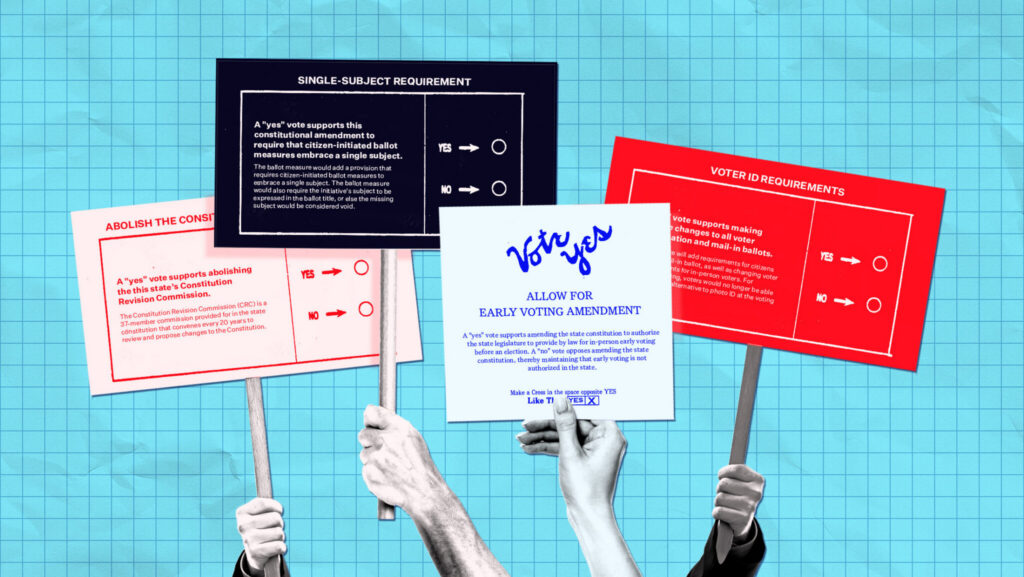
With early and mail voting underway, some voters are being asked to decide the future of direct democracy in their states.
In three red states — North Dakota, South Dakota and Utah — legislators have placed amendments on the ballot that would make it far harder for voters to pass citizen-led initiatives. It’s part of a wave of Republican-led states that have moved to gut the direct democracy process in recent years.
Meanwhile, in two other GOP-led states, Missouri and Montana, voters are pushing back against that same trend. Voters in those states will weigh in on ballot measures that would enshrine the initiative process as a right in their state constitutions.
Get updates straight to your inbox — for free
Join 350,000 readers who rely on our daily and weekly newsletters for the latest in voting, elections and democracy.
States’ rules for ballot initiatives vary, but many states allow citizens to place them on the ballot after gathering enough signatures. Some states also let lawmakers put them on the ballot by passing legislation to do so. In some cases, it’s a way not just to change the law but to amend the state constitution.
In recent years, red-state voters have used the initiative process to approve a series of measures opposed by Republican lawmakers: ending partisan gerrymandering, raising the minimum wage, and protecting reproductive rights.
That’s led the GOP to push back by changing the rules in order to restrict direct democracy.
“There have been so many different issues over the last decade where the people have been able to use the tool to make real progress and real change,” Chris Melody Fields Figueredo, executive director of the Ballot Initiative Strategy Center, told Democracy Docket. “What we’re seeing is, extremist lawmakers can’t win fairly, and so they’re trying to change the rules and move the goalposts to make it harder for the will of the people to be respected.”
Fields Figueredo said from her organization’s perspective, these attacks on direct democracy and efforts to subvert the will of the people are part of “rising authoritarianism.”
“For us, fighting for our right to direct democracy is more important than ever,” Fields Figueredo said.
Two states fight to keep direct democracy
After Missouri and Montana voters used direct democracy to legalize marijuana and another initiative enshrined the right to abortion, the legislatures sought to restrict ballot measures.
Montana changed the rules for gathering signatures for citizen-led initiatives, now requiring paid signature gatherers to introduce themselves with a specific script or risk their collected signatures being thrown out.
Missouri lawmakers tried to drastically raise the threshold for passing ballot initiatives — attempting to require future citizen- and legislator-led measures to win a majority in all of the state’s congressional districts as opposed to a statewide majority. Missouri voters overwhelmingly rejected that measure in August.
Now Missouri and Montana voters can avoid future attacks on the people’s power by adding the right to propose initiatives to their constitutions with Missouri Amendment 6 and Montana Constitutional Initiative Number 133.
Fields Figueredo said these kinds of protections are critical to ensure the voice of the people continues to be heard in the current political landscape.
“In a time where people feel incredibly disenchanted or disconnected from democracy and government, ballot initiatives allow the people to directly engage and make those tangible impacts on their day-to-day lives,” Fields Figueredo said.
Two states try to make it harder to alter constitutions
In North and South Dakota, lawmakers are asking voters to consider amendments that would make it harder to approve state constitutional amendments. If passed, the amendments would require all future constitutional amendments to receive a supermajority — approval from 60% of voters or more — to be ratified.
State Rep. Robin Weisz (R), speaker of North Dakota’s House of Representatives, told Democracy Docket he thinks it should be harder for voters to amend the state’s constitution.
“I believe our Constitution is a very important and special document, and it shouldn’t be changed lightly and that we’ve had way too many changes in the recent history in our Constitution — many things that, to me, shouldn’t go in the Constitution,” Weisz said.
For example, Weisz pointed to another measure on the ballot this year that would require all public schools to give students free breakfast and lunch.
“Certainly, that’s a noble cause, but that’s not something that belongs in the Constitution,” Weisz said.
Weisz said the supermajority requirement would only apply to constitutional amendments. Voter initiatives that aim to change state law could still pass with a simple majority.
“If the people don’t believe the legislature is answering to their concerns or wants, they can propose something and pass it,” Weisz said.
South Dakota Sen. Carl Perry (R) told Democracy Docket he voted to raise the passage requirement for constitutional amendments in the Mount Rushmore State because it protects the Constitution from being altered by a narrow majority.
“This is really a good idea because otherwise a small percentage of people could make the decisions for the state,” Perry wrote in an email.
Should both of these amendments pass, North and South Dakota would join Illinois and Florida, which also have a supermajority requirement for constitutional amendments. Supermajority requirements have killed proposed amendments that were approved by a simple majority of voters, including a 2024 citizen-led amendment in Florida which would have enshrined the right to abortion in the state constitution. The amendment failed with 57.17% of voters supporting it.
Kathy Tweeten, the president of the North Dakota branch of the League of Women Voters, said raising the threshold that has been used for more than 100 years is “totally unfair.”
“We believe that changes to the rules governing citizen participation must be toward preserving the broadest public access to the Democratic process, and not limiting it, which is what measure one does,” Tweeten said.
Even with a simple-majority threshold, amending the constitution is not easy, Tweeten said.
“It goes through many different steps to actually even get to the ballot,” she said. “And once it’s on the ballot, it takes major education of the voters for anything to pass, so I don’t agree with that argument at all.”
Utah tries to shield taxing power from voters
In Utah, the legislature is proposing a supermajority voting requirement to pass ballot measures that increase or expand taxes. While a supermajority for tax-related initiatives may seem less harmful to the people’s power, Fields Figueredo says it is just as alarming.
“People hear the word tax, and they have maybe a negative reaction, not understanding that many of the efforts to bring revenue to states is to make sure that people have quality schools, healthcare, public safety,” Fields Figueredo said.
Additionally, Utah Constitutional Amendment B would only apply this supermajority requirement to citizen-initiated ballot measures that make certain tax-related changes.
Fields Figueredo said this could be an attempt to limit voters’ power without going too far and triggering a backlash.
“They know it’s not going to be popular if they try to create a supermajority for all our citizen-led measures, so this is definitely a tactic to try and get something where they know this issue overall is entirely unpopular,” Fields Figueredo said.