Florida Senate passes own version of anti-voting SAVE America Act
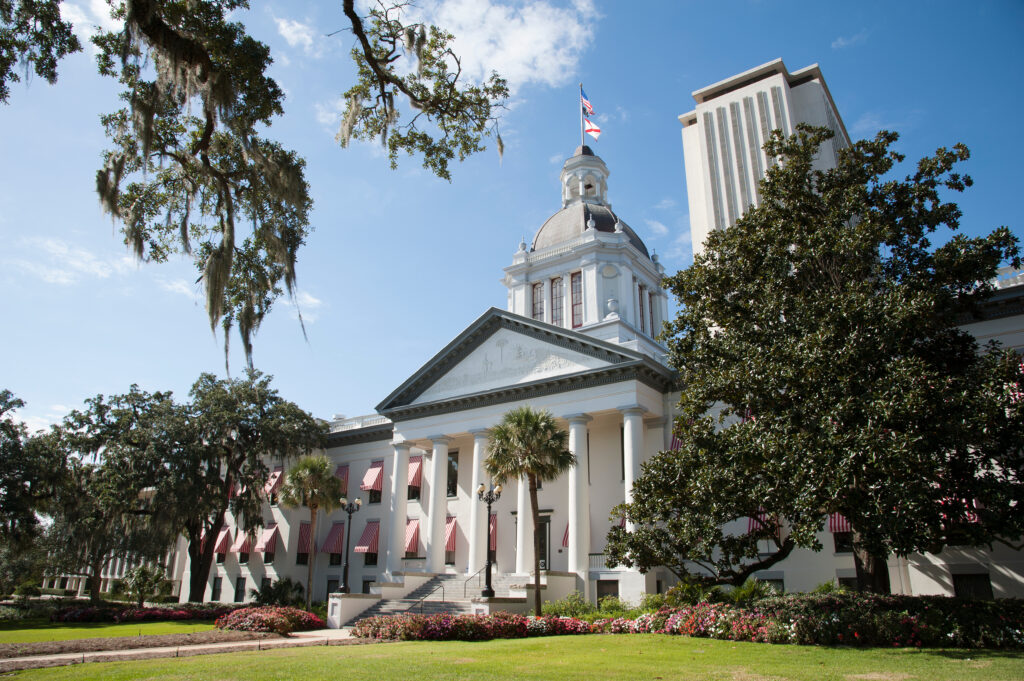
Florida lawmakers are poised to approve sweeping new restrictions that would require voters to prove their citizenship status, as well as remove student ID as an acceptable form of voter identification.
In a 27-12 vote, the state Senate on Thursday passed its own version of the SAVE America Act, a piece of national anti-voting legislation pushed by President Donald Trump.
The state House, which approved the legislation last month, must now approve the amended version of the bill. After that, it will head to Gov. Ron DeSantis (R) for signature.
If enacted, the national SAVE America Act would be the most restrictive piece of election legislation in history. Although the bill passed the House of Representatives last month, it appears doomed to fail when it heads to the Senate next week.
In light of that, the Florida bill represents an attempt to impose the bill’s severe voting restrictions on a state level.
Get updates straight to your inbox — for free
Join 350,000 readers who rely on our daily and weekly newsletters for the latest in voting, elections and democracy.
Under the proposed rules, Florida residents would not be able to register to vote until the state Department of Highway Safety and Motor Vehicles database can verify their citizenship or the applicant provides proof of citizenship. The bill would also require the state to identify registered voters who may be ineligible due to their citizenship status.
Shortly before the Thursday vote, Florida state Sen. Kristen Arrington (D) stressed that the state already has sufficient procedures to prevent and prosecute illegal voting.
“If the system is working, why are we making it harder for eligible Florida citizens to vote?” Arrington asked.
Jessica Lowe-Minor, president of the League of Women Voters of Florida, also questioned the utility of the bill.
“Supervisors of elections in Florida already have a number of ways to verify voters’ eligibility, including the use of their Social Security number and other types of data on those voters to ensure that folks who are registering are in fact eligible to vote,” she said.
“Under this provision, voters’ eligibility is essentially going to be tied to their presence in the Florida DMV database,” Lowe-Minor added.
Voters who have changed their legal names — including married women — will not be able to use their birth certificate as proof of citizenship unless they include additional legal documentation of their name change.
More than 9% of American citizens of voting age don’t have proof of citizenship readily available, according to the Brennan Center for Justice. In Florida, that’s more than one million people.
The measure will also block Florida voters from using a student ID as identification at the polls, a new obstacle for students who don’t have a Florida driver’s license.
“It’s definitely something that’s a major concern, and raises the question of what is the problem that they’re trying to solve here? We have had very good ratings in terms of election security here in Florida,” Lowe-Minor said.
State Sen. LaVon Bracy Davis (D) blasted Florida Republicans for the hypocrisy of making voting more difficult for students while celebrating the late Charlie Kirk’s efforts to energize conservatives on college campuses.
“When did students become the voting villain? When did that happen?” Bracy Davis asked.
“This chamber loves Charlie Kirk, who built an entire movement around engaging students in civic life and encouraging them to participate in democracy. And just so y’all know, this bill has a chilling effect to the mission of [Kirk’s organization] Turning Point USA.”
Legislators in both chambers worked to iron out differences in the two versions of the bill, such as when the law would go into effect.
The Senate adopted an amendment to the House version indicating that the proof of citizenship provision would go into effect in 2027. The earlier House version called for the change to be in effect for the November 2026 midterm election.
Were the restrictions to enter into force before November, the new rules could sharply depress voter turnout. But such a tight deadline would also pose an extraordinary challenge for the state’s election administrators.
Implementing the changes this year would have been “incredibly disruptive and very difficult” for election officials, Lowe-Minor said.
“However, ultimately this is still a massive change to our election system. And I think it’s going to be an unpleasant shock for a lot of Floridians,” Lowe-Minor said. “They’re really not doing us any favors by delaying the implementation by six months.”