Florida passes GOP gerrymander, sending map to DeSantis
The Florida Senate voted 21-17 Wednesday to approve a gerrymandered map that could deliver up to four more Republican seats in Congress in the upcoming elections. The vote sends the measure to Gov. Ron DeSantis (R), who proposed the map and has made clear he will sign it.
Litigation challenging the map, which could hand the GOP a 24-4 advantage in the state’s congressional seats, is expected to be filed imminently.
Florida becomes the fourth GOP-controlled state to bend a knee to Trump’s redistricting demands, after Texas, Missouri and North Carolina. But unlike in the other states, Florida Republicans face a major hurdle: Voters passed a constitutional amendment banning partisan gerrymandering over a decade ago.
Republicans have navigated that challenge by claiming the unusual mid-decade redraw was motivated by the state’s population growth — even though the new map was drawn using the same 2020 Census data — and by insisting it was necessary to comply with a major U.S. Supreme Court (SCOTUS) ruling on the Voting Rights Act, despite the fact that the court had not yet issued it.
That changed Wednesday morning, when the court released its Louisiana v. Callais opinion, gutting the landmark Voting Rights Act and severing minority voters’ protections against racial gerrymandering. For DeSantis, who has for months said publicly that he was waiting on the Callais opinion, SCOTUS delivered the ruling just in the nick of time.
House Republicans voted down a proposal to take a short break to read the ruling before voting on the map.
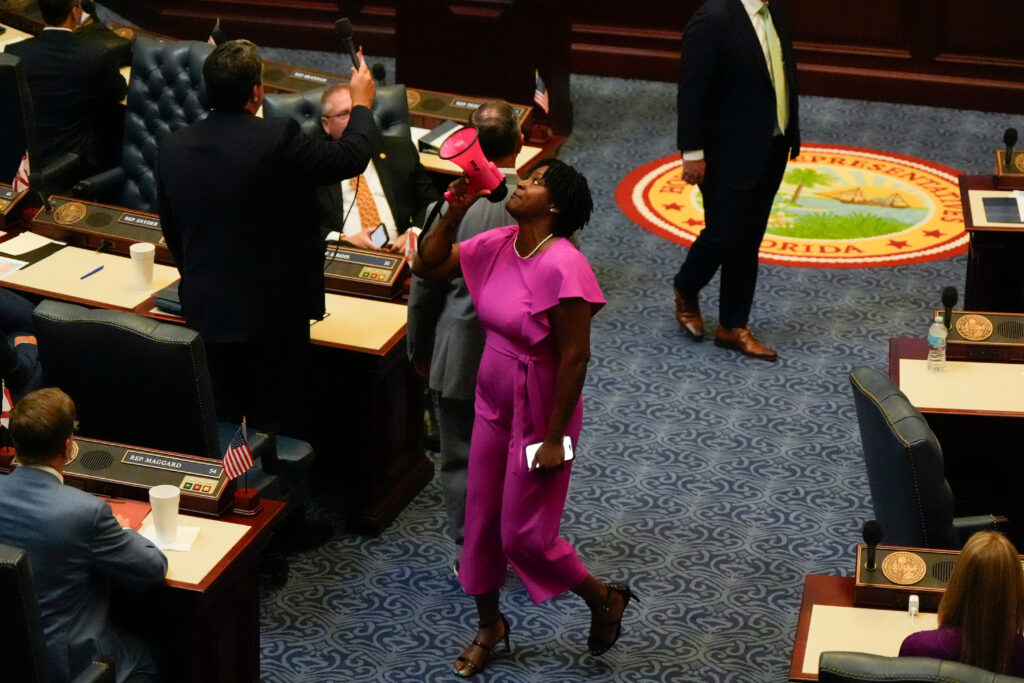
Instead, they proceeded, casting their final votes as state Rep. Angie Nixon (D) shouted into a bullhorn on the House floor: “This is a violation of the Constitution.”
Get updates straight to your inbox — for free
Join 350,000 readers who rely on our daily and weekly newsletters for the latest in voting, elections and democracy.
The Florida Senate gave its final vote hours later, sending it to the governor’s desk with virtually no opportunity for public input. DeSantis released the map Monday, committees held public hearings Tuesday, and both chambers approved the map Wednesday.
Senate Democrats blasted their Republican colleagues for obeying Trump’s orders rather than serving the interests of their own voters.
“Let’s not pretend that this is a real process. This is about acquiescing. This is about power. This is about relinquishing our power and giving it to the president,” State Sen. LaVon Bracy Davis (D) told lawmakers. “And we should all feel some kind of way that before it was presented to the legislature, it was presented on Fox News. It was rolled out on national media, color coded in red and blue, as if the outcome was already decided. As if our process did not matter. As if this body, and the work we are supposed to do, did not matter.”
Historically, legislators have had a role in drawing congressional maps and adjusting district lines based on public feedback. But Florida Republican lawmakers — including the bill sponsors in the House and Senate — repeatedly said they had no involvement in drawing the map. Rather, the map apparently was drawn solely by DeSantis staffer Jason Poreda, who testified in House and Senate committee hearings Tuesday.
Poreda admitted during testimony that he did use partisan data in drawing the map, though he said it wasn’t his prime concern. Florida’s constitution bars any type of partisan motivation in redistricting, though the state Supreme Court has issued rulings weakening the ban.
Rather than defend the new map, Florida Republicans stuck closely to a GOP script that was also used in Texas. Lawmakers insisted they were considering redistricting for the sole reason that the governor had put it in on the agenda.
Democrats eviscerated them for hiding behind excuses instead of acknowledging their role delivering a win in Trump’s redistricting war.
“This is about fear,” Bracy Davis said. “Not just any fear — panic — the kind of panic that comes from 1600 Pennsylvania Avenue when the ground is shifting beneath you and you can’t win in a fair fight. Fear of losing power. Fear of losing control. Fear so deep it changes the rules, bends the Constitution and has the nerve to call it strategy. Because when you can’t persuade the people, when you can’t inspire the voters, when you can’t defend your record, when you can’t ignore the Epstein files, you change the map.”
“So the plan becomes simple: if you can’t win with the people, you cheat the people,” Bracy Davis continued. “And the impact of this is not abstract. It is targeted…Black and brown voices that have fought to be heard are now being weakened. That is not coincidence. That is design.”