FBI’s Fulton County raid may have been illegal, legal experts warn. But it definitely raises fears for 2026
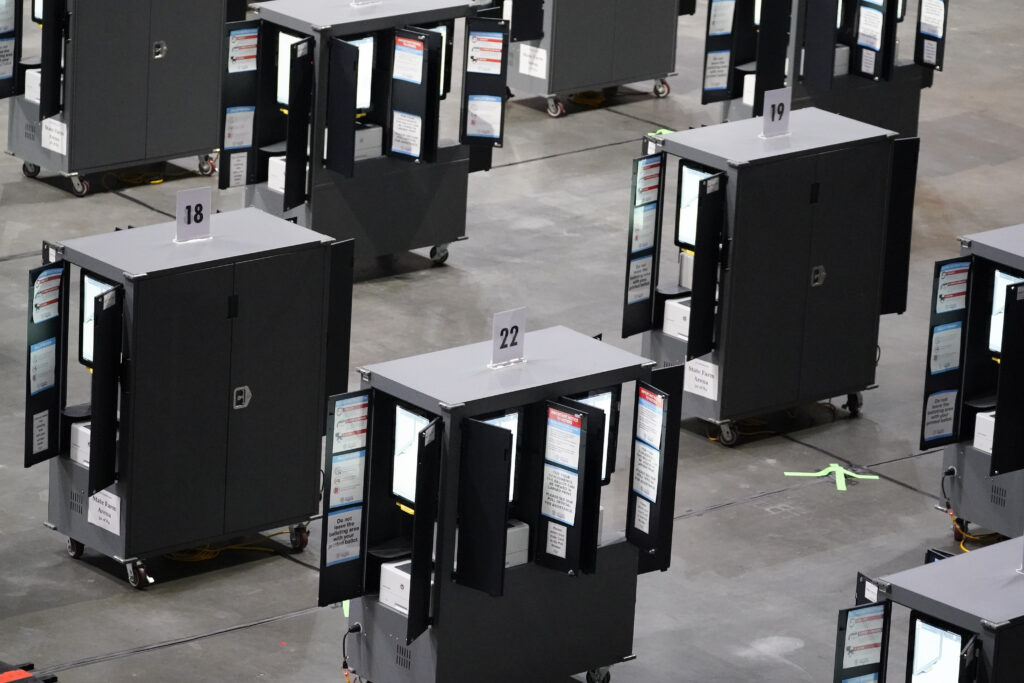
Election law experts are questioning the legality of the FBI’s unprecedented seizure of 2020 election ballots in Fulton County, Ga. in a raid that has further inflamed fears of federal interference in the upcoming midterm elections.
There is widespread doubt that the records will produce any evidence of prosecutable criminal activity, and not just because the 2020 election results have been recounted, audited, and litigated to death already.
But, they warn, 2020 isn’t the investigation’s real target — 2026 is.
“We know the 2020 election was secure, with paper ballots throughout the country counted and recounted and audited to confirm the results,” Center for Election Innovation and Research executive director David Becker said in a press call Thursday. “Ongoing through the 2026 — and perhaps 2028 — election cycles, the administration is going to use some of its actions to fuel false claims of fraud, to spread disinformation, to encourage distrust of our election system, particularly when elections yield results that the President doesn’t like.”
Get updates straight to your inbox — for free
Join 350,000 readers who rely on our daily and weekly newsletters for the latest in voting, elections and democracy.
The seizure of all of Fulton County’s ballots cast in 2020, along with registration rolls and other records, came less than a month after President Donald Trump said he might cancel the 2026 midterm elections and publicly shared his regrets over not seizing ballot boxes after the 2020 presidential campaign — a race he baldly asked Republican officials in Georgia to falsify in his favor by finding “11,780 votes.”
After an outcry over the unconstitutional musings, the White House said Trump was merely “joking.” But following Fulton County’s ballot abduction, worries Trump will order federal officials to interfere with November’s races were reignited.
It’s possible “that this is a test run for 2026, when control of Congress may be at stake, and Trump could try to seize voting machines or otherwise interfere with state ballot tabulation processes in swing districts around the country where control of Congress may be at stake,” University of California Los Angeles law professor Rick Hasen wrote on the Election Law Blog. “There’s going to have to be some proactive steps to make sure this does not happen in 2026.”
“It’s a dramatic escalation even among recent Trump administration actions like suing nearly half the states for their sensitive voter data,” said Derek Clinger, senior staff attorney with the State Democracy Research Initiative at the University of Wisconsin Law School.
Even by the standards of the the Department of Justice (DOJ) under Attorney General Pam Bondi, who has transformed the once staid, stentorian prosecutors’ office into a shrieking social-media driven publicity machine, Wednesday’s actions raised partisanship red flags.
Ahead of the raid, President Donald Trump signaled imminent action in 2020 investigations was coming, saying “people will soon be prosecuted.” A week before the warrant’s execution, the FBI’s special agent in charge of the Atlanta office was dismissed without any public notice.
The presence of Director of National Intelligence Tulsi Gabbard during the search led online agitators to speculate wildly about foreign interference in 2020. Gabbard has been probing 2020 “for months,” the Wall Street Journal reported Thursday.
If there was evidence of foreign interference, Gabbard would have had a duty to inform the congressional intelligence committees, Sen. Mark Warner (D-Va.) noted, which she didn’t do, suggesting her appearance was just a “political stunt designed to legitimize conspiracy theories that undermine our democracy.”
Following the raid, Trump continued spreading lies about the 2020 election, sharing dozens of social media posts by his coterie of conspiracy-addled supporters late Wednesday night and early Thursday morning.
Some observers also questioned why the attorney signing off on the application was Thomas Albus, the Trump-appointed U.S. Attorney for the Eastern District of Missouri. Bloomberg Law reported Thursday that Bondi had quietly assigned Albus to investigate election integrity cases nationwide.
Regardless of who signed it, the warrant has drawn scrutiny. To justify the search and seizure, the FBI cited alleged “violations of Title 52, United States Code, §§ 20701 and 20511” — sections of the 1960 Civil Rights Act (CRA) and the National Voter Registration Act (NVRA) — occurring after Oct. 12, 2020.
The main problem with the warrant, said Becker, was that there’s no evidence of any wrongdoing whatsoever, and warrants are supposed to only be issued upon probable cause that the places searched or effects seized will turn up evidence of a prosecutable offense.
“There is no crime because that election in 2020 — run in the middle of a global pandemic with record high turnout — has withstood more scrutiny than any election in world history, thanks to the hard work of our public servants, the Republicans and Democrats all across the country who ran it,” Becker said.
The CRA requires state and local officials to maintain ballots and other voter records for 22 months after an election, to allow for audits or investigations into potential violations of the law, which was passed to protect minorities’ right to vote.
Under that law, Fulton County would have been justified in destroying the records — paper ballots and forms take up large amounts of space — years ago, except for a judicial seal requiring their retention issued by Fulton County Judge Robert McBurney in an ongoing lawsuit.
The 700 boxes of records seized Wednesday included those documents under seal, County Commissioner Marvin Arrington Sr. told Democracy Docket, saying he was urging the county district attorney to sue the FBI.
“I think we need to be in front of a judge right now… because the records are sealed,” Arrington Sr. said. “The records are under seal, and the judge has not issued an order unsealing the records.”
The warrant also relied on provisions in the National Voter Registration Act (NVRA) outlawing voter intimidation, election interference and fraud. But, as Becker noted, the five-year statute of limitations for those crimes ran out long ago.
“By any measure of that five years — whether it was the date of the election or some date in the immediate aftermath of the election — that statute has run, it’s over,” he said. “There is no possible claim that could be brought that would pierce that statute of limitations.”
That should have doomed the warrant applications, Becker said.
“I’m kind of surprised that a federal judge, a federal magistrate, signed off on this warrant with that fact out there,” he added.
The warrant’s apparent deficiencies could possibly be explained in the FBI’s affidavit accompanying it, but that has been placed under seal, which isn’t uncommon in criminal investigations.
“I’m wondering what was in the affidavit to justify the search warrant… or whether this is just an oversight [by the magistrate], because that is a fatal flaw for any claims that might be brought in with regard to the seizure of ballots,” Becker added.
Writing on the Election Law Blog, Loyola Marymount University law professor Justin Levitt also wondered what a magistrate judge might have seen to authorize a warrant when the statute of limitations appears to be an unavoidable bar to prosecution. Levitt speculated that the alleged criminal act would have to be the discarding of election records within the CRA’s 22-month retention period but within the last five years, meaning sometime in 2021 or 2022. But that still wouldn’t explain the NVRA claim.
“I’m really curious what the FBI showed to get a federal magistrate to sign off on probable cause that the elections office intentionally threw documentation away before the 22-month mark, which ran in September 2022,” Levitt wrote. “Or the FBI’s explanation for why they need all of the 2020 data NOW, as relevant to prove that Fulton County (allegedly) improperly threw something away four years ago.”
Becker also said the seizure itself could cause problems in the hypothetical legal battle ahead. By taking the records from a secured facility, the FBI has introduced chain of custody questions.
“In many ways, the DOJ has destroyed the provenance of the evidence that it may rely upon for a future prosecution,” Becker said.
Then there’s the fact that litigation over the 2020 election records is already ongoing. A month before the FBI’s seizure, the DOJ sued the Fulton County clerk for the records. The county moved to dismiss, arguing the CRA and NVRA did not empower the federal government to make those demands, and last week DOJ attorneys responded. So far, the litigation remains active, with the judge yet to issue any rulings or even schedule a hearing.
That lawsuit was filed after Trump resurfaced old conspiracy theories about 2020 and escalated his rhetoric that the DOJ should investigate 2020 voter fraud claims and prosecute those responsible.
But soon after the filing, two federal courts blocked the DOJ’s demands for unredacted state voter registration data. In those cases — and the 23 others it has filed — the DOJ cited the same laws to support their claims for voting records, but judges in California and Oregon said neither the CRA nor the NVRA authorized the federal government’s encroachment on states’ constitutional authority to run elections. Those results suggest the DOJ’s lawsuit against Fulton County would similarly fail.
Even if the concerns over the warrant, the state court judicial seal and other legal issues can be resolved, allowing the FBI to hold onto the ballots and continue its investigation, Becker does not think any prosecutions are forthcoming, despite Trump’s recent promises to the contrary.
“There was no crime,” Becker said. “The statute of limitations has run, and the last thing this Department of Justice wants to do — given its track record over the last year plus — is to present evidence in court that will be scrutinized.”
In the wake of his 2020 loss, Trump and his supporters filed over 60 legal cases across the nation seeking to overturn the results, but they all failed, including those before judges he appointed. Over two years ago, the Georgia State Election Board cleared Fulton County election workers and officials of all alleged misconduct after a lengthy investigation.
“That election in 2020 — nationwide and specifically in Georgia — is the most scrutinized, most litigated, most reviewed, most recounted election in American history and perhaps in world history,” said Becker. “[The] paper ballots in Georgia in 2020 were counted three times, three different ways, twice by machine and once entirely by hand, with observers from the campaigns and the candidates watching to ensure that the count was Right. Every single count confirmed the outcome that Joe Biden won a fairly narrow race in Georgia in 2020 and there’s absolutely no doubt about that.”