Despite battles over voting, comity reigns at meeting of federal elections panel
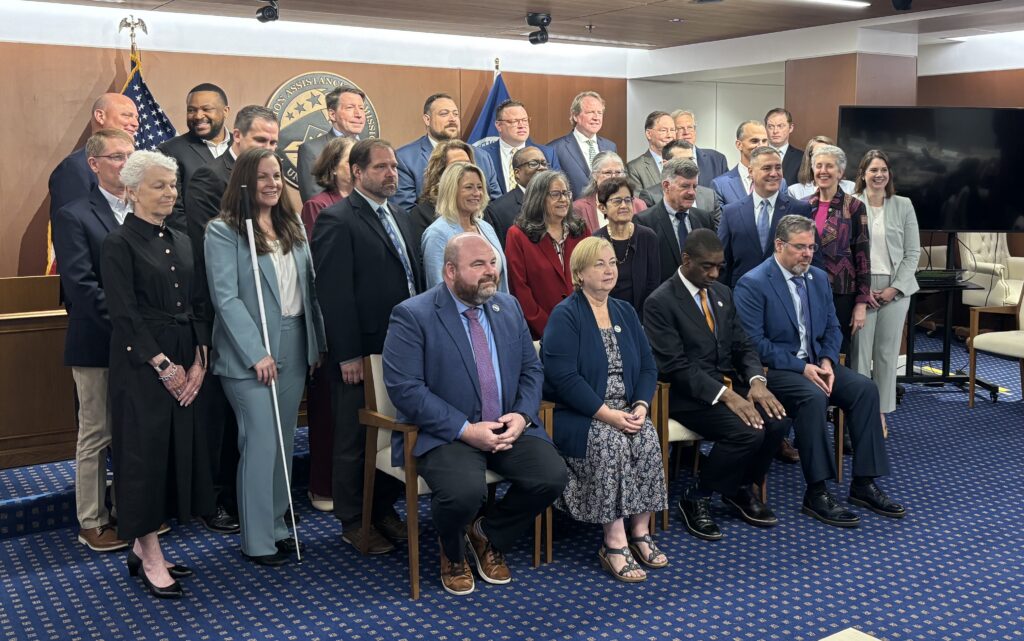
The members of the U.S. Election Assistance Commission’s (EAC) Board of Advisors gathered in the basement of a drab Washington, D.C., office building Tuesday for their annual meeting to discuss auditing standards and ballot security.
U.S. elections, already safe and secure, could be all the more so with improved data formatting interoperability, updated voting system guidelines and signature verification software, the state and local election officials gathered seemed to agree. But that would require Congress to act, they said.
“I think we all agree here. We want secure elections,” said Isaac Cramer, the executive director of Charleston, South Carolina’s Board of Elections. “But secure elections cost money. Lots of it.”
The EAC is a bipartisan commission created by the 2002 Help America Vote Act to help states administer elections, and its board of advisors is a 35-member body that meets to review the EAC’s Voluntary Voting System Guidelines (VVSG) and best practice recommendations.
Get updates straight to your inbox — for free
Join 350,000 readers who rely on our daily and weekly newsletters for the latest in voting, elections and democracy.
The advisory board includes officials from countrywide state and local governance groups, like the National Association of State Election Directors, as well as representatives from federal government agencies and Congress.
Also among its members are leaders of the movement to impose stricter voting rules, including Hans von Spakovsky of Advancing American Freedom, Christian Adams of the Public Interest Legal Foundation, and Eric Neff, the acting chief of the voting section at the U.S. Department of Justice.
While the two-day meeting began with a quietly contentious discussion of a proposed amendment to the advisory board’s by laws to ban proxy voting, widespread comity and accord prevailed across the highly technical discussions Tuesday, in marked difference to the fierce battles over election administration playing out daily online and in courtrooms across the nation.
During Tuesday’s meeting, EAC executive director Brianna Schletz presented a set of eight recommendations the commission has for Congress. Of them, five called for more funding: money to establish an independent security testing program, approprations for developing new, interoperable voter registration systems, subsidies for more state and local election official training, grants for voting machine modernization, and — befittingly — funding for research into the rising costs of election administration.
The advisory board largely supported the EAC staff’s work on developing a new version of the VVSG, which are used to certify the voting systems used in all U.S. elections.
The latest standards, VVSG 2.0, were adopted in 2021. So far, only two voting machines have been certified under the latest guidelines, with another five in the works, but the commission is already looking to make updates with VVSG 2.1.
Part of those updated standards would be forbidding voting machines from relying on QR or bar codes to record votes. That change, under consideration for years now, raised some concerns at the hearing. President Donald Trump included a directive to that effect in his 2025 executive order on voting, which was specifically blocked by a court injunction. But Democrats on the advisory board said a limited QR and bar code ban made sense, and EAC staff emphasized the proposal has been in the works for years.
Moreover, only a handful of counties across the U.S. currently rely on voting machines that record votes within bar or QR codes.
EAC staff estimate the cost of replacing all voting machines currently in use — mostly certified under earlier versions of the VVSG guidelines — with VVSG 2.0-certified counters at $2.71 billion.
In the current fiscal year, Congress only provided $45 million in HAVA grants for the EAC to distribute to the states, following a mere $15 million the year prior. Congressional appropriators are currently drafting spending bills for the coming fiscal year, leading to multiple exhortations at Tuesday’s hearing to reach out to representatives for more funds.
Since HAVA was enacted, the EAC has administered over $4.3 billion in elections-related grants to state and local authorities, which is roughly how much Congress has spent on renovating one of its office buildings.
During a presentation, EAC’s inspector general Sarah Dreyer noted that the HAVA money is being well-spent.
“Most of our grant audits find gaps in internal controls, not widespread fraud. As a case in point, we audited 40% of the CARES Act grant recipients and found that less than 1% of funds were used for unnecessary, unreasonable or unsupported reasons,” Dreyer said referring to a COVID-era federal funding law.
Jacob Knutson contributed to this report.