Congressman demands answers on Trump DOJ’s election monitors after troubling hire exposed
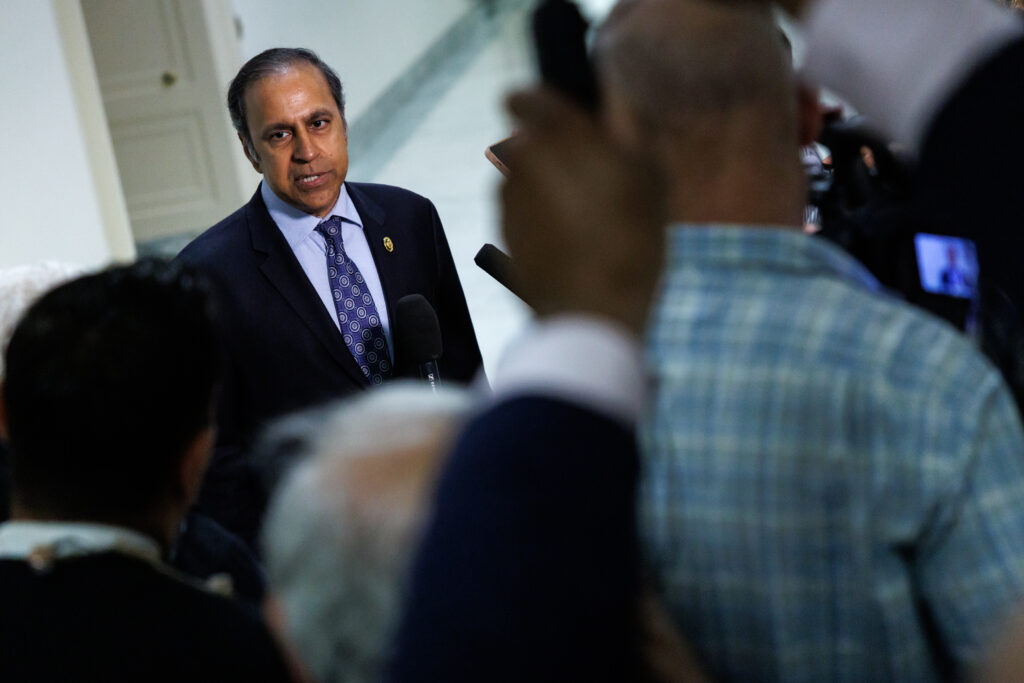
A Democratic member of Congress is demanding answers from Trump’s Department of Justice (DOJ) about how it’s vetting the roughly 1,000 election monitors it plans to deploy this fall, citing Democracy Docket’s exclusive reporting on David Michael Levin — a lawyer who pleaded guilty to hacking government election websites and appears to have joined DOJ’s Civil Rights Division.
In a letter sent Thursday to Attorney General Todd Blanche, Rep. Raja Krishnamoorthi (D-Ill.) said the report made previously raised concerns about the department’s monitoring plans “even more urgent.”
He pressed DOJ to explain whether it employs Levin, what role he played during the department’s monitoring of Minnesota’s August primary and whether officials knew about his criminal history before he appeared at a polling location.
“The Department has not publicly explained whether it employs Mr. Levin, in what capacity he may have served, or how he came to participate in a federal election-monitoring operation,” Krishnamoorthi wrote. “Those are not minor administrative questions.”
Get updates straight to your inbox — for free
Join 350,000 readers who rely on our daily and weekly newsletters for the latest in voting, elections and democracy.
The letter marks a direct congressional response to Democracy Docket’s investigation, which found last week that Levin appears to have joined DOJ’s Civil Rights Division and was seen alongside senior Voting Section attorney William F. Mohrman during the department’s election monitoring operation in Minnesota.
Levin was charged with three felonies in 2016 after Florida investigators said he used a cyberattack to obtain election official credentials and gain unauthorized access to government election websites. The charges were later reduced to misdemeanors. Levin pleaded guilty, served 20 days in jail and received two years of probation.
Krishnamoorthi cited that reporting while questioning what standards DOJ is using to select personnel for election related work.
“Mr. Levin’s record warrants serious scrutiny,” he wrote.
Krishnamoorthi also noted that Levin does not appear to be an isolated case.
His letter cited previous reporting on other controversial hires in the Civil Rights Division, including officials who questioned past election results, and asked: “What standards is the Department applying when selecting the personnel who will be responsible for protecting Americans’ voting rights?”
The question comes as DOJ attempts to dramatically expand its role in state-run elections ahead of the 2026 midterms.
The department continues a nationwide campaign to obtain states’ unredacted voter registration data while simultaneously planning a far larger presence at polling locations. Krishnamoorthi wrote that DOJ’s planned deployment would be nearly twice the size of its 2024 monitoring effort.
“Taken together, these actions have created legitimate concerns about whether the Department’s election-monitoring program is designed to protect voters or whether it risks becoming a mechanism for intimidating voters and pressuring local election officials,” he wrote.
Krishnamoorthi said federal election monitoring itself can serve an important purpose, but only when the personnel involved are “properly vetted, trained, impartial, and committed to protecting every eligible voter’s right to cast a ballot free from intimidation.”
The letter asks DOJ to answer seven sets of questions by Sept. 3, including what exact role Levin has at the Civil Rights Division, what vetting he underwent and whether officials knew about his 2016 conviction before he participated in the Minnesota operation.
Krishnamoorthi also demanded details about the screening criteria DOJ will use for its planned 1,000-person monitoring force, including whether criminal histories, prior conduct involving election systems and efforts to undermine confidence in lawful elections will be considered.
“The Department should not ask voters and election officials to simply trust that this process is being handled appropriately,” Krishnamoorthi concluded. “It should demonstrate that it is.”