As federal protections dwindle, more states pass their own voting rights acts
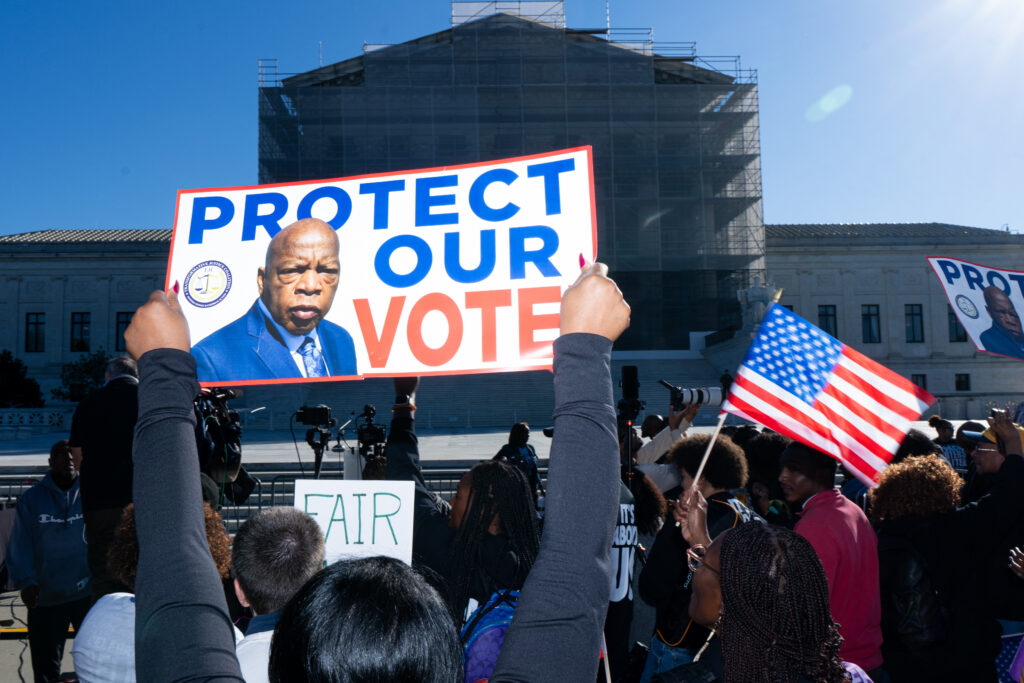
California passed its statewide Voting Rights Act (VRA) in 2002. Not many followed suit. But over two decades later, states are revisiting the idea with urgency.
A dozen states have now passed VRAs, with half enacting the legislation under the second Trump administration. And in the wake of the U.S. Supreme Court decision that gutted Section 2 of the federal Voting Rights Act of 1965, a flurry of states are passing their own versions of the legislation.
Most recently, Delaware’s General Assembly passed its state VRA to fight suppressive voting measures and reinstate previously guaranteed federal guardrails.
Get updates straight to your inbox — for free
Join 350,000 readers who rely on our daily and weekly newsletters for the latest in voting, elections and democracy.
In Louisiana v. Callais, the Supreme Court ruled against a court-ordered congressional map establishing two majority-Black districts because it said the state could not use race to redistrict for electoral representation.
The ultra-conservative court also now requires proof of intentional discrimination, meaning pro-voting groups must present evidence that gerrymandered maps were drawn with a racially discriminatory motive. Voting rights and legal experts have rebuked the updated standard as nearly impossible to prove.
State VRAs also reject this premise.
“Voter suppression claims do not require evidence of intentional discrimination,” the text of the Delaware bill reads.
Rep. Larry Lambert (D), who helped steer the act through the state Senate, said while the act is timely, he had been planning it long before Callais. Lambert referenced another Supreme Court blow to civil rights in the 2013 Shelby County v. Holder decision in his statement after the act was signed.
“The issues this bill aims to address are not hypothetical,” Lambert said. “The weakening of Federal VRA protections has already led to severe consequences for communities of color across the country, as at least 103 restrictive voting laws have been passed since the Supreme Court started to diminish Federal VRA protections in 2013.”
While 10 states already had their own protections, New Jersey joined Delaware as one of two states to pass statewide voting rights acts following the Callais decision.
Assemblymember Verlina Reynolds-Jackson (D) helped spearhead the New Jersey bill and spoke about its importance when it was signed into law in July.
“For voting access, I think about young people, I think about early voting, I think about vote by mail,” Reynolds-Jackson said. “We have three different ways to be able to vote, but if it doesn’t count, that means my voice doesn’t matter and that’s the problem.”
The bill highlights provisions in similar state VRAs. These include requiring ballots in multiple languages, prohibiting vote dilution and criminalizing voter intimidation.
Notably, the bill also requires the former federal preclearance protection that was eviscerated in 2013. In Delaware and New Jersey, voting laws must be reviewed to ensure measures such as voter identification and abrupt changes to polling locations are not discriminatory.
In 10 additional states, versions of state VRAs have been introduced or passed in one chamber of government. And in some states with existing acts, like Virginia and California, amended versions to account for what’s been eroded in federal law were introduced this year.
While there’s been increasing progress, not all state VRAs have survived legal scrutiny. Right-wing groups have wasted no time issuing challenges.
The Public Interest Legal Foundation (PILF), a conservative legal group, sued to strike down Illinois’ Voting Rights Act in May. It pulled directly from the Supreme Court’s Callais decision to justify blocking the law. Governor JB Pritzker (D) formally asked the court to dismiss the case.
PILF’s attack on state VRAs is just the latest in its anti-voting work.
And even in states without VRAs, GOP leaders have seized the moment to target states seeking to protect against voter suppression.
Sen. Eric Schmitt (R-Mo.) was outspoken in advocating for legislators to take action against blue maps “drawn or defended under the old regime” during a Senate Judiciary Committee hearing in May.
Schmitt also called on Trump’s Department of Justice to “end illegal racially-gerrymanded districts,” to which DOJ head Harmeet Dhillon promptly responded.
More states, specifically across the South, will continue their partisan justification to redistrict at the expense of minority voters for 2028. Meanwhile, state VRA proponents say massive redistricting exemplifies the need for statewide protections for minority voters.
California, the trailblazer that established its VRA 24 years ago, is now looking to expand its bill with two pieces of legislation to account for protections lost.