Appeals court looks set to deny DHS bid to continue harassing voters over citizenship
 Prefer us on Google
to see more of our voting rights news coverage when you search.
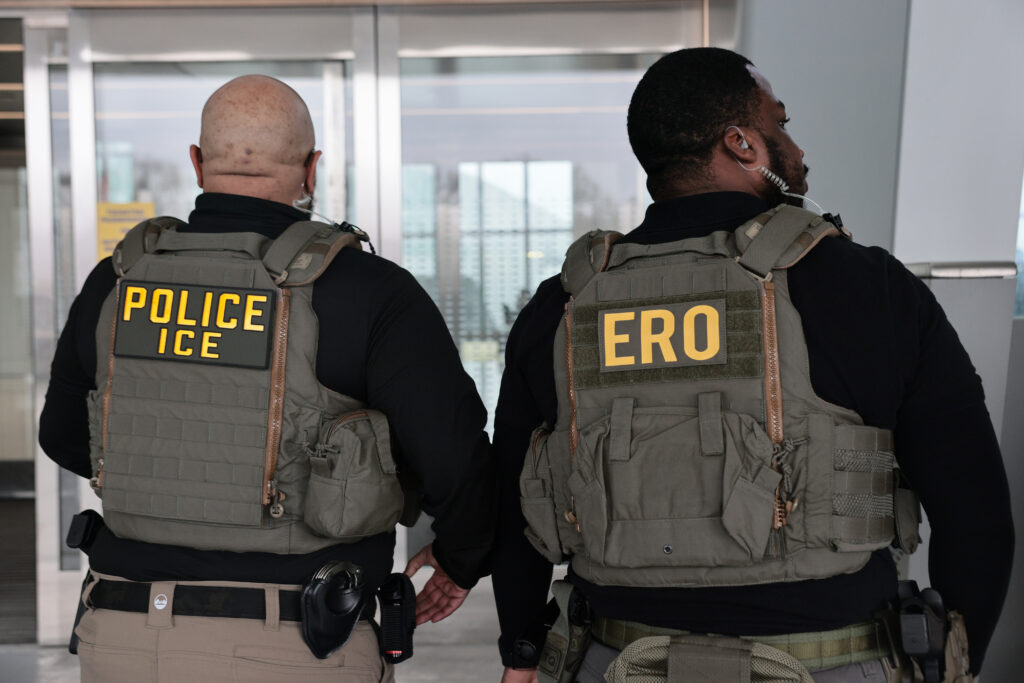
A federal appeals panel sounded skeptical Thursday of the Trump administration’s bid to continue conducting aggressive field investigations into noncitizen voting.
Pro-voting groups, along with the city of San Francisco and Santa Clara County, Calif., charged that the investigations are voter intimidation in a lawsuit they filed in September.
A district court ordered a block on the probes, which is being appealed to the 9th Circuit Court of Appeals by the Department of Justice (DOJ).
In Thursday’s hearing of a panel of 9th Circuit judges, the Trump administration struggled with answering the judges’ questions about why the investigations needed to happen so close to Election Day, and why the administration was using social media to publicize operations featuring armed agents using militarized tactics.
Get updates straight to your inbox — for free
Join 350,000 readers who rely on our daily and weekly newsletters for the latest in voting, elections and democracy.
The field investigations, which have involved armed federal agents badgering people about their citizenship and voting statuses, are a key component of the Trump administration’s wider campaign to drum up fears about noncitizen voting.
“We have to establish that there is an objectively reasonable fear arising from the defendant’s conduct and threats,” said the pro-voting groups’ attorney Hayden Johnson. “And that voters … are taking steps to mitigate their risks. That’s what plaintiffs have done here, and that’s sufficient.”
Two of the appeals court judges repeatedly asked during Thursday’s hearing why the Department of Homeland Security (DHS) and Immigration and Customs Enforcement (ICE) needed to do these stinging probes while people are actively voting.
“So, why is the rush?” Judge Sidney Thomas, an appointee of President Bill Clinton, asked. “What’s the irreparable harm for four days to, as the district court said, let the elections occur, and then … if you want to prosecute later, fine.”
DOJ lawyer Gabriel Schonfeld said the “injunction would be improper on any time frame.”
But Judge Thomas continued to prod him with questions about what the investigations could accomplish before Election Day.
“What do you need in the next four days?” Judge Thomas asked. “What are you prevented from doing in the next four days? You can’t prosecute anybody in four days. You can’t convict them in four days. Why do you need this?”
“I can’t speak to the specifics of what might happen in any given investigation, your honor,” Schonfeld answered. “The government is facing a far broader chill than just the relatively narrow set of investigations that are into naturalized citizens predicated on pre-naturalization conduct.”
However, Judge Kim Wardlaw, a Clinton appointee, appeared more concerned about the chilling effect of public videos depicting the militarized tactics that ICE agents have used in their field operations.
The federal agents have notoriously brought film crews with them as they confront people they suspect are noncitizens and then use the footage to create video content used for social media. The clips show armed agents pulling people out of their homes and cars, and then forcefully shackling and arresting them.
“I’m wondering where the PR aspect of this fits in,” Judge Wardlaw said, “because it seems what you’re publicizing — militarized people with masks on pulling people out of the house, and the people wearing their pajamas — I mean, isn’t part of this that the program, or whatever it’s called, ‘initiative,’ has an aspect of it that seemingly actually wants to intentionally make an effort to instill fear?”
The pro-voting groups’ attorney, Johnson, said “the fear is the harm” committed against voters who, upon seeing these videos and being aware that ICE’s initiative is impacting naturalized citizens, are being intimidated from participating in the midterms.
ICE’s violent social media videos are “a key part of the program,” Johnson said. He pointed to a DHS memo entered as evidence explaining how DHS has set up an online portal so that federal agents can immediately upload photos and clips of their often-violent encounters with suspects.
“That is something that DHS has never done before,” Johnson said. “That’s a totally new system set up just for this purpose. The goal is to send a signal during the voting period. This isn’t DHS doing … banal investigations of the vanishingly rare incidents of non-U.S. citizens wrongly participating in elections. This is as loud as possible, and that has a serious chilling effect and intimidating effect on voters.”
The third judge on the appeals court panel was Anthony Johnstone, who was appointed by President Joe Biden.
Members of the California Nurses Association and Voto Latino Foundation, two of the groups who brought the lawsuit, say the targeted stings are preventing their members from carrying out voter mobilization duties, such as promoting early voting and registering new voters.
They fear that even their eligible voter members will be swept up by the federal government’s hostile dragnet operations.
A lower district court ruled on October 21 that the DHS investigations promote “ongoing intimidation.” It barred the DHS and ICE from continuing the operations in nine states, and from using “target lists,” assembled from flawed databases, to identify noncitizens.
The injunction blocking the government’s investigations expires after Election Day.