A Texas county is quietly planning to swap voting maps between its primary and November election
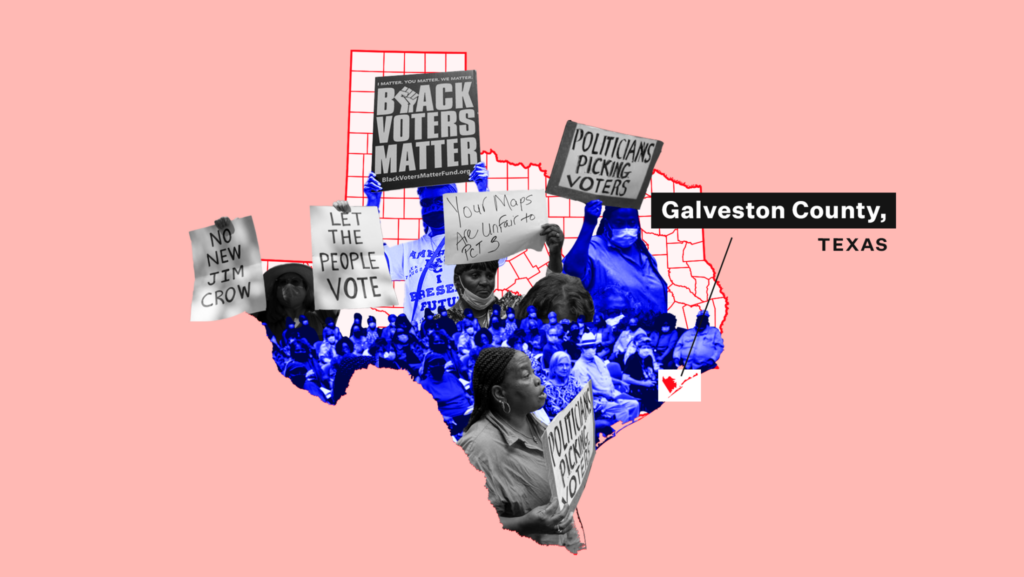
In what could signal an alarming new precedent, a Texas county revealed it plans to move some local candidates to new districts under a revised map drafted between the primary and general elections.
If allowed to proceed, it would likely be the first time Texas voting maps are changed between the primary and general elections. That means the candidates some voters will see on their November ballots will be different from those voters selected in the primary just months ago.
Pro-voting plaintiffs are warning the state’s highest court that the maneuver is a dangerous test that, if not stopped, could be repeated elsewhere across the state to undermine the will of the voters.
The plaintiffs, which include candidates for local offices who were moved to new districts, filed an emergency petition Tuesday asking the Texas Supreme Court to block Galveston County from implementing new maps for the November general election. They argue the switch violates voters’ state and federal constitutional equal protection rights by denying them the opportunity to choose their preferred candidates in the primary.
“If this is not stopped, the precedent set will be horribly damaging to democracy,” the plaintiffs argued. “It will make Texas’s primary elections an empty exercise.”
Get updates straight to your inbox — for free
Join 350,000 readers who rely on our daily and weekly newsletters for the latest in voting, elections and democracy.
They went on to warn that this strategy could be deployed by lawmakers across the state if the Texas Supreme Court does not stand in the way.
“Inaction from this Court in response to this Petition will greenlight them to redraw their maps prior to November, thwarting the voices of voters — perhaps in a perpetual ‘post-primary’ redistricting scheme,” the petition stated.
They cautioned that, if allowed to move forward, Galveston County’s plan will open an entirely new path for elected officials to undermine the will of the voters, even empowering them to meddle in their own races.
“If polling against their general election opponent is looking bad,” they argued, “they can just change the map — up to the very eve of the election — to evade the voters’ judgment.”
The Texas Election Code requires that a political party’s nominees for a county general election be selected by a primary election, they argued.
Galveston County’s 11th hour move to change district lines came to light during a federal court hearing last week in the long-running Petteway lawsuit challenging GOP gerrymanders adopted by the county in 2021. U.S. District Court Judge Jeffrey Brown, who was appointed by President Donald Trump, struck down the Galveston maps in 2023, ruling that they violated Section 2 of the Voting Rights Act (VRA). The decision was later reversed by the ultra-conservative Fifth Circuit, and some of the claims are still being litigated in the district court.
After the U.S. Supreme Court’s landmark decision this April to gut the VRA, Galveston County voted to adopt a new map with new district lines for justices of the peace, constables and county commissioners.
While multiple Southern states enacted new maps this summer in the aftermath of that ruling, none did so after their primary elections were already held. In Mississippi, Republicans will hold off on redrawing maps until after the November election because the state already conducted its primaries in March, the week after the Texas primaries.
Until last week, it wasn’t clear whether Galveston County officials intended to actually use their newly adopted map in November.
But at a July 28 hearing in federal court, Joe Nixon — an attorney with the Public Interest Legal Foundation (PILF) representing Galveston County — revealed the plan.
“(T)he 2026 map is the legal map that’s now in effect, and the elections in November are being held under the 2026 map lines,” Nixon told the court.
Nixon and PILF, a leading anti-voting law firm based in Washington D.C., oversaw last year’s mid-decade GOP gerrymander in Tarrant County — which outraged Texas voters described as a clear-cut illegal racial gerrymander. A federal court upheld the map.
When asked by Brown, the federal district judge hearing the Petteway case, Nixon could not provide any precedent for this change.
The Galveston plaintiffs argued in their emergency petition that the county’s maneuver would put voters in a bizarre position: “Many voters participated in a primary election for a different precinct than that in which the general election will occur, many others participated in the March 2026 primary election but have been moved to precincts in which there will be no November general election, and people who may have wished to run as a candidate in the March primary were precluded from doing so because they were only moved into the new general election precincts after the primary was held.”