Right-wing influencers are going viral claiming voter fraud. The problem? They’re wrong
In mid-January, a video recorded by popular far-right influencer Benny Johnson circulated widely online, claiming to uncover voter fraud in California.
In the supposed exposé, a sunglasses-clad Johnson spoke into his phone while standing in front of a vacant lot in Venice Beach, California.
“We’re in front of a very important place here in California,” Johnson explained. “You’ll see it’s just home to a Porta John and a giant empty parking lot. But inside of this empty parking lot is something really important in the state of California. As you can see here, we have registered voters. Twenty-six registered voters for this exact location… 26 people registered to a Porta John in an empty parking lot.”
By mid-February the video had garnered more than 1.6 million views, with Trump administration officials and prominent conservatives reposting it on X.
But Johnson’s video wasn’t exposing anything. Instead, it was just pushing a false and provocative narrative claiming that voter fraud was running rampant across the country.
That isn’t true. And Johnson isn’t the only right-wing figure with a massive platform publishing misleading viral videos alleging voter fraud in recent weeks.
Get updates straight to your inbox — for free
Join 350,000 readers who rely on our daily and weekly newsletters for the latest in voting, elections and democracy.
As the GOP continues its efforts to disenfranchise voters by advancing anti-voting bills like the Safeguard American Voter Eligibility Act (SAVE) America Act and the Make Elections Great Again (MEGA) Act in Congress, far-right figures and conservative influencers are attempting to gin up grassroots support by pushing out false narratives of widespread voter fraud, with videos highlighting decrepit and abandoned buildings or empty lots, where they claim dozens of people are illegally registered to vote.
Democracy Docket investigated two of the most popular recent videos and found that right-wing influencers like Johnson were primarily taking aim at homeless and transitional housing — and exaggerating their “findings.” It’s a strategy state election officials have long been aware of.
“A lot of this is about homeless people, or people who are in sort of dire situations financially, living in buildings that are condemned… and moving, and therefore the building no longer exists. But their registration hasn’t been updated,” Dana Barrett, the commissioner of Fulton County, Georgia, told Democracy Docket.
She’s been sent countless similar misleading videos from other right-wing internet personalities purporting to expose voter fraud in her district.
“At the end of the day, the danger here — like in anything these guys are throwing at all of us — is that if we respond, we continue to get into these fights about false narratives.”
California dreaming
Johnson doesn’t outright say it, but the implication in his video is that there are 26 people illegally registered to vote at a vacant lot in Venice — and the problem is supposedly widespread throughout California.
The video is par for the course for Johnson, a longtime conservative content creator and controversial former journalist known for pushing out false and misleading claims to his massive audience.
Johnson — who was unwittingly duped in 2024 by a Russian scheme to manipulate U.S. political influencers into promoting pro-Kremlin messages — also has a long history of spreading false claims about elections.
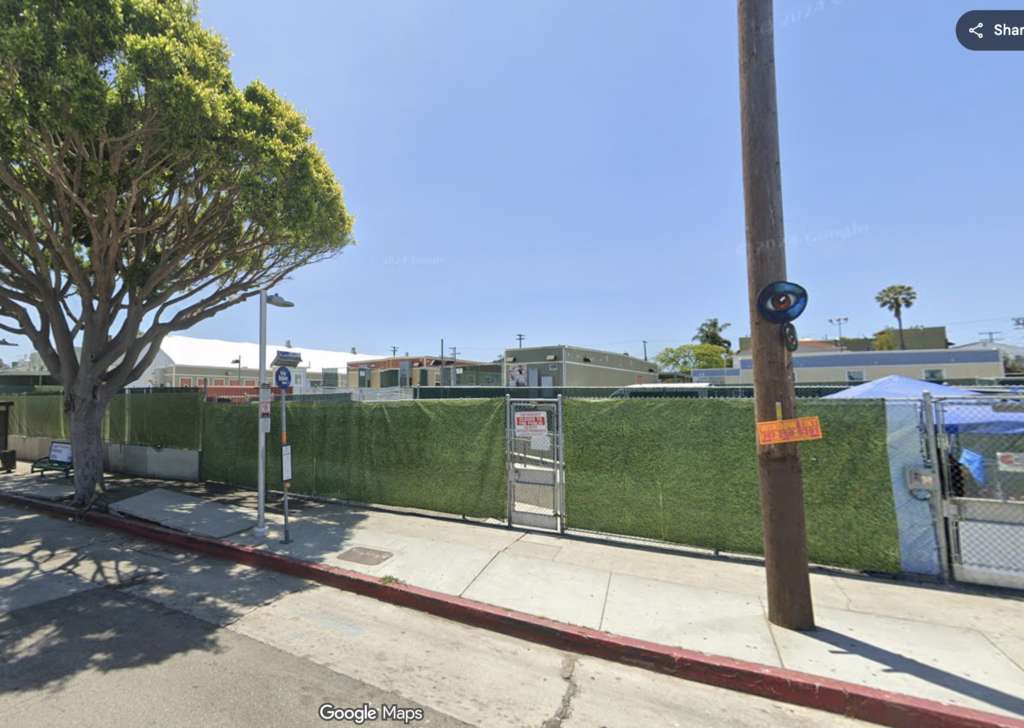
Like most of Johnson’s content, the California video is easily debunked. California state law gives people experiencing homelessness the flexibility to use any location to register to vote. As long as unhoused residents can describe the place where they spend most of their time — whether it’s an address, a cross street or a vacant lot — they can legally list it as their address on their voter registration form.
A spokesperson for California Secretary of State Shirley Weber (D) confirmed to Democracy Docket that the people registered to vote at the address in Johnson’s video are “unhoused individuals.”
Moreover, a review of the video by Democracy Docket found that the address was the site of a temporary housing facility from 2020 until the very end of 2024, just over a year before Johnson recorded his video. Google Street View and satellite images of the lot show portable buildings appeared in 2020 and were visible there well into 2025.
“There is no voter fraud associated with this address,” Weber’s spokesperson said. “This is the address used by 26 unhoused individuals exercising their constitutional right to vote. All counties, and the state, perform continuous list maintenance in compliance with federal and state laws.”
Distortions in Georgia
Beginning in mid-January, right-wing commentators David Khait and Fabian Garcia released a series of videos similar to Johnson’s claiming to expose voter fraud in Fulton County, Georgia.
That county has played a central role in President Donald Trump’s false narrative that the 2020 presidential election — which he lost — was stolen. Late last month, the FBI raided the county’s election operations hub to seize records, including ballots, from that election.
When the government unsealed the search warrant affidavit behind the raid, it revealed that the FBI’s criminal probe was based upon long-debunked conspiracy theories pushed by far-right anti-voting activists, some of whom are now members of the Trump administration. The raid was widely condemned by Fulton County officials, former FBI officials, pro-voting advocates, and Democrats.
In one of Khait and Garcia’s main videos, they visited locations like an abandoned homeless shelter, a UPS store, and a church that the influencers claimed at least 2,000 people use as their voter registration address.
The video shows Khait and Garcia standing outside of an abandoned building that they say was a homeless shelter that closed in 2017. The video, which has also been broken up into clips for reposting, has been viewed by millions on social media and, in January, was even reposted by Trump.
“According to Georgia’s registration rolls, people are still registered to vote here,” Khait tells Garcia in the video. “Over 70 people are actively registered to vote according to the most recent Georgia registration rolls that we received.”
And just like Johnson’s video, the Khait and Garcia one is purposefully misleading.
In their videos, Khait and Garcia don’t mention whether the people registered to vote at the addresses they visit actually voted in recent elections — just that they’re currently registered to vote there. Per Georgia law, before voters can cast their ballots in an election, they must confirm their current address with the county registrar in order to verify their voter eligibility.
The process for removing voters from the state’s voter roll is only triggered after five non-voting years, and can take several election cycles to complete. So it’s entirely plausible that some people used the homeless shelter in Khait and Garcia’s video as their primary address to vote in 2017, did not vote in subsequent elections, but still remain on Georgia’s voter rolls. And that’s neither fraud nor a violation of the law.
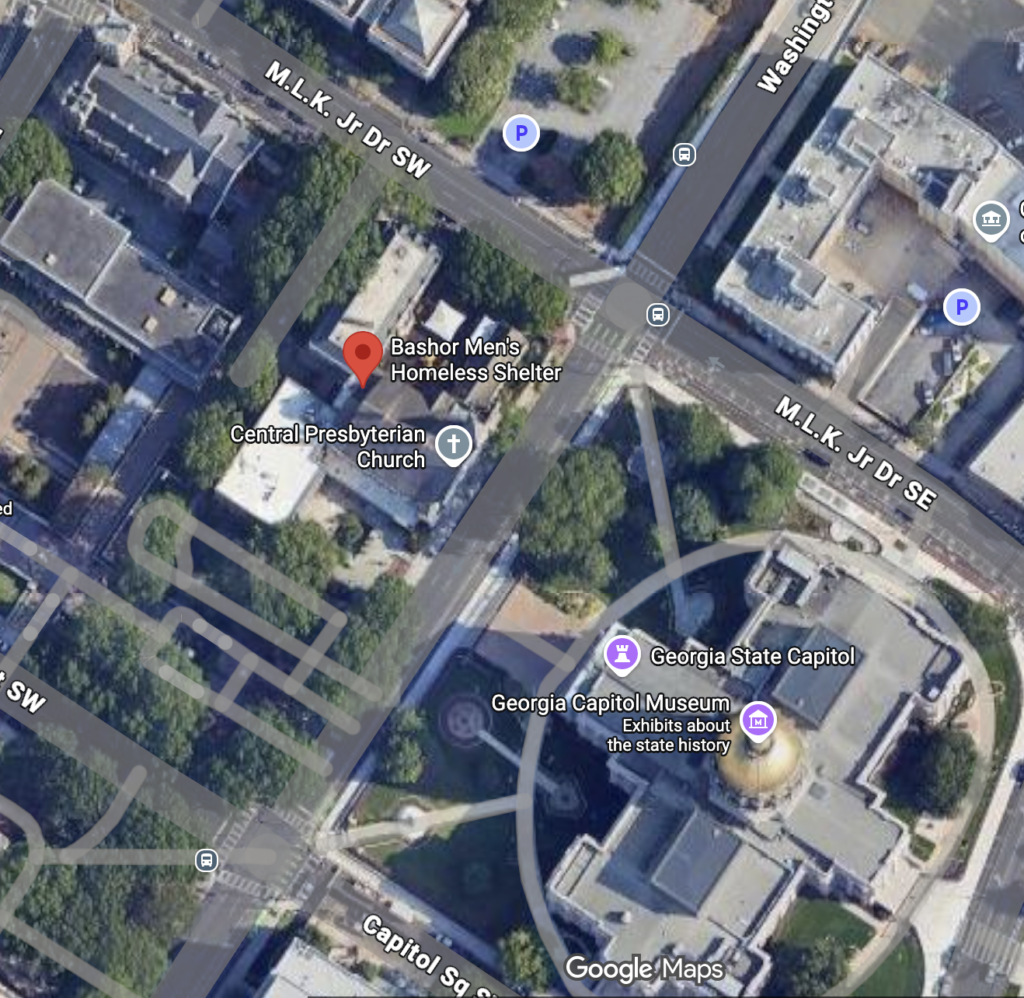
Khait and Garcia’s other claims also don’t stand up to scrutiny. They visit Atlanta’s Central Presbyterian Church and claim that “thousands of people” are registered to vote there. But a simple review of Google Maps reveals that that same address operates a seasonal homeless shelter.
Like California’s voting laws, Georgia law allows unhoused people to register to vote if they don’t have a traditional address. They have the option of listing a place they regularly stay — including a shelter or church — as their voting address.
Khait and Garcia also claim that there are 96 people registered to vote at an Atlanta-area UPS Store. While they are correct that voters are not allowed to use a P.O. Box as their home address, there are some nuances they are ignoring.
In 2024, Georgia passed a new voting law that no longer allowed voters to use P.O. Boxes, or other nonresidential addresses, to confirm residency and made it easier for any citizen to challenge a voter’s eligibility for any reason.
But just because some voters still list P.O. Boxes does not mean they are engaged in fraud. To vote, they would still need to confirm a legitimate residential address or — if they truly had no place they regularly stayed — they would need to register at the local courthouse.
And if the people registered to P.O. Boxes didn’t vote, the process of removing them from the voter rolls could still take years.
Political sensationalism
Barrett, the Fulton County commissioner, says videos like Khait and Garcia’s are blowing cases like these out of proportion.
“I think the sensationalism of what they’re doing misses the fact that, even if some people have the wrong address, the percentage of people we’re talking about, in the grand scheme of things, still would not have affected the outcome of the 2020 election, or any other election,” she said.
Barrett said that the new law has made it especially difficult for vulnerable populations — like the unhoused — to maintain their voting rights because it’s easier for bad-faith actors to file mass challenges of voters’ registrations.
“It’s an excuse for their McCarthyism-esque attempts to file thousands upon thousands upon thousands of voter challenges against people whose voter registration is completely legitimate,” Barrett said.
In the last election cycle in Georgia, Barrett recalled numerous stories about voters who needed to go to their local elections board to defend their voter registration, but couldn’t get there because they were elderly, disabled or and didn’t access to transportation. If a voter does not respond to a challenge to their registration, they are removed from the rolls.
“Because the rules in Georgia have been changed to allow [any] citizens to report voter challenges, we have set ourselves up for these kinds of viral videos that just are really being done as an excuse to kick more people legitimately off the rolls,” Barrett said. “And that’s the real danger.”