Georgia Republicans and the Trump Administration Are Working to Undermine the 2026 Elections
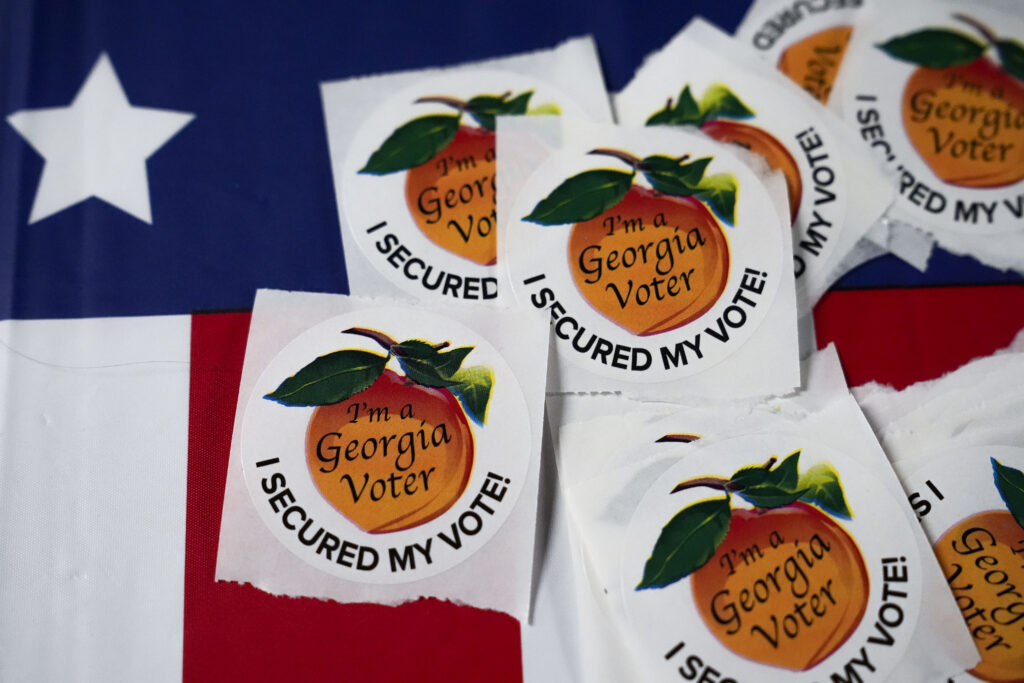
In 2025, for the first time in nearly five years, Georgia hasn’t enacted any new anti-voting laws.
Instead, Republican lawmakers spent the year laying the groundwork to pass an avalanche of voter suppression laws next year that would radically alter elections in the Peach State.
Meanwhile, the U.S. Department of Justice (DOJ) is reportedly investigating false claims of voter fraud in the 2020 election in Georgia — adding fuel to the fire of election denialism that festers within local election boards in some of the state’s largest counties, and at the state level
It’s all setting the stage for Georgia Republicans to make it harder to vote in the 2026 midterm elections. It’s even raising fears that the Trump administration could try to take control of voting in the crucial swing state.
Since 2021, when Georgia Republicans enacted the sweeping anti-voter law Senate Bill 202, lawmakers have consistently passed a steady stream of brazen voter suppression laws to make it one of the least voter-friendly states in the country. GOP lawmakers have since passed new laws that create a risk of partisan influence on local election boards, target election officials, and make it easier for election deniers to challenge the voting eligibility of large swaths of registered voters.
But new anti-voting laws waiting in the wings align with the anti-voting agenda President Donald Trump and the GOP are broadly pushing for: Gutting vote-by-mail, scrapping the use of electronic voting machines, mass voter purges, and severely limiting voter registration efforts.
Get updates straight to your inbox — for free
Join 350,000 readers who rely on our daily and weekly newsletters for the latest in voting, elections and democracy.
In October, Janice Johnston, the vice chair of the Georgia State Election Board (SEB) and noted election denier, laid out the board’s wishlist of voting law changes at the final meeting of the General Assembly’s Blue-Ribbon Study Committee on Election Procedures. Among them: A switch to hand-marked paper ballots, a push for handwritten numbered voter lists, and getting rid of no-excuse absentee voting.
“Discourage absentee voting and encourage in-person voting,” Johnston told the committee. “Ballot drop boxes were a pandemic response, they’re no longer needed and should be removed.”
Johnston, who was appointed to the SEB in 2022, has been one of the leading forces in the board’s recent push to restrict voting access and promote election conspiracy theories. Last year, in the months before the election, the SEB tried to impose a slew of strict anti-voting measures — including hand counting of ballots, video surveillance on drop boxes, increased poll watchers and others.
The SEB’s rules were met with a barrage of lawsuits and a judge permanently blocked many of the rules weeks before the election, declaring them “illegal, unconstitutional, and void.”
Some of Johnston’s proposed voting law changes pitched to lawmakers in October match the anti-voting agenda that the Georgia Republican Party unveiled at the beginning of the year. In addition to gutting early in-person and no-excuse absentee voting, the Georgia GOP are urging lawmakers to introduce legislation to scrap automatic voter registration, create a monetary reward system to encourage citizen-led mass voter purges, and codify a slew of the SEB’s 2024 anti-voting rules into law, among other proposals.
“Far-right extremists see Georgia as a laboratory to test new policies concocted to let Republicans keep power by restricting access to the ballot,” Max Flugarth, the communications director of the pro-voting advocacy group Fair Fight, told Democracy Docket.
A Trump takeover of Georgia?
As Georgia GOP lawmakers are gearing up to pass their onslaught of anti-voting laws, the Trump administration is looking into how Georgia runs its election — a sign that it could be getting ready to meddle in the state’s voting process next year.
Last month, Ed Martin — DOJ’s pardon attorney and head of the department’s vague weaponization task force — acknowledged on social media that the department was looking into claims of voter fraud in Fulton County, the state’s largest county. In August, Martin allegedly sent a letter to a Fulton County judge demanding to “immediately access” 148,000 absentee ballots being stored in a ballot warehouse.
“I am at present undertaking an investigation into election integrity here at the Department of Justice,” he wrote. “A review of the ballots and envelopes is imperative for this work.”
DOJ hasn’t officially said if it’s investigating voter fraud in the 2020 election in Georgia, but it is digging around for records. In July, the GOP-controlled SEB passed a resolution calling on state authorities to ask the department for assistance in probing 2020 voter fraud claims in Fulton County. In October, DOJ demanded Fulton election officials to hand over records related to the 2020 election.
Other anti-voting activists have indicated that a DOJ probe is happening. Mark Davis, a right-wing political consultant and member of the Georgia GOP’s Election Confidence Task Force, said he received a call from a DOJ investigator to follow up on his recent claims that hundreds of voters illegally voted in previous jurisdictions in the 2020 election, according to reporting from The Guardian.
If DOJ is actually investigating false claims of voter fraud in Georgia — which isn’t farfetched considering the president recently escalated his demands for investigations into the 2020 election — it could have major repercussions for the midterms.
At best, it would continue to sow discord, disinformation, and distrust in the voting process in a state that’s already been radically reshaped by the election denial movement.
At worst, it could give the Trump administration an avenue to take control of elections in Georgia and undermine fair elections in 2026.