Georgia’s Sweeping Anti-Voting Law Suppressed Black Votes, New Data Shows
 Prefer us on Google
to see more of our voting rights news coverage when you search.
Four years after GOP lawmakers in Georgia enacted one of the most aggressive anti-voting laws in the country, new evidence filed in federal court shows that Senate Bill 202 (SB 202) has drastically deepened racial inequalities in voting access in the state.
The findings came in a recent filing by voting advocates challenging the law, and they were drawn from 2024 election data and expert testimony. They indicate that more than 1.6 million registered voters faced increased barriers because of the law, with Black and minority voters bearing the biggest brunt.
“SB 202’s challenged provisions were enacted, and have operated, to harm minority voters and voters with disabilities and severely restrict the means of participation that they have relied upon,” the pro-voting plaintiffs wrote in the brief filed last week. “Through its restrictions on absentee voting, drop-box access, out-of-precinct ballot counting, and line-relief activities, among other limitations — imposes new and unequal harms, individually and collectively, on Georgia voters, especially Black, Asian American Pacific Islander (“AAPI”), and Latinx voters, and voters with disabilities.”
Among the starkest findings is how the law’s voter ID requirements for absentee ballots, and its shortened deadlines to request them, coincided with a dramatic decline in mail voting by nonwhite voters.
The number of Black voters who used mail ballots to vote dropped sharply from 29% in 2020 to 5% in 2024 — a 23-point decline. Among Asian American voters, mail ballot use fell from 40% to 7%, and among Latino voters from 23% to 3%.
In comparison, mail ballot use by white voters fell by 19 points.
The plaintiffs argue the change is no coincidence — the law’s ID requirements for mail voting hit Black voters harder.
Nearly 130,000 Black voters lacked valid or matching driver’s license IDs in their registration files in 2024, compared with roughly 80,000 White voters. As a result, the brief argues, Black voters were 25 percentage points more likely than white voters to have their mail ballot applications rejected.
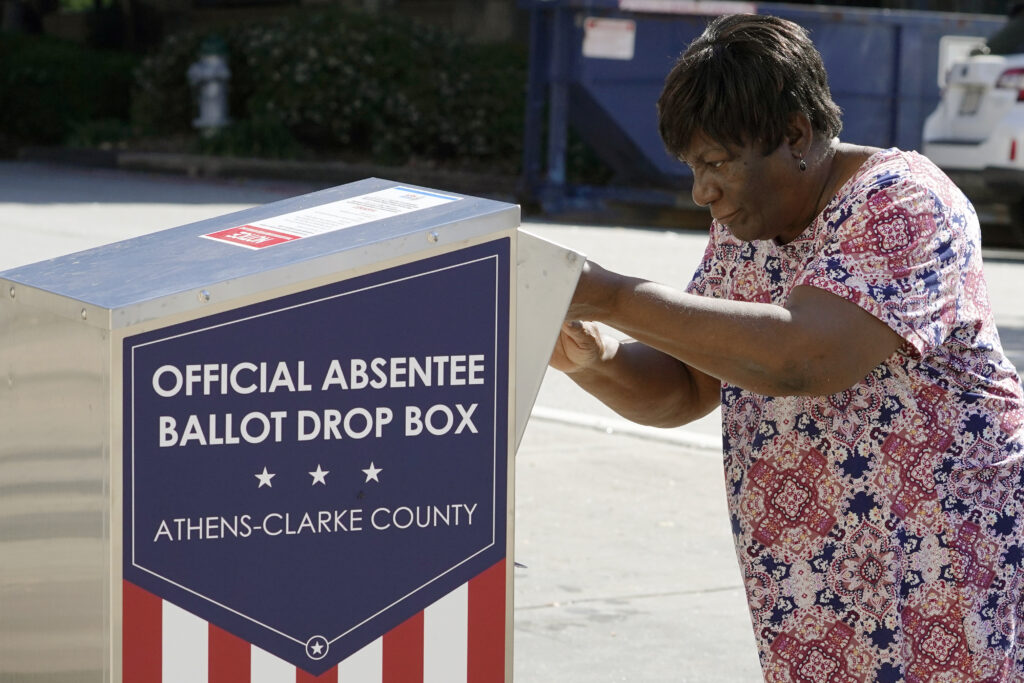
SB 202 also severely restricted the use of ballot drop boxes, limiting them to a few indoor early-voting sites. In the eight counties where most of Georgia’s Black, Asian and Latino residents live, the number of drop boxes fell by 77%.
Nearly three-quarters of Black voters lost access to a drop box in their home county, compared with just over half of white voters.
“The drastic reduction in drop boxes disproportionately curtailed access for Black voters,” the filing states. “While Georgia does not report individual-level data about which voters cast their mail ballot in a drop box, the evidence leaves little doubt that the sharp reduction of drop boxes in urban counties was disastrous for many voters.”
The filing highlighted other practical barriers.
Black voters were more likely to have provisional ballots thrown out under new limits on out-of-precinct voting. And the law’s ban on handing food or water to people waiting in line still affects communities where long waits persist.
In 2024, 6.3% of all Georgia voters waited more than 30 minutes to cast ballots, with Black voters significantly more likely to endure those lines.
“SB 202’s implementation demonstrably increased barriers to voting that Georgians face, with disproportionately strong impacts on Black, Latinx, and Asian American/Pacific Islander Georgians,” the plaintiffs noted. “It was these very methods of voting and voting activities that the Legislature targeted when enacting SB 202. The U.S. Constitution prohibits targeting racial minority voters as a means to increase political advantage.”
SB 202 was signed into law by Gov. Brian Kemp (R) in March 2021, months after record turnout from Black and young voters helped flip Georgia for President Joe Biden and elect two Democratic senators. Following baseless claims of fraud after the 2020 election, the GOP-controlled legislature moved swiftly to overhaul voting rules — tightening absentee procedures, limiting drop boxes, shortening runoffs and banning volunteers from giving food or water to voters in line.
The backlash was immediate and national. Major Georgia-based corporations — including Delta Air Lines and Coca-Cola — issued statements condemning the bill. Major League Baseball relocated its 2021 All-Star Game from Atlanta in protest, a move praised by voting rights advocates but decried by Republican leaders as “cancel culture.”
Georgia officials have since argued that Democrats exaggerated the law’s impact, suggesting that overall turnout hasn’t dropped significantly. But they have ignored that the racial turnout gap has widened since SB 202’s passage. In 2024, white turnout increased while Black turnout fell.
The brief argues that the data shows how organized efforts and voter determination compensated for new obstacles — not that the obstacles don’t exist.
The consolidated lawsuits challenging SB 202 continue in federal court in Atlanta. While the Justice Department withdrew its own case earlier this year, voting rights groups representing* Georgia voters are pressing ahead, urging the court to proceed to trial.
*The Elias Law Group (ELG) represents the plaintiffs in the case. ELG Firm Chair Marc Elias is the founder of Democracy Docket.