Why New Hampshire students face unique barriers to the ballot box this election
 Prefer us on Google
to see more of our voting rights news coverage when you search.
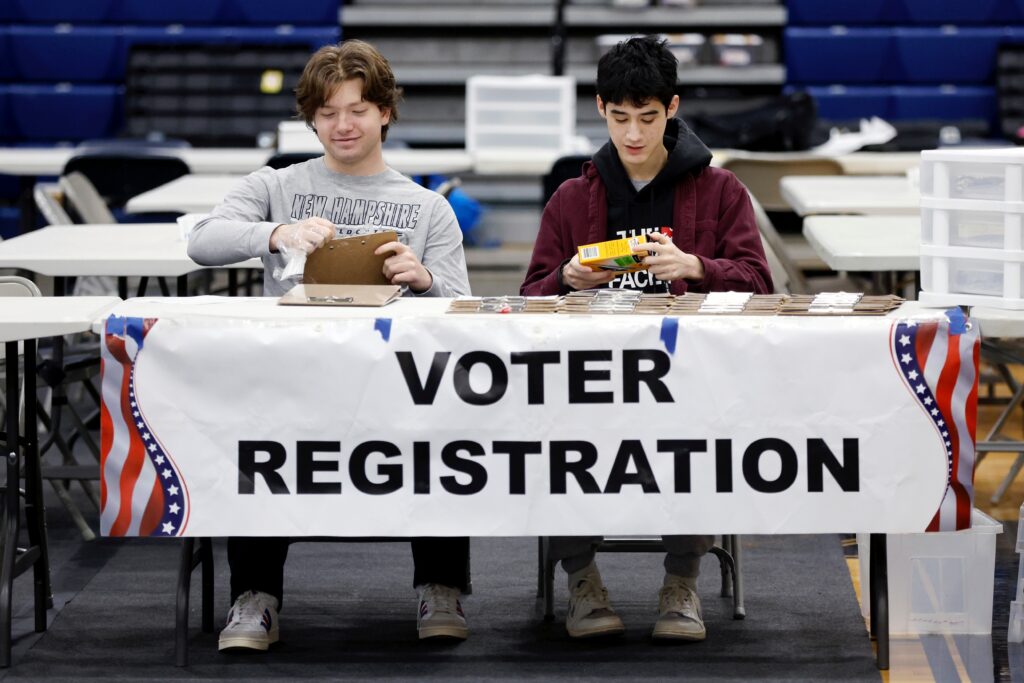
It’s no secret that New Hampshire has some of the most restrictive voting laws in the country. State rules routinely make it hard to register to vote and vote by mail.
While those laws affect every New Hampshire voter, they can have a disproportionate impact on students, who are often less experienced with voting and may have recently relocated from out of state.
And the state consistently has one of the largest populations of college students per capita.
With multiple consequential races on the ballot this fall — including a showdown between Rep. Chris Pappas (D) and former Sen. John Sununu (R) to succeed retiring Sen. Jeanne Shaheen (D) in the U.S. Senate — voting access in the Granite State could easily affect who controls the next Congress.
So what makes New Hampshire so bad for student voting?
For starters, it’s one of only three states that do not have an early voting period. It is also one of 13 states without no-excuse mail voting. In order to get an absentee ballot, voters must prove that they can’t vote in person because of work, travel, religious observance, disability or illness.
That means students must make plans to cast their ballot in person on Nov. 3 — even if their campus is far from a polling place, they lack reliable transportation or they just have a lot of lectures that day.
Over the past decade, New Hampshire Republicans have also made voting more difficult, with several laws specifically targeting students.
In 2017, former Gov. Chris Sununu (R) signed a law that imposed strict residency requirements for voter registration. Voting rights advocates said the law made it harder for students to register to vote, and the League of Women Voters subsequently sued the state.
Get updates straight to your inbox — for free
Join 350,000 readers who rely on our daily and weekly newsletters for the latest in voting, elections and democracy.
In 2021, the state Supreme Court found that the law violated the state’s constitution.
But the efforts to impose new voting restrictions didn’t stop.
In 2024, Republicans passed an anti-voting law that required proof of citizenship to register to vote or cast a ballot. The New Hampshire Youth Movement — a progressive political group focused on organizing young people — sued Secretary of State David Scanlan (R) to block the law.
Earlier this year, a federal district court blocked the proof-of-citizenship law. Scanlan appealed to the 1st Circuit Court of Appeals, but, in September, the court kept the lower court’s ruling in place, a win for voters.
Then, in April, Gov. Kelly Ayotte (R) signed a new measure, HB 323, into law. It eliminated student IDs as an acceptable form of identification for obtaining a ballot. Scanlan soon told local election officials that they can no longer accept student ID to prove a voter’s identity when registering to vote, requesting an absentee ballot, or checking in to vote.
The pro-voting group Coalition for Open Democracy sued New Hampshire in August to block the GOP-backed state law from taking effect. A federal judge last week upheld the student ID ban, but he also ruled that Scanlan went too far in issuing guidance to election officials barring them from considering student IDs as evidence of identity under the state’s safety-valve provision, which permits a voter without qualifying photo ID to establish identity by other means.
That seemingly contradictory ruling means that, while student IDs are not automatically considered an acceptable form of identification for voting, local election officials may still consider student IDs as evidence that a voter is qualified to vote.
But that case is still pending, as Scanlan asked the 1st Circuit this week to pause the ruling and make sure that students can’t use IDs to vote.
The ongoing litigation means that, less than a month before Election Day, New Hampshire students don’t have a final answer on whether they can use student IDs at all for voting purposes.
And regardless of what the court rules, the saga has likely created confusion for student voters, who already face a variety of obstacles to casting their ballots — including the lack of early voting and no-excuse mail voting.