Trump’s gerrymandering grab failed. But the war for democracy isn’t over
 Prefer us on Google
to see more of our voting rights news coverage when you search.
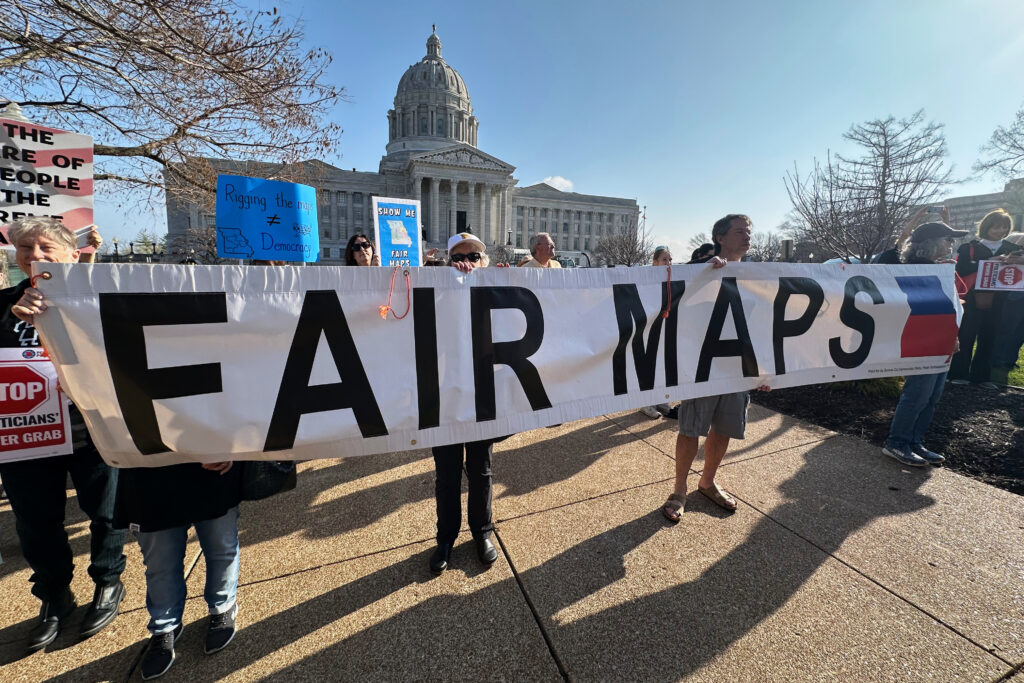
When Republicans pushed the country into a mid-decade gerrymandering crisis, the goal was clear. President Donald Trump and his allies boasted that they’d secure a congressional majority before a single vote was cast. They planned to steal more than 21 congressional seats, guaranteeing two more years of Speaker Mike Johnson, the popular vote be damned.
They failed.
Instead of the windfall of more than 21 seats that President Trump predicted, the net shift toward the GOP will likely be somewhere in the two- to three-seat range. More importantly, Republicans are all but certain to lose the House majority.
But their plot to rig the midterms did not fail on its own. Instead — at a time when big law firms, prestigious universities and massive corporations had all folded to Trump’s whims — Democrats fought back.
Get updates straight to your inbox — for free
Join 350,000 readers who rely on our daily and weekly newsletters for the latest in voting, elections and democracy.
Rallied by former Attorney General Eric Holder, chairman of the National Democratic Redistricting Committee, they offered up relentless resistance. Recognizing that we could not let “our commitment to fairness blind us” to Trump’s scheme, he urged Democrats to take “extraordinary steps, with the hope that we can then save democracy and ultimately heal it.”
And small groups of Republican state legislators ignored threats of political retribution, and even violence, to defy the White House’s demands in Indiana, Kansas, New Hampshire, Nebraska, Georgia and South Carolina.
This victory, however, is a reprieve, not a resolution. If Republicans do lose the House, they’re all but certain to double down on their efforts to gerrymander heading into 2028 — to cheat and sidestep the voters rather than try to win them back.
Over the last two years, more than a third of states attempted to redraw their congressional maps. In the next two years, we could see even more states join the fray.
As soon as the polls close on Nov. 3, Republicans are anticipated to take up the pen again to try to enact new mid-decade gerrymanders. During the lame-duck period in states like Georgia and Texas, Republican-led state legislatures could attempt to rush through new, even more skewed maps, or change who controls map drawing, before a new governor is sworn in. Mississippi, South Carolina, Indiana and Kansas — where redraws were thwarted over the past year — are expected to begin their efforts anew to gerrymander without constraints.
This endless cycle of mid-decade redistricting weaponizes the map-drawing process, turning it into a partisan cudgel rather than a once-a-decade adjustment that ensures every person’s vote is counted equally and communities are represented fairly.
Continuing to rely on piecemeal, state-by-state litigation every time power-hungry politicians decide to change the boundaries is no way to run a country. The structural threats to Americans’ representation in Congress are only growing more severe with this year’s disastrous Supreme Court decision in Louisiana v. Callais, which further eroded voting rights by creating a permissive environment for even more discriminatory gerrymanders.
The solution to stopping this endless cycle of map manipulation is to enact a federal ban on partisan gerrymandering and mid-decade redistricting. Everyone must be playing by the same rules. Congress must establish uniform national standards for how congressional lines should be drawn — and what is not permitted. We must explicitly outlaw the drawing of districts that favor one political party over others, and provide a clear path to course-correct when that happens.
This federal action is essential before the next census in 2030. The combination of Callais and the upcoming reapportionment following the census could be catastrophic for equal representation. Without action, the result will be a widening — and perhaps unbridgeable — gap between the will of American voters and their Congress.
Texas, for example, has some of the fastest population growth in the country, driven primarily by diverse urban populations. The state’s mid-decade gerrymander, however, further empowers its shrinking rural population.
America’s founders created the House of Representatives to be the body most responsive to the people. Without a national ban on partisan gerrymandering, that intent will be turned on its head.
The past year proved that when it comes to gerrymandering, even the most powerful politicians can be thwarted. Americans from different states and ideologies united to blunt the Trump-inspired mid-decade gerrymandering offensive. But defending democracy in a perpetual game of whack-a-mole is unsustainable.
It is time for Congress to act. The foundation of our American democracy depends on it.
John Bisognano is the president of the National Democratic Redistricting Committee.