Hakeem Jeffries pledges to pursue voting rights agenda under new Democratic House majority
 Prefer us on Google
to see more of our voting rights news coverage when you search.
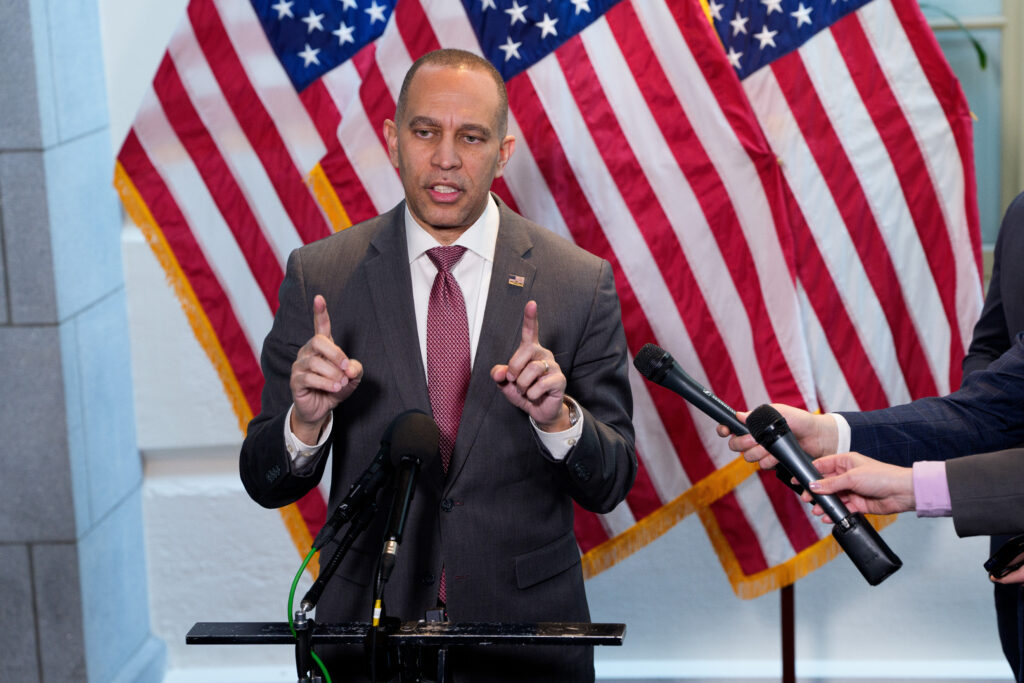
House Speaker-designate Hakeem Jeffries pledged to make voting rights legislation a top priority when Democrats take control of the House in January, promising to advance a bill restoring federal protections against discriminatory voting laws and a ban on gerrymandering.
In an interview with MeidasTouch Wednesday, Jeffries outlined an ambitious legislative agenda for the incoming Democratic majority, including passing the John R. Lewis Voting Rights Advancement Act, banning gerrymandering and pursuing Supreme Court reform.
Asked whether he would prioritize passing the John Lewis bill and dismantling voter suppression, Jeffries gave an unequivocal answer.
“Thank you for asking about that. That’s a high priority,” Jeffries said. “We will absolutely move the John Robert Lewis Voting Rights Advancement Act so we can end the era of voter suppression in the United States of America.”
Get updates straight to your inbox — for free
Join 350,000 readers who rely on our daily and weekly newsletters for the latest in voting, elections and democracy.
The legislation would restore and strengthen key protections of the Voting Rights Act of 1965, including federal oversight of election changes in jurisdictions with histories of voting discrimination.
That oversight system was largely gutted by the Supreme Court’s 2013 decision in Shelby County v. Holder, which invalidated the formula used to determine which jurisdictions needed federal approval before changing voting laws.
The John Lewis legislation would establish a new formula for determining which jurisdictions must obtain federal approval before implementing changes to their election rules. It would also strengthen protections against racial discrimination in voting.
The legislation has long been a priority for congressional Democrats, but previous efforts to pass it have stalled amid Republican opposition.
Jeffries also committed to pursuing a ban on gerrymandering, the practice of manipulating electoral district boundaries to benefit a political party or other interests.
Asked directly whether House Democrats would ban gerrymandering, Jeffries responded, “Definitively.”
The pledge comes after a contentious redistricting battle ahead of the 2026 midterms, with congressional maps facing legal challenges and states pursuing efforts to redraw district boundaries.
Jeffries did not specify which legislation Democrats would pursue to restrict gerrymandering or whether the proposal would address partisan redistricting, mid-decade map changes or both.
He also expressed support for Supreme Court reform, another issue closely tied to the future of voting rights protections.
Asked whether Democrats would enact such reforms, Jeffries again responded, “Definitively.”
Although Jeffries did not outline specific proposals during that portion of the interview, he has previously criticized the Supreme Court’s decisions weakening federal voting rights protections and called for changes to the nation’s highest court.
His latest commitments come as Democrats prepare to assume control of the House following their November midterm victories.
House Democrats nominated Jeffries for speaker earlier this month, positioning the New York Democrat to become the first Black speaker in U.S. history. The full House is expected to vote on the speakership in January.
During the interview, Jeffries also endorsed an array of other Democratic priorities, including banning congressional stock trading, raising the federal minimum wage, protecting union organizing rights, restoring Affordable Care Act tax credits and reversing cuts to Medicaid and food assistance.
But his voting rights commitments carry particular significance following years of court battles over election laws, congressional redistricting and federal voting protections.
Even with Democrats controlling the House, passing the John Lewis bill would require Senate approval and the president’s signature, or sufficient congressional support to override a veto.